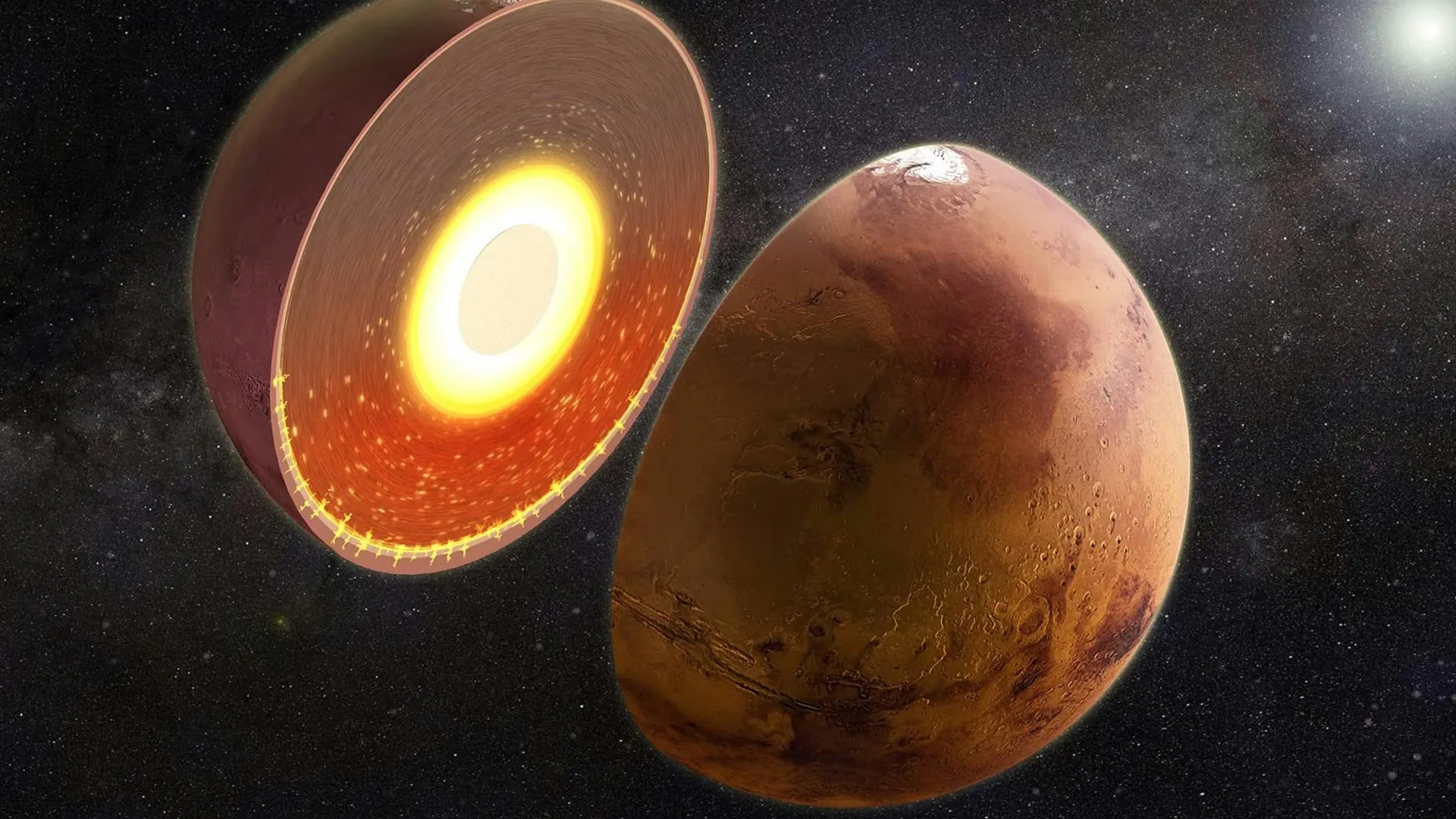
Mars Has a Hot Southern Interior, Because Why Would Anything Be Simple?
Mars's southern half is running a fever, and scientists are only beginning to understand why - hint: it might involve impacts, convection, or just bad insulation.
In a plot twist that nobody saw coming, scientists have discovered that Mars's interior is not just a uniform ball of rock - it's got a temperature imbalance that would make your average thermostat weep. The planet's southern interior appears to be a toasty 200 to 400 degrees Celsius warmer than its northern half, and may even be partially molten. This revelation, published in Nature on August 27, offers a new window into the Red Planet's geologic history, including those halcyon days when it might have hosted life.
Alexander Berne, a Caltech alumnus (PhD '26) now at the University of Arizona, led the study. He developed a model that uses subtle variations in gravity to peek inside planetary bodies, then applied it to Mars. The team analyzed decades of data from three Mars missions: Mars Global Surveyor, Mars Odyssey, and Mars Reconnaissance Orbiter. By tracking tiny changes in the spacecrafts' velocities, they reconstructed the gravitational field around Mars.
Using a technique called tidal tomography, they studied how the Sun's gravitational pull on Mars changes with the seasons - because Mars has an elliptical orbit and a tilted axis, because why not - and built a model of the planet's interior. "Scientists usually assume that the interiors of planetary bodies are generally spherically symmetric, but this is not necessarily true," Berne says. "As we get more gravity data, we can determine the three-dimensional intricacies of a planet's interior structure."
Mars has always been a tale of two hemispheres: the south is mountainous and cratered, the north is flat and low. Now we know the contrast goes deep - like, hundreds of degrees deep. This hidden heat could explain other Martian mysteries, like the unusual magnetic signatures in iron-rich minerals in the south, and why seismic waves from NASA's InSight mission lose energy faster there. "The dichotomy that we see between north and south is important to understand because it gives information about processes that may have influenced the hydrology of Mars, including the formation of basins that may have held water," says co-author Amirhossein Bagheri, a Caltech postdoc and former InSight team member.
As for what caused this thermal anomaly, the researchers have a few guesses: a giant impact that released heat from the north, spontaneous convection in the southern mantle, or thick geological structures trapping heat like a poorly insulated attic. The paper, titled "Tidal Tomography Reveals a Thermal Anomaly Beneath Mars's Crustal Dichotomy," includes a veritable who's who of planetary science from Brown, Arizona, NASA Goddard, Academia Sinica, Rome, Delft, UCLA, Texas, Colorado Boulder, and UC Santa Cruz.
So, Mars is not just a cold, dead rock - it's a cold, dead rock with a hot flash. Who knew?
The Good Times
News in your inbox.
One sardonic roundup, delivered on your schedule. Free. Unsubscribe whenever your tolerance for wit runs out.
Already subscribed but we never reach your inbox? Check your spam folder and hit 'Not spam' (or 'Remove from spam') to bust us out of junk-mail purgatory. You'll be helping everyone else too.
Don't open any of our emails for a month and you'll be automatically removed from the mailing list.
Rewrite Article
Select parts to regenerate with a fresh AI pass. Translations will be updated automatically.
Generate AI Image
Creates a sardonic version of the article image using OpenAI.