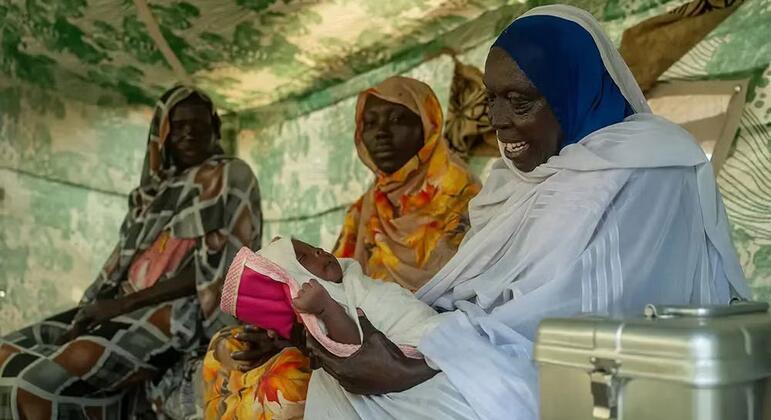
Giving Birth in Sudan: A C-Section, a Donkey Ride, and a 100-Kilometre Hike
UN reports that pregnant women in Sudan's Darfur region walk for hours or hire donkeys to reach the only C-section-capable hospital, often arriving too late, while health facilities run out of essential supplies.
UN humanitarians have confirmed what should be a universal truth: giving birth is hard, and giving birth in a war zone is a special kind of hell. On Friday, the UN sexual and reproductive health agency (UNFPA) issued an alert about expectant mothers in Golo, a mountain town in Sudan's Central Darfur region, where the nearest hospital capable of performing a C-section is the only one for miles around - and that's the problem.
"Most women reach it from mountain villages on foot, often walking for hours or being transported on crude wooden stretchers through the mountains, when they're already in labour or bleeding," said Fabrizia Falcione, UNFPA Sudan Country Representative. "Those who can afford it hire a donkey, but many women cannot. Many arrive when it is already too late for them and also for their babies."
Golo hospital's dedicated staff often run short of supplies, including anaesthetic, which is as essential to surgery as a scalpel. After a C-section, women return to their villages on foot, because the alternative is a donkey you apparently have to rent. Falcione called for mobile clinics closer to vulnerable communities, because walking hours in labour is not a birthing plan.
Meanwhile, at the sprawling Tawila displacement camp, some 60 miles (around 100 kilometres) away across mountainous terrain - a nine-hour drive in a four-by-four - the situation is equally dire. The camp hosts hundreds of thousands of people displaced by the war between the paramilitary Rapid Support Forces (RSF) and the Sudanese Armed Forces (SAF), which broke out after a failed transition to civilian rule in April 2023. "Women come even from Golo to get a C-section when they know that their situation is desperate," Falcione said. "Now, if it took us by four by four, nine hours [by car], you can imagine how long it will take a woman on a donkey... And that is exactly why the medical health providers told us when the women reach here, it's often too late and they cannot do anything and they lose their lives and those of their babies."
Health facilities in Tawila and across central and northern Darfur are running out of oxytocin, the drug used to stop fatal bleeding during childbirth. The camp itself, with more than 700,000 people displaced, stretches across the desert "in all directions; you can't see the beginning or the end of it," Falcione described. New families arrive daily, erecting makeshift tents.
Falcione insisted on decentralizing reproductive healthcare: "We can't give pregnant women no other option than going across this vast and difficult terrain to reach a hospital to give birth safely." She also highlighted the unsung heroes: community midwives, "everywhere" but often paid in bars of soap or sugar. "A well-trained and properly equipped midwife can meet 90 per cent of medical needs before, during and after delivery," she stressed.
Elsewhere in Sudan, RSF fighters continue to use attack drones and siege tactics against El Obeid in North Kordofan, still under SAF control. In October 2025, the RSF overran El Fasher, unleashing violence that OHCHR called war crimes and possible crimes against humanity, killing more than 6,000 people.
In neighbouring South Sudan, over 650,000 refugees and asylum seekers risk losing food and nutrition assistance due to funding shortfalls. Up to 3,000 refugees and returnees arrive from Sudan each week, straining resources. "For refugees and host communities, food assistance is often the difference between coping and crisis," said Adham Effendi, Deputy Country Director for WFP in South Sudan. WFP faces an immediate $37 million funding gap for its refugee response, while UNHCR has secured only 28 per cent of the $286 million it needs this year to sustain protection for nearly four million people. Because nothing says 'humanitarian crisis' like a funding gap and a donkey ride.
The Good Times
News in your inbox.
One sardonic roundup, delivered on your schedule. Free. Unsubscribe whenever your tolerance for wit runs out.
Already subscribed but we never reach your inbox? Check your spam folder and hit 'Not spam' (or 'Remove from spam') to bust us out of junk-mail purgatory. You'll be helping everyone else too.
Don't open any of our emails for a month and you'll be automatically removed from the mailing list.
Rewrite Article
Select parts to regenerate with a fresh AI pass. Translations will be updated automatically.
Generate AI Image
Creates a sardonic version of the article image using OpenAI.