Cats Dump Catnip for Silver Vine, Prove They Have Better Taste Than Your Uncle's Political Takes
May's scientific leftovers include a prehistoric copper mine, a singing mouse wiring diagram, a new blue octopus, slapstick acoustics, the golden ratio of abstract art, political polarization as a phase transition, and cats snubbing catnip for…
May was a packed month for science, and as usual, there wasn't enough time to cover everything. But here's what nearly slipped through the cracks: a possible prehistoric copper mine in the Pyrenees, a new species of tiny blue octopus, why cats prefer silver vine to catnip, and the discovery that political polarization behaves like a phase transition. You know, light reading.
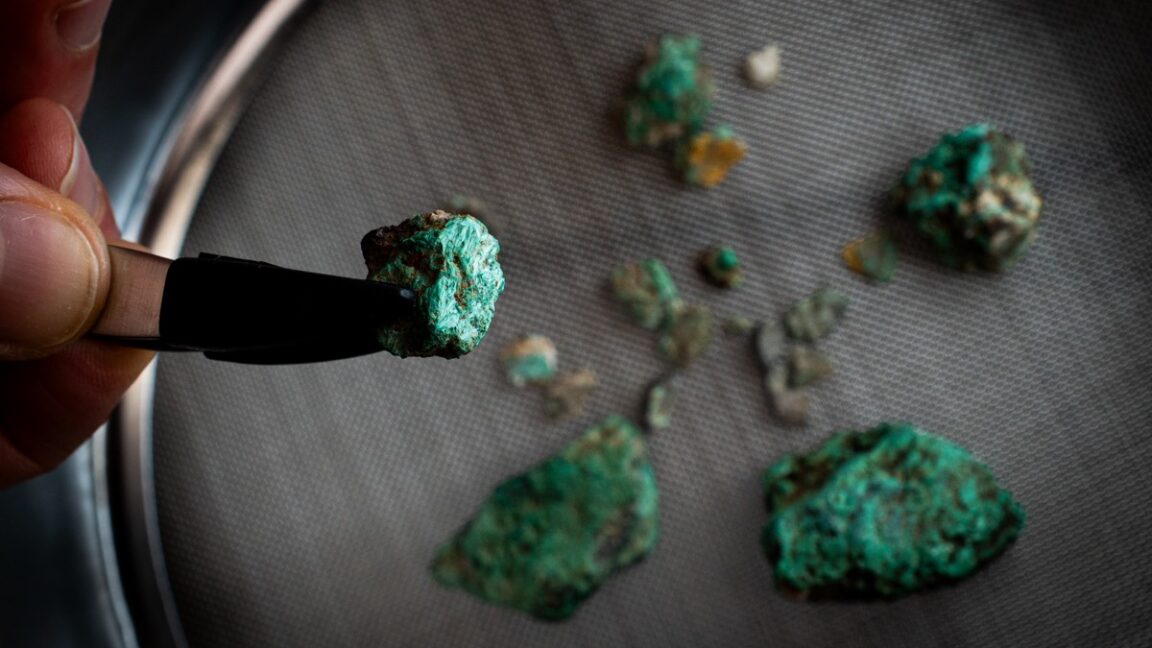
High in the eastern Pyrenees, a cave excavated between 2021 and 2023 may have been an ancient copper smelting spot, according to Spanish archaeologists writing in Frontiers in Environmental Archaeology. They found 23 hearths - between 4,000 and 5,500 years old - filled with crushed green mineral fragments that look suspiciously like malachite, which can be heated to produce copper. They also found two prehistoric pendants, a human finger bone, and a baby tooth from an 11-year-old. No word on whether the kid was grounded for losing it.
Singing mice in Costa Rica's cloud forests chirp call-and-response duets, and scientists at Cold Spring Harbor Laboratory figured out that this ability doesn't require a major brain upgrade - just a couple of wiring tweaks. Using a molecular barcoding technique, they found triple the number of neurons connecting mouth control to hearing and vocalization regions. The authors suggest it might one day be possible to make an ordinary lab mouse sing. Because what the world needs is more rodent karaoke.
In 2015, a deep-sea expedition in the Galapagos spotted a tiny blue octopus 5,800 feet below the surface. Charles Darwin Foundation researchers have now declared it a new species, Microeledone galapagensis, after using mini-CT scans to avoid cutting open the only known specimen. It has short arms, few suckers, no ink sac, and very smooth skin. Basically, it's the octopus equivalent of a minimalist influencer.
Foley artists have used slapsticks to mimic whip cracks since the mid-20th century - think Leroy Anderson's "Sleigh Ride." But Daniel Ludwigsen of Kettering University tested five commercial slapsticks and found that not all are created equal. The two smallest ones, with spring hinges, excelled at high frequencies; longer models like the "Sleighride Special" dominated low frequencies. The sound's tone also depends on how hard you smack them. Science: solving the mysteries that keep you up at night.
Mathematicians claim to have found a hidden "golden rule" of abstract art, according to a paper in PLoS Computational Biology. They used computational topology to analyze paintings by Pollock, Kandinsky, and Rothko, and found a balance of visual elements at the edges - specifically the Alexander duality. Eye-tracking experiments showed people's brains processed real art more stably than AI-generated "pseudo-art." So yes, there's a reason you'd rather stare at a Pollock than a robot's attempt at abstract expressionism.
Political polarization behaves like a phase transition, researchers at the Complexity Science Hub report in Physical Review Letters. Analyzing 6,357 House races from 1980 to 2020, they found a tipping point of $1.8 million at the district level. Below that, community dynamics decide elections; above it, polarization deepens without changing the outcome. Spending more just makes everyone angrier. Also, incumbents have a $140,000 head start. Democracy: it's basically thermodynamics.
Finally, Japanese researchers have confirmed what cat owners already knew: cats prefer silver vine (matatabi) to catnip. In a study published in the Journal of Chemical Ecology, they tested free-roaming and captive cats and found a clear preference for silver vine, even though catnip contains 170 times more bioactive compounds. The theory? Living catnip smells too intense. Commercial catnip is sold dried for a reason. As botanist Philip Miller noted in 1768, cats love catnip "when it is withered" but ignore it in clusters. Some things never change.
The Good Times
News in your inbox.
One sardonic roundup, delivered on your schedule. Free. Unsubscribe whenever your tolerance for wit runs out.
Already subscribed but we never reach your inbox? Check your spam folder and hit 'Not spam' (or 'Remove from spam') to bust us out of junk-mail purgatory. You'll be helping everyone else too.
Don't open any of our emails for a month and you'll be automatically removed from the mailing list.
Rewrite Article
Select parts to regenerate with a fresh AI pass. Translations will be updated automatically.
Generate AI Image
Creates a sardonic version of the article image using OpenAI.