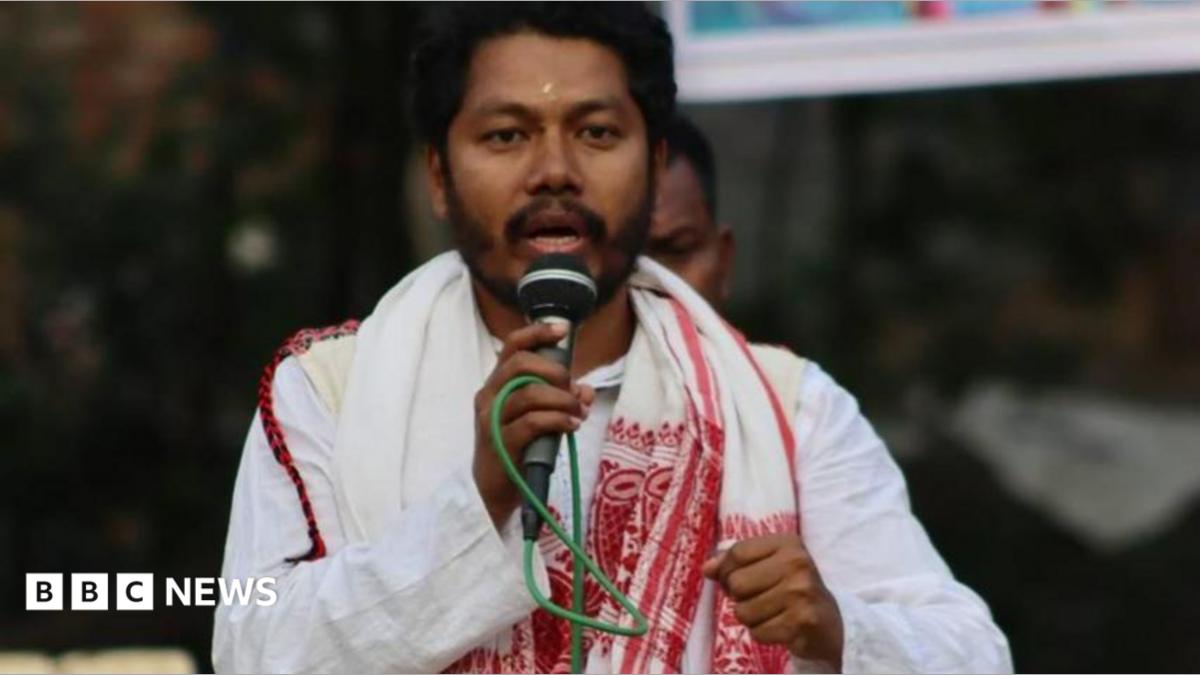
On 30 July, the day Pranab Doley was supposed to walk free from prison in Assam, his father and lawyer showed up to take him home. Instead, they got a plot twist worthy of a legal thriller: the state government invoked the National Security Act, a law with a reputation for making 'bail' a four-letter word.
Doley, 40, had been arrested weeks earlier for joining a June protest against a proposed luxury hotel near Kaziranga National Park - a Unesco World Heritage Site that houses elephants, tigers, and the world's largest population of one-horned rhinos. A court had granted bail to him and four others on 29 July, but the Assam government had other plans, citing 13 criminal cases since 2017, a pattern of 'unlawful assembly, intimidation, obstruction and violence,' and suspicious foreign transactions.
Critics see this as a classic case of using a draconian law to quash dissent. His lawyer Mrityunjoy Pegu insists Doley is merely 'an activist who fights for people's rights,' noting that most old cases were resolved and only two were pending. Doley even declared these in his affidavit when he ran as an independent candidate in the state election - because nothing says 'I'm transparent' like a failed political bid.
The hotel, a five-star project by Juniper Hotels (backed by Saraf Group and Hyatt), promises investment, jobs, and wealthier tourists. Officials say the 10-acre plot is government-owned, and Deputy Commissioner Biswajit Phukan assures that eligible residents have been compensated and offered job training. But dozens of families claim they've farmed this land for generations and have receipts dating back to 1956. Geeta Gwala, whose family cultivated 2.81 acres, says, 'We have receipts from 1956 showing the payment for this land.' The court-ordered demarcation hasn't happened yet, though a notice scheduled it for 24 June - conveniently after the protest.
Doley's story is deeply rooted in the land. He grew up on the Brahmaputra's floodplains, where rivers shift and families lose their fields faster than bureaucrats can update records. His parents still lack land rights. He's seen rhinos and elephants trample crops during floods, leading to deadly conflicts. His activism spans from challenging alleged extrajudicial killings of poachers to fighting evictions and land grabs. Last year, he spoke at the UN Forum on Business and Human Rights in Geneva, urging protection for indigenous communities.
The protest on 28 June turned ugly. Police claim protesters damaged equipment and attacked officers, and accuse Doley of inciting the crowd. But the judge who granted bail found video footage didn't support key allegations - no direct attacks, no arson attempts. Doley was seen talking to officials, seeking dialogue. The judge wrote, 'True public order is achieved not by silencing the affected, but by listening to them.'
Doley's organization, the Greater Kaziranga Land and Human Rights Protection Committee, says he wasn't even involved in the confrontation. Now, as his lawyer puts it, 'he is the one waiting for justice.' Or at least, for a hotel that doesn't require sacrificing the locals.
The Good Times
News in your inbox.
One sardonic roundup, delivered on your schedule. Free. Unsubscribe whenever your tolerance for wit runs out.
Already subscribed but we never reach your inbox? Check your spam folder and hit 'Not spam' (or 'Remove from spam') to bust us out of junk-mail purgatory. You'll be helping everyone else too.
Don't open any of our emails for a month and you'll be automatically removed from the mailing list.
Rewrite Article
Select parts to regenerate with a fresh AI pass. Translations will be updated automatically.
Generate AI Image
Creates a sardonic version of the article image using OpenAI.