Trump Administration Unveils 'Peace Pipelines' to Export Climate-Wrecking LNG to Europe, Because What Could Go Wrong?
Trump administration pushes 'Peace Pipelines' to export LNG to Europe - because nothing says peace like supercooling fossil fuels and shipping them across the ocean to replace Russian gas with American climate destruction.
In the midst of a war in Iran and skyrocketing energy prices at home, the Trump administration is pushing to boost sales of U.S. liquefied natural gas across Central and Eastern Europe - because nothing says 'peace' like a pipeline full of climate-busting fuel.
Energy Secretary Chris Wright and other U.S. officials announced this week that they had reached agreements aimed at boosting the construction of “Trump Peace Pipelines” across the region to facilitate more LNG exports. 'President Trump is unleashing a new era of cooperation for Central and Eastern Europe,' Wright said in a news release. 'These partnerships are rooted in our mutual support for an energy addition agenda - more jobs, more opportunity, and more investment.' The announcement came at the Three Seas Initiative Summit in Dubrovnik, Croatia, a gathering of 13 nations surrounding the Baltic, Black and Adriatic seas.
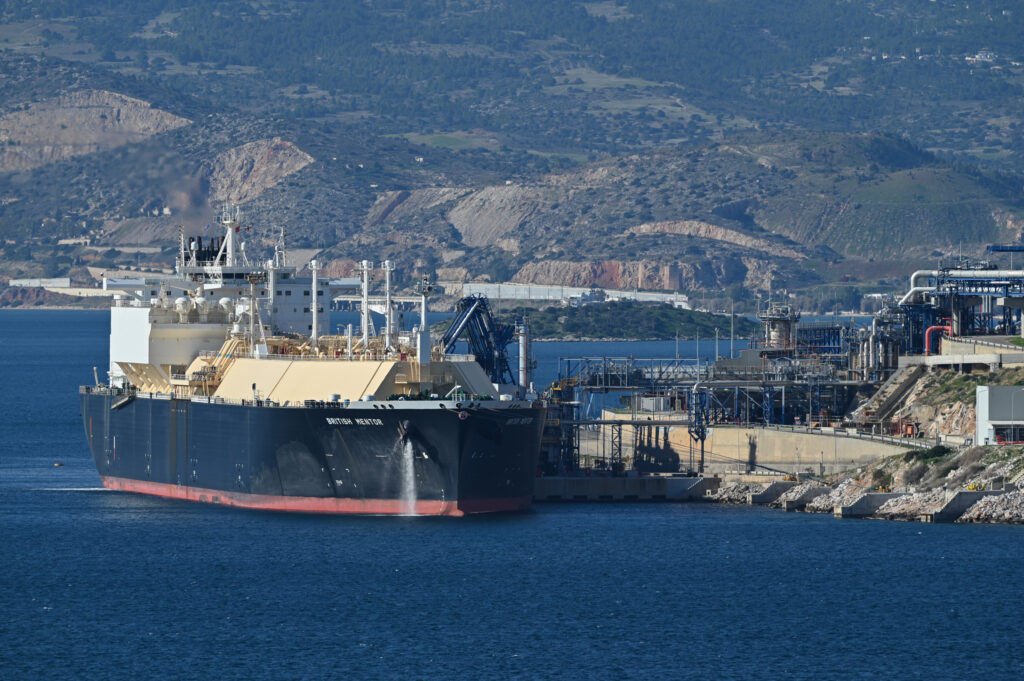
According to the Department of Energy, the United States now produces as much natural gas as Russia, China and Iran combined, while leading the world in LNG exports. The department said LNG exports are on track to 'more than double' over the next decade. But that gas carries a steep environmental toll: it comes primarily from fracking wells, must be supercooled to -161 degrees Celsius for transport (a highly energy-intensive process), shipped thousands of miles on tankers, and leaks methane - a potent greenhouse gas - at nearly every step.
In 2024, Cornell University professor Robert Howarth found that only 34 percent of LNG’s greenhouse gas emissions come from burning the fuel to generate electricity, with the rest occurring earlier in the process. Howarth concluded that LNG’s carbon footprint 'equals or exceeds that of coal.' Meanwhile, LNG export terminal construction has significantly contributed to localized pollution in places like Louisiana.
James Hiatt, a former oil refinery worker who founded the environmental group For a Better Bayou in 2023, said the construction of new export terminals in coastal Louisiana is dramatically impacting life there - air pollution, siltation from dredging, heavy tanker traffic - and the community receives little benefit due to local tax incentives. Fishermen have blamed LNG activity for declining fish and shrimp harvests. 'They’re paying more and more to be polluted and dumped upon and get no benefit from it,' Hiatt said. 'We don’t talk about climate here much, but the reality is, the more we extract carbon from underground and add it to the atmosphere, the more chaos we will see.'
The consumer advocacy group Public Citizen says LNG exports also contribute to rising U.S. energy costs by putting the country’s gas reserves up for sale to the highest international bidder. 'That’s really not good for the working people of this country,' Hiatt added. 'It might be good for a few wealthy folks, but it’s not good for America. It’s more like “America Last” policy, not “America First.”'
The European Three Seas agreements announced Wednesday include a memorandum of understanding to advance pipelines and other energy infrastructure in Central and Eastern Europe; a statement of support for a pipeline between Croatia and Bosnia and Herzegovina; a joint statement between the U.S. and Croatia to enhance nuclear technology through small modular reactors; the announcement of Project Pantheon, a $50 billion data center project developed by a U.S. company in Croatia; and a statement of intent by Westinghouse Electric Co. to launch a design study for a small modular nuclear plant in Slovakia.
Much of the region previously depended on Russia for natural gas, and much of it still runs on Russian gas transported through Turkey since the 2022 Russian invasion of Ukraine. U.S. oil companies have increasingly stepped in to fill the void, according to Ana Maria Jaller-Makarewicz, lead energy analyst for the Institute for Energy Economics and Financial Analysis in Europe. According to the group, U.S. LNG exports to Europe have nearly tripled since Putin’s invasion, rising from 2.51 million metric tons in February 2022 to 6.16 million metric tons in December 2025.
'In 2022, we were depending almost 50 percent from only one supplier [Russia] on gas, and that already created a big crisis in Europe,' Jaller-Makarewicz told Inside Climate News. Europe has pursued two paths: diversify by adding LNG imports, and reduce consumption via efficiency and renewables. She warned the EU is on the verge of trading a dependency on Russian gas for one on U.S.-produced LNG, and should invest in localized renewables instead. 'It’s expensive and it’s not offering us any security supply,' she said. 'Right now, our LNG dependency is our weakest point.' U.S. LNG is not always guaranteed, with shipments sometimes rerouted to Asia or delayed for a better price. 'We are becoming more fragile, more dependent on external factors,' she added. 'The only thing we can control is our demand. We cannot control the supply.'
The Good Times
News in your inbox.
One sardonic roundup, delivered on your schedule. Free. Unsubscribe whenever your tolerance for wit runs out.
Already subscribed but we never reach your inbox? Check your spam folder and hit 'Not spam' (or 'Remove from spam') to bust us out of junk-mail purgatory. You'll be helping everyone else too.
Don't open any of our emails for a month and you'll be automatically removed from the mailing list.
Rewrite Article
Select parts to regenerate with a fresh AI pass. Translations will be updated automatically.
Generate AI Image
Creates a sardonic version of the article image using OpenAI.