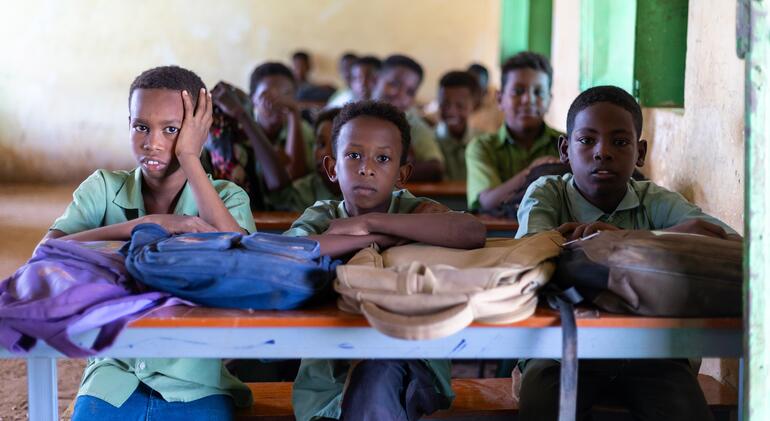
For millions of children in Sudan, the classroom remains a distant dream as the country's civil war keeps disrupting their education. To tackle this monumental problem, the UN global education fund on Monday announced a $22 million initiative to help 200,000 youngsters return to learning.
The three Sudanese states receiving support are West Darfur, South Kordofan, and Gedaref, where the aim is to restore "safe, quality and inclusive education" amid the world's largest humanitarian and displacement crisis. Because when you're in the middle of the world's worst crisis, a little education seems like a good place to start.
Maysa Jalbout, Director of Education Cannot Wait, insisted that education remains one of the most powerful tools in the humanitarian toolbox to protect millions of children and support recovery. "This investment is about much more than reopening classrooms," she said, in a statement that probably made every humanitarian worker nod vigorously. "It is about supporting children to regain a sense of safety and normalcy while strengthening education systems that can continue serving communities through crisis and into recovery."
Since conflict erupted in April 2023 between the country's rival militaries, 14 million people have been forced to flee their homes, and 33.7 million people now require humanitarian assistance. That's a lot of people needing help, but the numbers keep coming.
Announcing the multi-year investment initiative, Education Cannot Wait said that at least eight million children - nearly half of Sudan's 17 million school-age children - are still out of school. "Across the country, large numbers of schools remain non-operational, while millions of children have endured prolonged disruptions to their education, with some missing nearly 500 days of learning," the organization stressed. That's over a year of school, gone, just like that.
The three-year programme will reach those left furthest behind in the country - including internally displaced children, refugees, and vulnerable host communities, with at least 60 per cent girls and 10 per cent children with disabilities. Because if you're going to help, you might as well help the ones who need it most.
The initiative will establish safe learning environments, provide mental health and psychosocial support, strengthen teacher capacity, improve access to learning materials, and address barriers facing girls and children with disabilities. Implementation will be led by Save the Children, in partnership with Plan International, Lakarmissionen International (LM International), and local partners Alsalam Organisation for Relief and Development (AORD) and Sadagaat.
In its mid-year update on Sudan, the UN Children's Fund, UNICEF, said that 81 per cent of schools in Darfur remain closed, 70 per cent of children there are not attending school, and 5.8 per cent of schools are being used as shelters. It also says schools have come under direct attack this year. Because nothing says 'we care about the future' like bombing the places where the future is supposed to learn.
According to Education Cannot Wait, 258 million school-aged children and teens in crisis are affected by disrupted learning worldwide. Of these, 93 million are out of school altogether. A recent report from the UN's global education fund found that nearly 80 per cent of children unable to go to school because of crises or conflict live in just 20 countries. Often it is the most marginalized groups that suffer the most exclusion, especially girls, displaced youngsters, and children with disabilities.
The Sudan announcement comes as Education Cannot Wait launches the global campaign - Hope Starts Here - to mobilize $600 million to reach 10 million children whose learning continues to be impacted by the world's most severe crises. Because hope, apparently, starts with a hefty donation.
The Good Times
News in your inbox.
One sardonic roundup, delivered on your schedule. Free. Unsubscribe whenever your tolerance for wit runs out.
Already subscribed but we never reach your inbox? Check your spam folder and hit 'Not spam' (or 'Remove from spam') to bust us out of junk-mail purgatory. You'll be helping everyone else too.
Don't open any of our emails for a month and you'll be automatically removed from the mailing list.
Rewrite Article
Select parts to regenerate with a fresh AI pass. Translations will be updated automatically.
Generate AI Image
Creates a sardonic version of the article image using OpenAI.