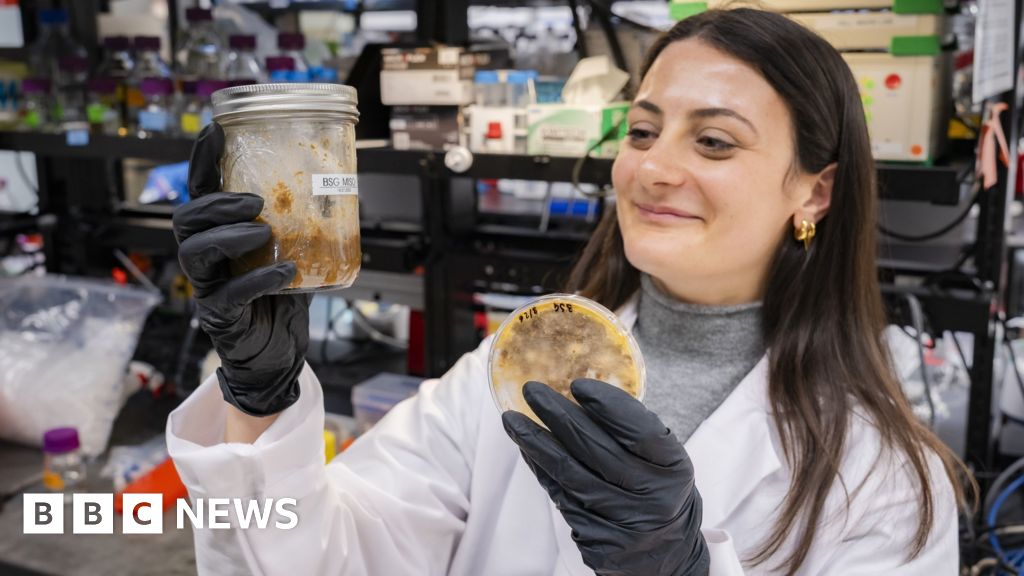
Vayu Hill-Maini's lab at Stanford University in California has created a new cheese - or at least something that tastes like cheese - but is actually made from food waste. The bioengineer and his team are experimenting with fermentation using fungi, a process that turns discarded by-products into something that could plausibly grace a charcuterie board.
"One of the most amazing things that we found recently is that we could take waste and add a few other ingredients in a fungal fermentation and create this delicious cheese that is like a Pecorino or Parmigiano," Hill-Maini says.
Fermentation is a biological process where organisms convert carbohydrates like starch or sugar into substances like alcohol, without using oxygen. The best-known examples are baking and brewing, where yeast breaks down sugar into ethanol and carbon dioxide. But it's not just wheat flour or barley that can fuel fermentation - all sorts of substances are suitable, known in biology as substrates.
With the latest biotech tools, companies are taking by-products of the food industry that are currently discarded or have little value, and using fermentation to turn them into something useful. UK-based Fermtech is transforming cocoa shells, which are normally thrown away, into a cocoa powder substitute. "If you were to sniff a bag of cocoa shells, you would be really struck by the intense chocolatey nature of it," says CEO Andy Clayton, who thinks it's a shame that by-products are composted or burnt rather than using microorganisms to break down the hard bits and make them bioavailable for humans while retaining flavours.
Utilising a broader palette of substrates can save money, help the environment, and expand flavour. "We're kind of like flavour miners," Clayton says.
Take peas. Protein makes up about a quarter of a pea, and pea protein has become increasingly popular. What then to do with the other three-quarters? That makes "a perfect substrate for fermentation," according to Bosco Emparanza, CEO of Spain's MOA Foodtech. His company gathers data on environmental conditions and available substrates, sequences the genomes of microorganisms appropriate for the food industry, and has trained an AI to work out what combinations achieve the best yields. Emparanza marvels at the speed: "When we started the company, we were able to develop one bioprocess in two weeks. Nowadays, the platform can develop 300 bioprocesses per hour."
MOA Foodtech discovered the best microorganisms to make use of leftover starch and fibre from the pea protein industry - by-products that would normally sell at rock-bottom prices for animal feed or be discarded. The company is working to put them back into the human food chain.
Germany's MicroHarvest has developed a confidential process that speeds up fermentation, using by-products of the sugar industry like molasses, which isn't typically eaten in Germany. Instead of farmers feeding it to cows, MicroHarvest works with sugar makers and pet food producers to convert side streams into premium pet food. CEO and co-founder Katelijne Bekers describes the cat snack Vegcat as having an umami taste without the bitterness of some plant-based proteins.
Singapore's Mottainai Food Tech also uses unconventional and underappreciated ingredients that are nutritious and widely available throughout Asia. The name comes from the Japanese term mottainai, which laments waste - think "waste not, want not." The company has produced a meat substitute called Jiro Meat based on okara, a soy pulp typically discarded after making tofu and soymilk, and recently started a plant-based tuna project. They've experimented with different microorganisms to minimise off-flavours and maximise desirable flavour compounds like umami or sweetness. "In five years' time, we hope to be able to have a wide range of ingredients," says co-founder Daryl Pek.
Back at Stanford, Hill-Maini's lab is working on precision fermentation, which involves genetically engineering microorganisms like moulds to produce specific materials. This can adjust aesthetics, aroma, flavour, and digestibility. Some waste products are rich in cellulose, which humans can't digest, but fungi can break it down and convert it into protein. "They become kind of a bioconversion machine where they can remove some of those complicated molecules that the human gut cannot digest and convert them into more digestible substances," Hill-Maini says.
Hill-Maini hopes his work inspires others to think differently about food waste, but he doesn't want it to stay in the lab. They have a chef in residence and an R&D culinary innovation kitchen to ensure their food experiments appeal to consumers. Of the recently developed Pecorino-like cheese, made using a Neurospora mould (though the waste substrate remains secret until publication), he says: "You can grate it, it's salty, it has a nice texture, it can be added to pasta. And it's just really cool to see… the fermentation can help it become delicious."
The Good Times
News in your inbox.
One sardonic roundup, delivered on your schedule. Free. Unsubscribe whenever your tolerance for wit runs out.
Already subscribed but we never reach your inbox? Check your spam folder and hit 'Not spam' (or 'Remove from spam') to bust us out of junk-mail purgatory. You'll be helping everyone else too.
Don't open any of our emails for a month and you'll be automatically removed from the mailing list.
Rewrite Article
Select parts to regenerate with a fresh AI pass. Translations will be updated automatically.
Generate AI Image
Creates a sardonic version of the article image using OpenAI.