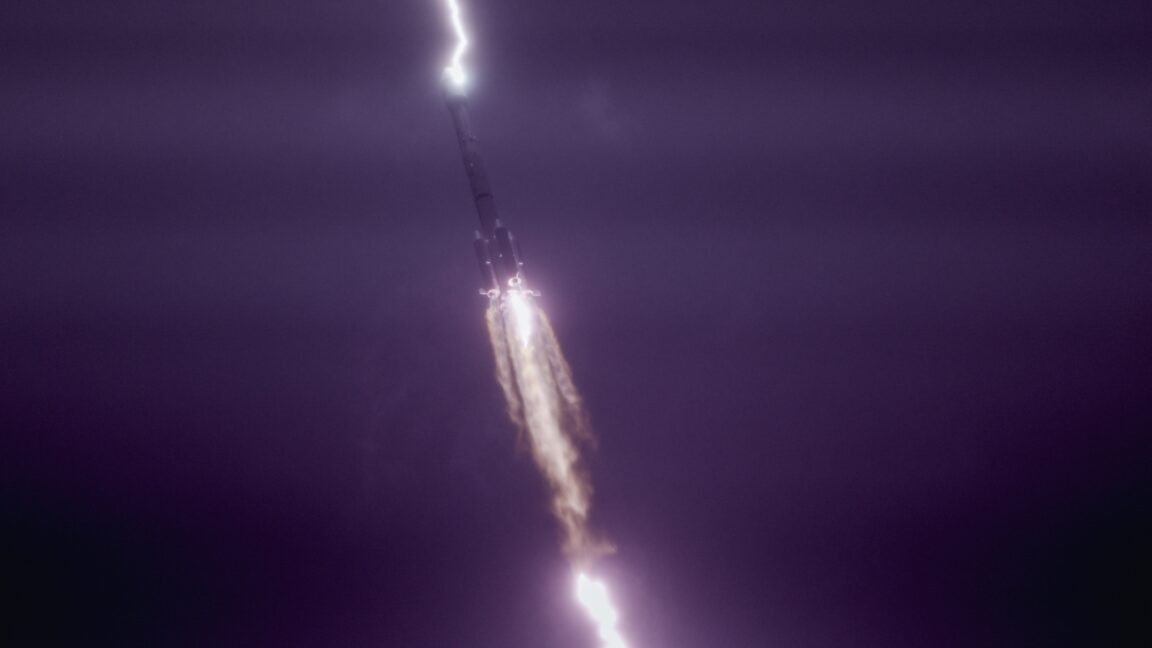
Rocket Report: Lightning Strikes Chinese Rocket, Continues Anyway; Starship Scrubs Again
From lightning-struck Chinese rockets to Starship engine swaps and oil platforms turned launch pads, the rocket industry keeps finding new ways to reach orbit - and new delays.
Welcome to Edition 9.04 of the Rocket Report, where we bring you news of things going up - sometimes despite lightning, engine swaps, or the general passage of time.
India’s first private rocket, Skyroot Aerospace’s Vikram-1, reached orbit Saturday from Sriharikota Island in the Bay of Bengal. The 72-foot (22-meter) rocket, capable of carrying 770 pounds (350 kilograms) to low-Earth orbit, fired three solid-fueled stages and a liquid fourth stage to reach 280 miles (450 kilometers) at 60 degrees inclination. It was India’s first fully commercial satellite launcher, and it did so without any major problems - after a half-hour delay to fix a last-minute technical hiccup.
The U.S. Interior Department wants to turn old offshore oil platforms into rocket launch pads. The Bureau of Ocean Energy Management issued a public comment request to explore the idea, aiming to ease spaceport congestion and improve resilience. Former FAA official George Nield called it “not as crazy of an idea as you might think.” Sea Launch pulled it off 36 times from 1999 to 2014, so there’s precedent.
Venus Aerospace and Lockheed Martin are collaborating on rotating detonation rocket engine (RDRE) technology. The supersonic shockwave drive could improve efficiency and reduce complexity for military missiles. Venus has already completed a low-altitude flight test, but scaling from prototype to combat-ready platform remains a challenge.
Russia’s Amur-LNG rocket, announced in 2020 as a Falcon 9 clone with a 2026 debut, now won’t fly until 2031. That’s five years of delay after six years of development - meaning SpaceX landed its first orbital rocket nearly two decades before Russia’s answer might arrive.
The U.S. Space Force tripled the maximum value of its Lane 1 National Security Space Launch contract to $17 billion, citing rising demand. Combined with Lane 2’s $13.7 billion for 54+ missions, the total now exceeds $30 billion - and that number is likely to climb.
Northrop Grumman launched its Mission Robotic Vehicle (MRV) on a SpaceX Falcon 9 from Cape Canaveral. The satellite, equipped with two robotic arms, will install propulsion pods onto other satellites in geosynchronous orbit, extending their lives. It’s the most advanced servicing satellite ever launched.
Relativity Space plans to expand at Cape Canaveral, adding thousands of jobs by 2034 and building a factory for its Terran R rocket. The reusable first-stage booster is officially scheduled for a first flight by year’s end, though that timeline is unlikely to hold.
China launched a Long March 3B rocket Thursday despite being struck by lightning shortly after liftoff from Xichang Satellite Launch Center. The rocket continued to orbit, delivering a Tianlian data relay satellite for the Tiangong space station. Lightning strikes on rockets are rare but not unheard-of - Apollo 12 survived one in 1969, while an Atlas-Centaur was destroyed in 1987.
SpaceX scrubbed its 13th Starship test flight on July 16 after computers aborted due to engines not lighting. The booster was rolled back to swap two Raptor engines and returned to the pad this week. Bad weather canceled a Thursday attempt, so the next try is Friday evening, with a 90-minute window starting at 5:45 pm CDT. The goal is a controlled splashdown in the Indian Ocean after deploying 20 Starlink satellites.
The Good Times
News in your inbox.
One sardonic roundup, delivered on your schedule. Free. Unsubscribe whenever your tolerance for wit runs out.
Already subscribed but we never reach your inbox? Check your spam folder and hit 'Not spam' (or 'Remove from spam') to bust us out of junk-mail purgatory. You'll be helping everyone else too.
Don't open any of our emails for a month and you'll be automatically removed from the mailing list.
Rewrite Article
Select parts to regenerate with a fresh AI pass. Translations will be updated automatically.
Generate AI Image
Creates a sardonic version of the article image using OpenAI.