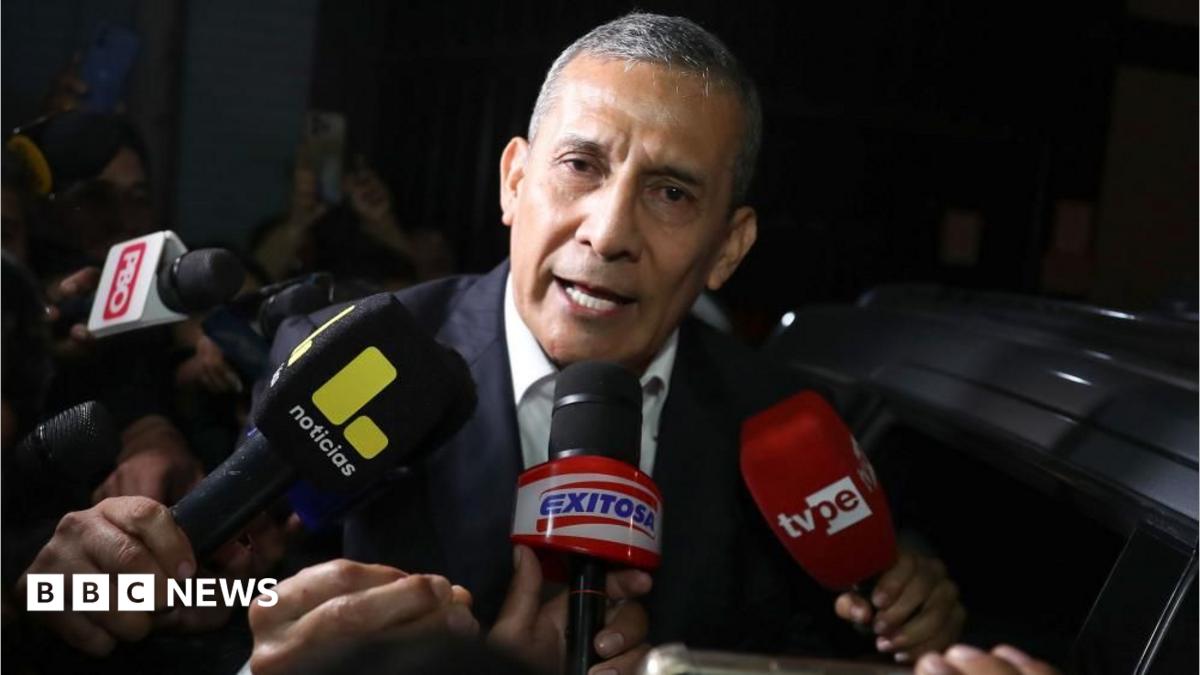
Peru's Ex-President Ollanta Humala Walks Free After Court Decides Corruption Conviction Was Just a Misunderstanding
Peru's constitutional court overturns ex-president Ollanta Humala's corruption conviction, freeing him from prison and proving that political donations are just friendly gifts, not bribes.
In a stunning twist that will surprise absolutely no one following Latin American politics, Peru's constitutional court has overturned the 15-year jail sentence handed to former President Ollanta Humala, declaring the entire criminal proceedings against him null and void. Humala, who led the country from 2011 to 2016, was convicted in 2025 of accepting illegal funds from the Venezuelan president and Brazilian construction giant Odebrecht to fuel his 2006 and 2011 election campaigns. But on Friday night, he was released from Barbadillo Prison in Lima, greeted by a crowd of supporters who apparently had nothing better to do on a Friday evening.
Humala's lawyer, Julio Espinoza Goyena, took to social media to celebrate, explaining that the court ruled the contributions his client received during electoral campaigns 'do not constitute money laundering.' Because, of course, when a construction company hands you millions of dollars, it's just a friendly gesture, not a crime. The lawyer added that the Criminal Chamber must now order the definitive dismissal of the proceedings and the 'FREEDOM' of Humala, in all caps for emphasis.
Humala, ever the victim, told reporters outside the prison: 'We have been victims of political and judicial persecution.' Because being investigated for taking bribes is exactly the same as being persecuted. His wife, Nadine Heredia, who was also convicted of money laundering and sentenced to 15 years, managed to skip town to Brazil after seeking asylum in the Brazilian embassy. Nice work if you can get it.
Humala is just one chapter in Peru's ongoing Odebrecht saga, a scandal that has ensnared four of the country's presidents. Alejandro Toledo, who governed from 2001 to 2006, was sentenced last year to more than 20 years for taking $35m (£26m) in bribes. Alan García, who served two terms, killed himself in 2019 rather than face arrest over bribery allegations he denied. Pedro Pablo Kuczynski, in office from 2016 to 2018, faced impeachment over payments from Odebrecht, though he insists they were legal. Sure, Pedro, sure.
Humala and his wife were accused of accepting $3m in illegal contributions from Odebrecht to fund his 2011 campaign, plus $200,000 from Venezuela's Hugo Chávez for the 2006 race. But they always maintained their innocence, claiming political persecution. Humala, a former army officer, first hit the national stage in 2000 when he led a short-lived military rebellion against then-President Alberto Fujimori. He ran for president in 2006 on a platform inspired by Chávez's socialism, lost, then tried again in 2011 with a more moderate approach, defeating Keiko Fujimori, daughter of the man he once rebelled against. Politics is a strange circle.
His legal troubles began after his term ended in 2016, when Odebrecht admitted to bribing officials across Latin America with hundreds of millions of dollars. Humala and Heredia spent a year in pre-trial detention before their 2025 conviction. Now, with the court's ruling, Humala is free, and Peru's justice system has once again proven that when it comes to political corruption, the rules are more like suggestions.
The Good Times
News in your inbox.
One sardonic roundup, delivered on your schedule. Free. Unsubscribe whenever your tolerance for wit runs out.
Already subscribed but we never reach your inbox? Check your spam folder and hit 'Not spam' (or 'Remove from spam') to bust us out of junk-mail purgatory. You'll be helping everyone else too.
Don't open any of our emails for a month and you'll be automatically removed from the mailing list.
Rewrite Article
Select parts to regenerate with a fresh AI pass. Translations will be updated automatically.
Generate AI Image
Creates a sardonic version of the article image using OpenAI.