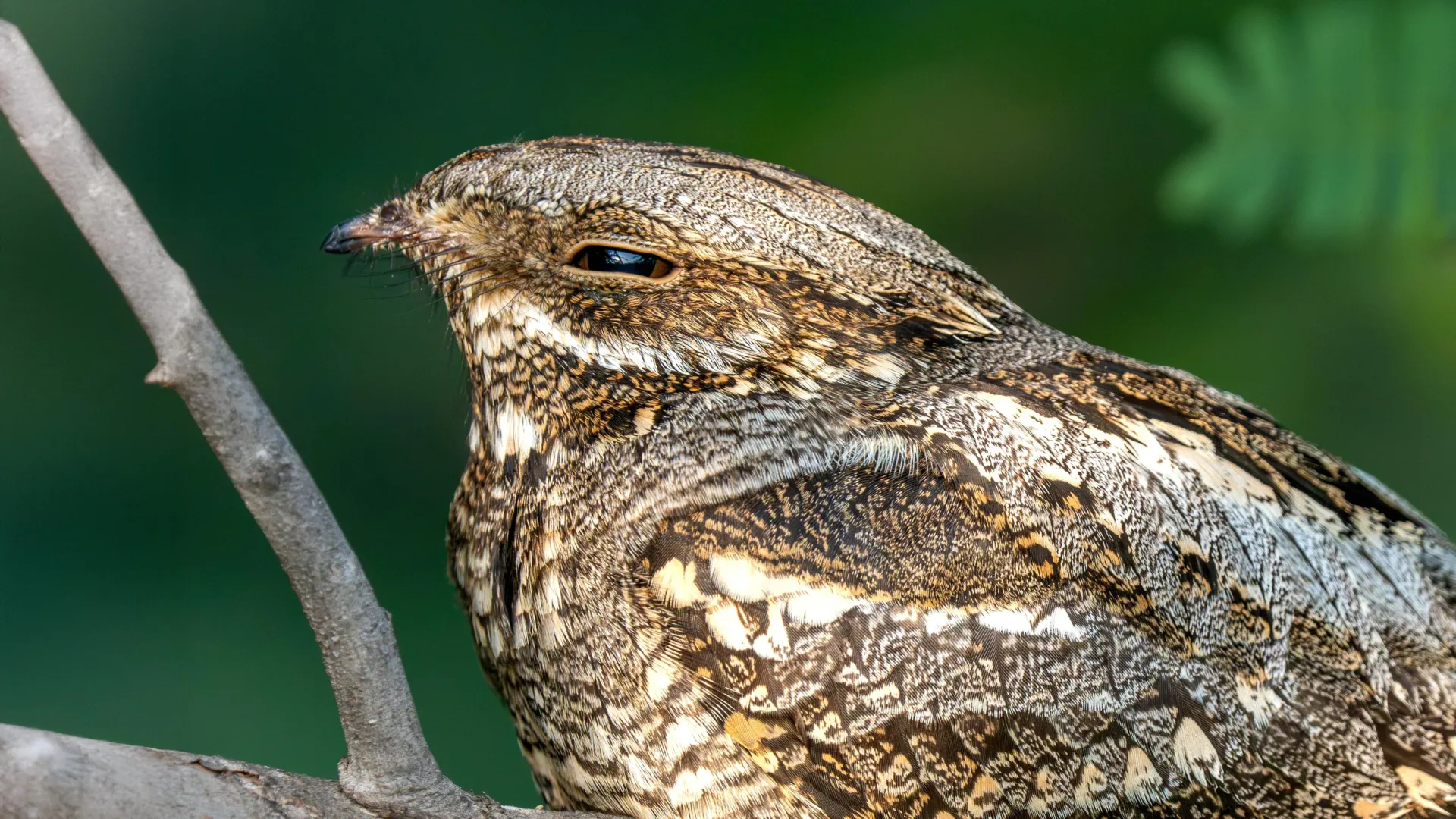
In news that will surprise absolutely no one who has ever tried to be good at two things at once, scientists have found that the European nightjar (Caprimulgus europaeus) is not a perfectly optimized flying machine. The bird, which migrates thousands of miles between Europe and southern Africa, apparently sacrifices flight efficiency for agility. Shocking.
Researchers at Lund University studied the birds in a wind tunnel, recording their movements at different speeds and measuring airflow patterns behind their wings. What they found was that the nightjar's broad wing tips - likely useful for maneuvering during slow flight - become a liability at higher speeds, generating lift less efficiently. Lift, for those not up on their aerodynamics, is the force that keeps a bird airborne. So the nightjar is basically that colleague who's great in meetings but falls apart under deadline pressure.
The findings challenge the assumption that long-distance migrants must have wings optimized primarily for efficient long-distance flight. "This runs counter to the intuitive image of a long-distance migrant as a perfectly optimized flying machine," says Christoffer Johansson, associate professor at Lund University. "Instead, the nightjar's wings appear to be a compromise between several different demands. The bird can fly slowly and maneuver while hunting, but the trade-off is reduced efficiency in lift generation at higher speeds." In other words, evolution is just like the rest of us: juggling competing demands and occasionally dropping the ball.
But wait, there's more. The researchers also discovered that the nightjar continues to generate thrust during the upstroke - the upward portion of each wingbeat. This is unusual because such active upstroke has previously been linked mainly to bats and insects, not birds. It's as if the nightjar looked at the bat's playbook and said, "Sure, I'll try that." The discovery suggests that animals with very different evolutionary histories may have developed similar aerodynamic solutions. "What's interesting is that the same type of aerodynamic solution seems to appear in quite different animals," Johansson says. "This suggests that the upstroke does not have to be merely a passive or lift generating part of the wingbeat. It can be actively used to generate thrust when the wings cannot be folded very much." So much for birds being original.
The broader lesson, according to the researchers, is that evolution doesn't produce perfect designs - it produces compromises. For the nightjar, that means combining continent-spanning migration with the agility to hunt insects at low speeds. It's the biological equivalent of a Swiss Army knife: not great at any one thing, but handy in a pinch. Understanding these compromises could also lead to improvements in aviation technology, particularly drones and other robotic aircraft that use flapping wings. Like birds, these machines may face mechanical restrictions on wing folding, and learning how nightjars generate thrust during the upstroke could help engineers develop more effective ways to move through the air. Because apparently, we need more drones.
Researchers now hope to determine whether this unusual flight mechanism is widespread among other birds and flying animals or whether it's a more specialized adaptation. "We now want to investigate how common this way of generating force is among other birds and flying animals," Johansson concludes. "It could help us understand which aerodynamic principles are specific to the nightjar and which are more general. This knowledge may also inspire the development of new types of flapping aircraft." So stay tuned: the nightjar may soon be responsible for a new generation of robotic birds. Or at least for some very confused engineers.
The Good Times
News in your inbox.
One sardonic roundup, delivered on your schedule. Free. Unsubscribe whenever your tolerance for wit runs out.
Already subscribed but we never reach your inbox? Check your spam folder and hit 'Not spam' (or 'Remove from spam') to bust us out of junk-mail purgatory. You'll be helping everyone else too.
Don't open any of our emails for a month and you'll be automatically removed from the mailing list.
Rewrite Article
Select parts to regenerate with a fresh AI pass. Translations will be updated automatically.
Generate AI Image
Creates a sardonic version of the article image using OpenAI.