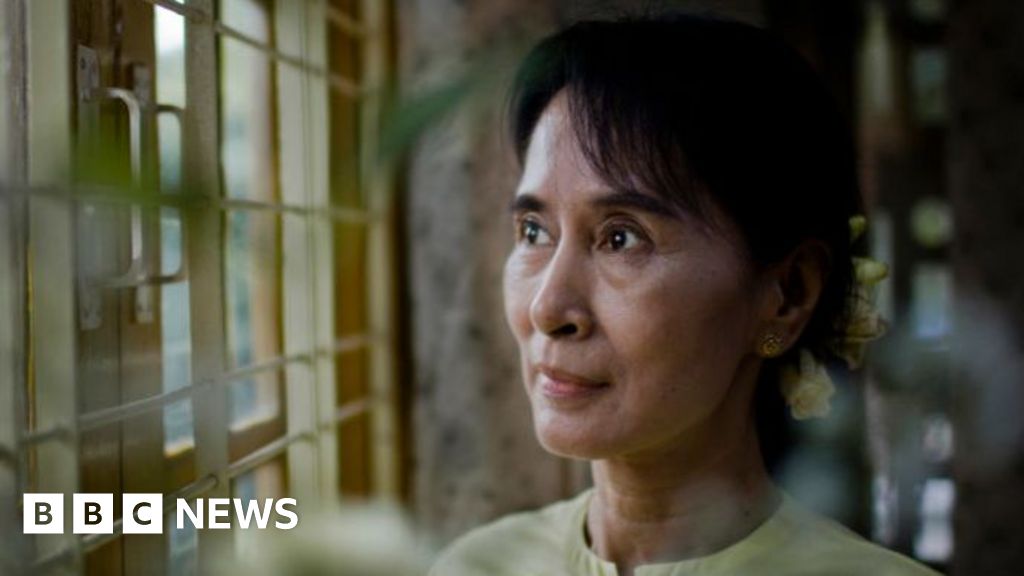
Myanmar's Junta Says It Moved Aung San Suu Kyi to House Arrest; Son Unconvinced, Demands Proof of Life
Myanmar's junta says it moved Aung San Suu Kyi to house arrest and provided a two-year-old photo as proof. Her son is not buying it, and her lawyers were not notified.
Myanmar's state media has announced that the country's detained former leader, Aung San Suu Kyi, has been moved to house arrest. The 80-year-old Nobel laureate has been held in detention - likely in a military prison in the capital Nay Pyi Taw - since being ousted in a 2021 coup. Military leader Min Aung Hlaing, who led the coup, said he "commuted her remaining sentence to be served at the designated residence." State media helpfully broadcast a picture of her sitting with two uniformed personnel - a photo her son Kim Aris dismissed as "meaningless" because it was taken in 2022.
Kim Aris said he remains skeptical and lacks proof she is alive. "I hope this is true. I still haven't seen any real evidence to show that she has been moved," he told the BBC. "So, until I'm allowed communication with her, or somebody can independently verify her condition and her whereabouts, then I won't believe anything." Prior to the announcement, nothing was known about her health or living conditions, and Kim Aris said in December he had not heard from her in years. Her legal team told Reuters they had received no direct notification about her house arrest.
Little has been seen - and nothing heard - from Aung San Suu Kyi since her arrest on the day the armed forces ousted her elected government over five years ago. Her lawyers have not seen her for more than three years; her family has had no contact for more than two. The only previous image of her was at a court appearance in May 2021, at the start of a series of trials on charges widely dismissed as fabricated. Since then, her 33-year sentence has been reduced several times.
Her sudden reappearance in state media suggests the military authorities may be preparing for further changes - possibly a partial or complete release. The coup leader Min Aung Hlaing is eager to end his regime's international isolation and appears more confident after a string of battlefield wins against armed opposition groups. The junta held an election earlier this year, restoring a notionally democratic government that leaves the same military leaders in charge.
"The military regime that rules Myanmar is very much on a PR offensive at the moment," said Sean Turnell, former economic adviser to Aung San Suu Kyi, on the BBC's Newsday program. He added that the military is "trying to convince the world that it's a legitimate government," and the reports of her relocation are "part and parcel of that." Turnell, who was detained alongside Myanmar's democratically elected leaders for over a year after the coup and kept in the same prison as Aung San Suu Kyi, described conditions as "medieval" and "just really, really awful," with bad food and medical care and cells "open to the elements." With her now 80, those are "terrible conditions for her."
During her earlier confinement, Aung San Suu Kyi's dignified, non-violent resistance won her admirers worldwide, and she famously made speeches from her family home. She won the Nobel Peace Prize in 1991. But her decision to lead Myanmar's defense against charges of genocide at the International Court of Justice over the military's atrocities against Muslim Rohingyas in 2017 badly tarnished her saint-like international image. Despite years of incarceration away from public view, Turnell says her standing among the Burmese people remains "extremely high." "She has a charisma and connection with the Burmese people that is almost spiritual. And I don't think that's been diminished at all," he said, adding that people in the country are "just hoping that she'll be released."
The Good Times
News in your inbox.
One sardonic roundup, delivered on your schedule. Free. Unsubscribe whenever your tolerance for wit runs out.
Already subscribed but we never reach your inbox? Check your spam folder and hit 'Not spam' (or 'Remove from spam') to bust us out of junk-mail purgatory. You'll be helping everyone else too.
Don't open any of our emails for a month and you'll be automatically removed from the mailing list.
Rewrite Article
Select parts to regenerate with a fresh AI pass. Translations will be updated automatically.
Generate AI Image
Creates a sardonic version of the article image using OpenAI.