
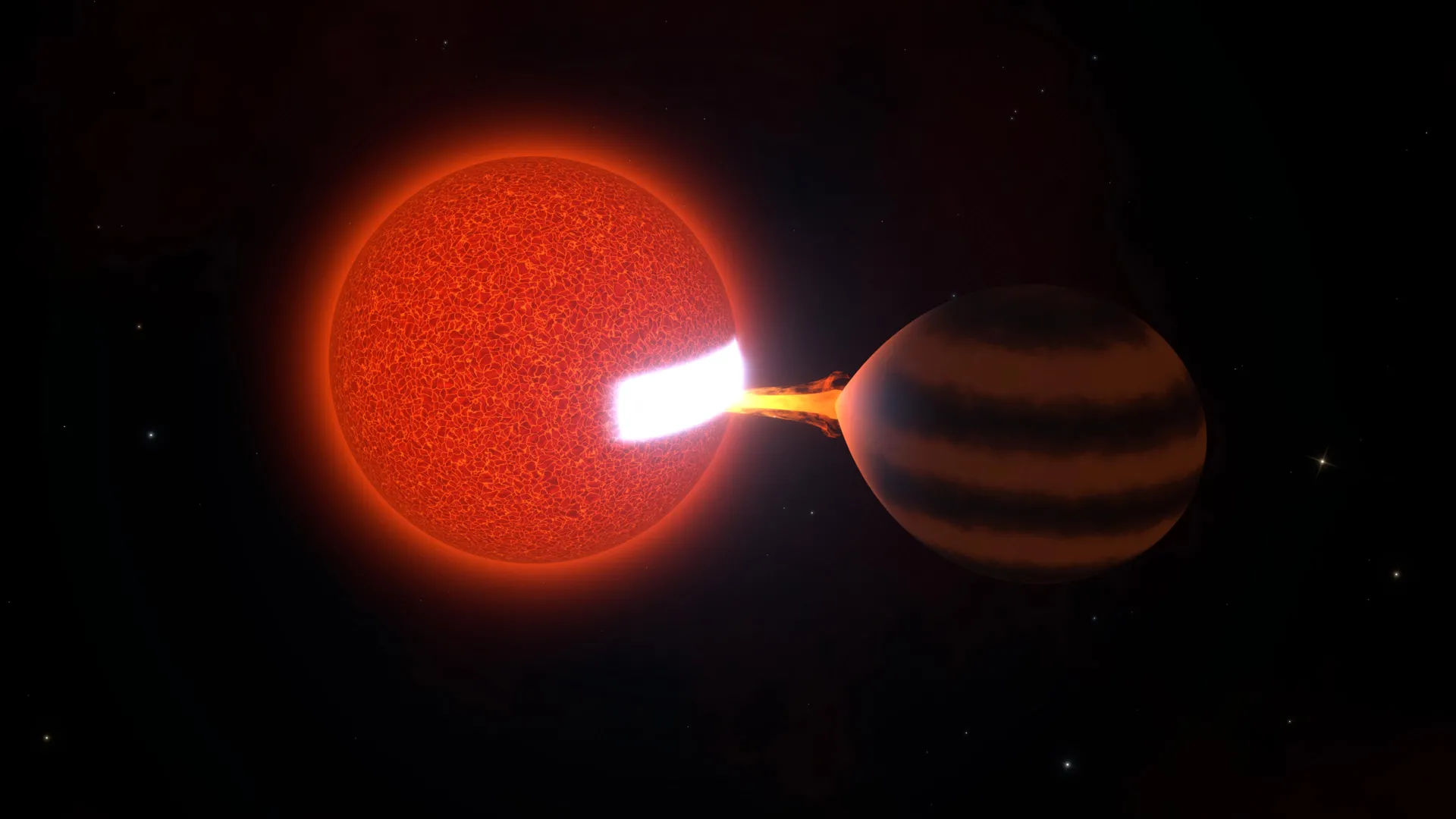
Good news for anyone who thought the cosmos only did drama: astronomers have found a star system 300 light-years from Earth where a small star is methodically consuming a brown dwarf, not in some explosive binge, but in a leisurely, drawn-out meal that could stretch for billions of years.
Most planets, Earth included, orbit their stars in relatively stable arrangements. But get too close, and gravity will drag you in for a one-way embrace. Scientists have seen plenty of stable orbits and a handful of stars rapidly swallowing their planetary companions. Now, in a study published October 5 in Nature Astronomy, an international team led by MIT has identified the awkward middle ground: a low-mass star steadily siphoning material from another low-mass object.
The system, designated ZTF J0440+2325, sits about 300 light-years away in the Milky Way. It's the first observed example of a low-mass star gradually drawing matter from a brown dwarf - an object more massive than a typical planet but not hefty enough to sustain hydrogen fusion like a proper star. And the transfer is so slow that the feeding could continue for hundreds of thousands of years, potentially even billions.
"When we think of stars interacting with planets or brown dwarfs, the picture is always that the star eventually swallows the other thing," says Kevin Burdge, assistant professor of physics at MIT. "This is what will happen to the Earth when the sun becomes a red giant. But here, we've found an alternative: Instead of swallowing the thing up, the star can gradually eat it, for billions of years."
The MIT team also includes Aaron Householder, Kaitlyn Shin, Saul Rappaport, Joheen Chakraborty, and Emma Chickles, with collaborators from Caltech, the University of Hawaii, the Instituto de Astrofísica de Canarias and Universidad de La Laguna in Spain, and the Harvard-Smithsonian Center for Astrophysics.
The first clue came from the Zwicky Transient Facility (ZTF), which scans the sky for objects whose brightness changes. Operating with a telescope at Palomar Observatory in California, ZTF repeatedly photographs large sections of the night sky, catching sudden events like supernovae, gamma-ray bursts, and neutron star collisions.
Several years ago, Burdge noticed a strange pattern in the ZTF data. Astronomers use light curves to track brightness changes; supernovae typically produce a rounded, bell-like shape. But this signal repeatedly traced something resembling a triangle. "I remember first looking at this and thinking, stars don't make triangular waveforms like this," he recalls.
At the time, Burdge and colleagues were investigating a "black widow binary" - a system where a rapidly spinning neutron star strips material from a smaller companion, named after the spider that devours its mate. They wondered if the triangular signal might be another black widow. But typical black widow binaries show a strong contrast in mass, producing a distinctive whipping motion of the smaller companion. This signal showed none of that. "We weren't seeing that whipping back and forth here," Burdge says. "It didn't make any sense. We couldn't explain what this was."
That led to another idea: perhaps both objects had relatively small masses, allowing them to orbit gently without dramatic motion. "If you have less mass in the system overall, things can gently orbit each other without whipping back and forth," Burdge says. "That was the idea. But we never had any proof. And this weird triangle just sat for years."
Eventually, Burdge and Aaron Householder, a graduate student in MIT's Department of Earth, Atmospheric, and Planetary Sciences, returned to the signal. Using ZTF data, they pinpointed the source at roughly 300 light-years away. They then aimed several telescopes at ZTF J0440+2325 to study it in detail.
A key measurement was the wobble caused by the objects' mutual gravitational pull. It was far smaller than what black widow binaries produce. "That was the real clincher for this system," Householder says. "When we measured that wobble, we found we were not seeing a black widow. This was a low-mass star that's orbited by a brown dwarf. The wobble was too small in amplitude to be anything else."
The observations revealed two compact objects in an extremely tight orbit. The central star has about 85 times the mass of Jupiter, while the brown dwarf weighs about 25 Jupiter masses. For comparison, the Sun is over 1,000 times as massive as Jupiter. The brown dwarf completes a full orbit in just 87 minutes, and its entire orbit would fit within the diameter of the Sun.
That closeness suggested gravity might be doing more than just keeping them in orbit. The researchers suspected the star was actively pulling matter from the brown dwarf - a process called accretion. Accretion is common in systems with black holes or neutron stars, where material forms a swirling disk before falling in. But ZTF J0440+2325 works differently: an ordinary low-mass star is receiving material directly onto its larger surface. "The difference here is, the thing absorbing matter is not a tiny black hole but a star, which is relatively big in size," Burdge explains. "So matter just pummels directly onto the surface, at very high speeds, like an asteroid hitting the Moon."
To confirm, the team ran computer simulations of particles leaving the brown dwarf and moving under both objects' gravity. The results showed the material indeed falls straight onto the star. "When we track those test particles, we see they indeed fall right onto the surface of the star," Householder says. "This is the first time we've caught a low-mass star actively accreting from another low-mass object."
The team also estimated the rate of consumption: about one hundred-thousandth of Earth's mass every year. That's roughly 40 million dump trucks' worth of matter, or about 1.3 trillion one-pound burritos every second. Despite these staggering numbers, the brown dwarf is so massive that the loss is a tiny fraction of its total mass, meaning the feeding could continue for billions of years.
This gradual process also explained the triangular light pattern. As matter streams from the brown dwarf and hits the star, it creates an intensely heated region - a bright hotspot like a persistent fireball. As the brown dwarf orbits every 87 minutes, the hotspot rotates in and out of view, producing the brightening and dimming that puzzled astronomers. "It's like you've got this continuous fireball onto one of the objects, and as one orbits the other, that hotspot comes in and out of view, and the peak of the triangle signal is when you're looking right at the fireball," Burdge says.
With the mystery solved, the researchers are now searching for other systems that behave similarly. Until now, close star-companion interactions have mostly been either stable or rapidly destructive. ZTF J0440+2325 shows a third way: a small star can steadily extract matter from a brown dwarf without immediately destroying it. Finding more examples could reveal how common this process is, how long it lasts, and what ultimately happens to objects in such tight orbits. "It's inspiring a lot of new searches on our part," Householder says. "I think we're going to learn a lot about a different kind of way that planets and brown dwarfs interact with their host stars."
This research received partial support from the National Science Foundation.
Materials provided by Massachusetts Institute of Technology. Original written by Jennifer Chu. Note: Content may be edited for style and length.