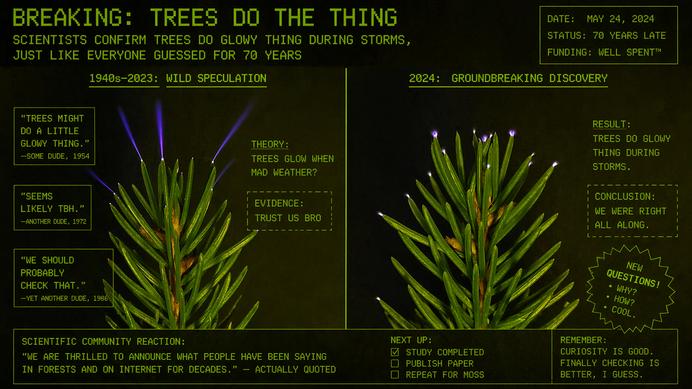
Scientists Confirm Trees Do Glowy Thing During Storms, Just Like Everyone Guessed For 70 Years
After 70 years of suspicion, scientists finally caught trees glowing with UV light during storms, proving a long-held theory and opening new questions about forest-atmosphere chemistry.
In a stunning display of scientific persistence, a team from Penn State has finally confirmed what researchers have suspected since the Truman administration: trees glow with electricity during thunderstorms. The group, consisting of distinguished professor William Brune, doctoral student Patrick McFarland, assistant research professor Jena Jenkins, and former associate research professor David Miller, embarked on a road trip in June 2024 in a modified 2013 Toyota Sienna. Their mission: to capture the elusive phenomenon of corona discharge in the wild.
For three weeks, they chased Florida's famously fickle summer storms, coming up empty-handed. The breakthrough came not in the Sunshine State, but during a strategic pit stop at the University of North Carolina at Pembroke. There, they aimed their custom-built Corona Observing Telescope System at a sweetgum tree about 100 feet away during a two-hour thunderstorm. They recorded 859 corona events on that tree and another 93 on a nearby long needle loblolly pine, each event lasting from a fraction of a second to several seconds.
The phenomenon occurs when thunderclouds develop large negative charges, attracting positive charges from the ground that travel up trees and concentrate at leaf tips. This creates an electric field intense enough to produce a faint glow in both visible and ultraviolet light. This UV radiation can break apart water vapor to form hydroxyl, a key atmospheric oxidizer that helps clean pollutants, including methane, from the air.
This field confirmation builds on the team's earlier lab work, where they applied high-voltage, low-current pulses to branches and linked UV emissions to hydroxyl production. They also noted minor leaf damage at the corona points. The telescope system, a Newtonian scope hooked to a UV-sensitive camera, is specially calibrated to block solar UV, ensuring only corona, lightning, or fire trigger it.
"This just goes to show that there's still discovery science being done," said McFarland, lead author of the paper published in Geophysical Research Letters. He described the vision as "swaths of scintillating corona glowing as thunderstorms pass overhead," a spectacle nearly invisible to the naked eye but with potential implications for air quality, climate processes, and forest health.
Now that they've proven the 70-year-old theory correct, the researchers have moved on to the next logical questions: Does this glowy process hurt the trees? Do they somehow benefit from it? Have they evolved to tolerate or even exploit it? To find out, they're teaming up with tree ecologists and biologists. The study was funded by the U.S. National Science Foundation.
The Good Times
News in your inbox.
One sardonic roundup, delivered on your schedule. Free. Unsubscribe whenever your tolerance for wit runs out.
Already subscribed but we never reach your inbox? Check your spam folder and hit 'Not spam' (or 'Remove from spam') to bust us out of junk-mail purgatory. You'll be helping everyone else too.
Don't open any of our emails for a month and you'll be automatically removed from the mailing list.
Rewrite Article
Select parts to regenerate with a fresh AI pass. Translations will be updated automatically.
Generate AI Image
Creates a sardonic version of the article image using OpenAI.