Scientists Briefly Create a Star Under a University, Because Why Not
A former lead scientist describes the hours of meticulous, silent work required to fire a petawatt laser for 10 seconds, creating a star-like condition under a university campus.
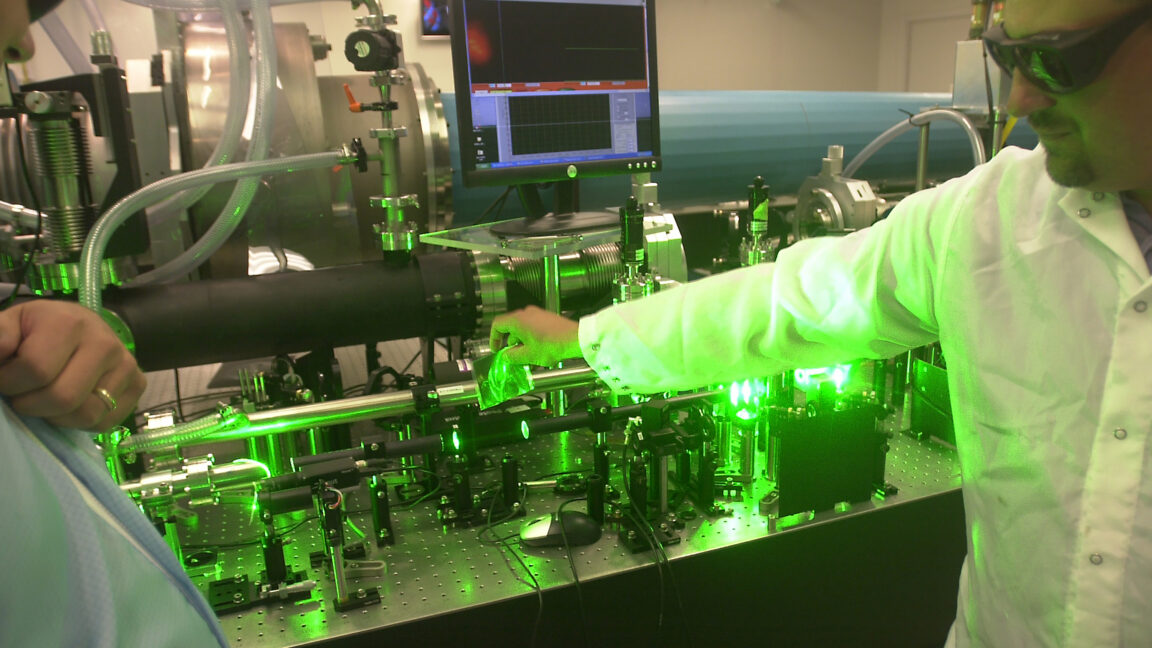
If you stroll across the University of Texas at Austin's Physics, Math, and Astronomy building yard, you'll see a 17-story tower and a huge L-shaped building. You will not see the Texas Petawatt laser, because it's two floors underground behind heavy doors with a logo most students miss. It's one of the most powerful lasers in the United States, though it's currently closed due to funding cuts.
I was the lead laser scientist on the Texas Petawatt (TPW) from 2020 to 2024. This government-funded research center, part of the Department of Energy's LaserNetUS network, let scientists from across the country apply for time to use specialized equipment. This laser takes a tiny pulse of light, stretches it, amplifies it until it briefly carries more power than the entire US electrical grid, then compresses it back to a trillionth of a second to create, essentially, a star in a vacuum chamber.
On a shot day, the target might be a piece of metal foil thinner than a human hair, a gas jet, or a tiny plastic pellet. Scientists used TPW to study stellar interiors, fusion energy, and even new cancer treatment approaches. Contrary to movie depictions, a 'shot day' is hours of quiet, repetitive work followed by about 10 seconds where nobody breathes.
A typical shot day began with me arriving two hours early, donning a gown, boots, and hairnet, and entering a cold clean room. You don't just turn the laser on; you coax it awake. I'd start with the oscillator, a small box generating the first seed of light, and record fixed parameters like energy and center frequency. Then I'd fire up the pump laser to amplify the pulse from nanojoules to about half a joule.
The system needed 30 minutes to stabilize, during which I checked alignment through every pinhole and camera. A slight misalignment could be catastrophic, burning through optics that take months to replace. Next, the beam entered the first amplifier: a glass rod surrounded by flash lamps. The beam made passes, growing stronger until it reached about 12 joules - roughly the energy of a ball thrown hard across a room. This process alone took the better part of an hour.
I'd then expand the beam and send it through the final stage: the disk amplifiers. Two amplifiers, each with two massive 30-centimeter glass disks, were pumped by a huge bank of flash lamps powered by capacitor banks so large they had their own room on a separate floor. Fast optical shutters between each stage acted as gates.
When the experimental team confirmed the target was in position, we'd prepare for a system shot. Every monitor would flash 'System Shot Mode' in red. I'd announce it over a vintage microphone, open the compressor beam dump (a heavy glass plate that takes two minutes to move), and then perform a safety check. With a small interlock key, I'd lock every door; if one opened, the shot aborted.
Back in the control room, I'd charge the capacitor banks. At this point, there's no going back except for an emergency shutdown. The room would go silent. I'd share a glance with the researcher, like Joe from Los Alamos National Lab on one day, who'd be gripping his coffee cup. 'Charge complete. Firing system shot in three, two, one. Fire.'
I'd press the button. A loud thud would roll through the building as the stored energy dumped into the beam. Monitors would freeze, capturing diagnostics. Downstairs, in the vacuum chamber, a spot smaller than a human hair would reach temperatures measured in millions of degrees. I'd lean back and record parameters as everyone exhaled. A radiation safety officer would check the chamber first, then the experimental team would collect data.
Sometimes it worked perfectly. Sometimes it didn't. One afternoon in 2023, after three hours of prep, I pressed the button and heard nothing. A shutter had failed. The monitors showed black. I wrote SHOT FAILED in the logbook and started the hourlong cooldown. We sat in silence, then got the shot four hours later. That's the part they don't show in movies.
This anticipation is the job: hours of patience for 10 seconds you never quite get used to. It all happens underneath a campus where thousands walk, unaware that for a fraction of a second, a tiny point of matter hotter than the Sun's surface just existed below their feet.
The Good Times
News in your inbox.
One sardonic roundup, delivered on your schedule. Free. Unsubscribe whenever your tolerance for wit runs out.
Already subscribed but we never reach your inbox? Check your spam folder and hit 'Not spam' (or 'Remove from spam') to bust us out of junk-mail purgatory. You'll be helping everyone else too.
Don't open any of our emails for a month and you'll be automatically removed from the mailing list.
Rewrite Article
Select parts to regenerate with a fresh AI pass. Translations will be updated automatically.
Generate AI Image
Creates a sardonic version of the article image using OpenAI.