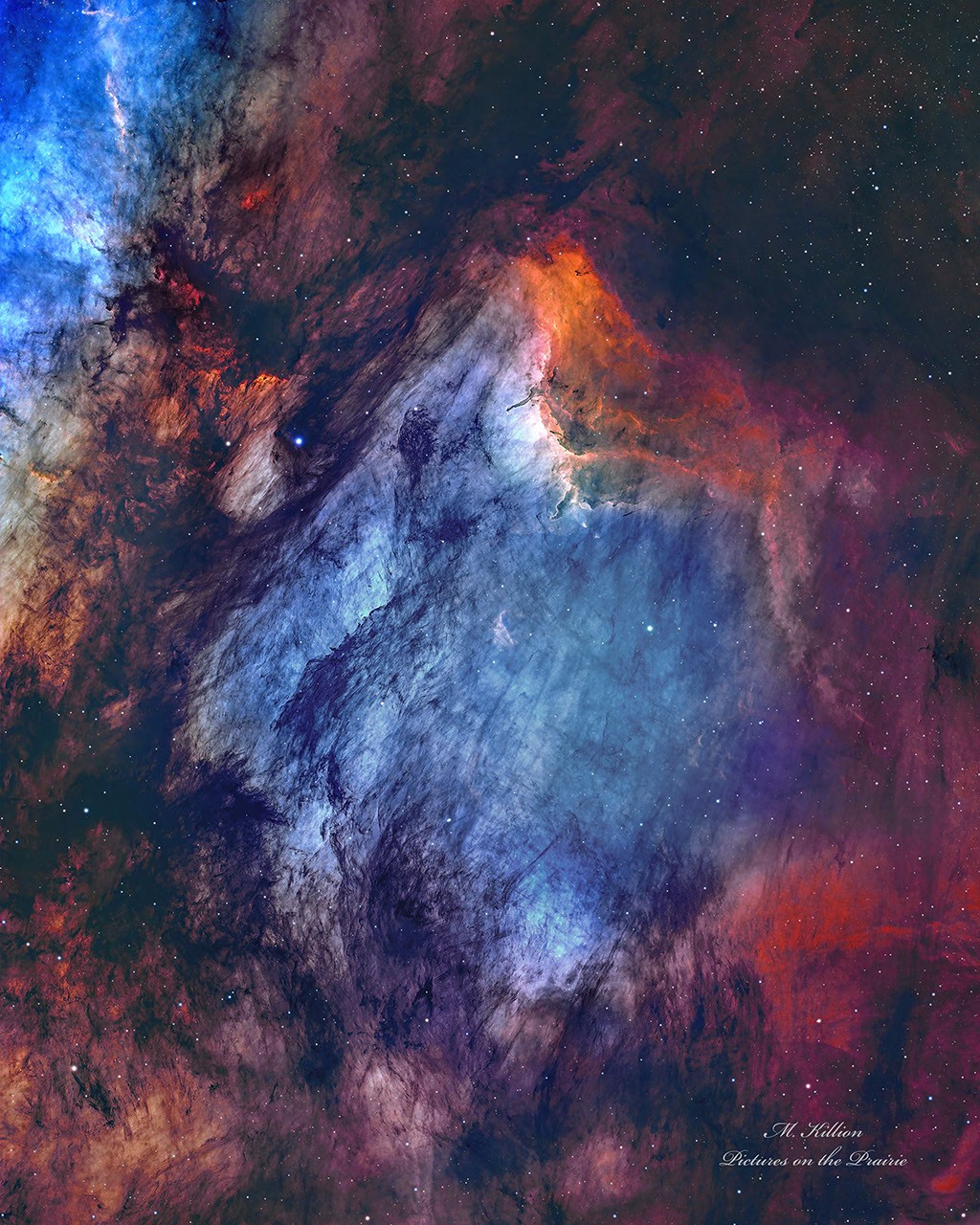
Pelican Nebula Undergoes Slow-Motion Identity Crisis, Astronomers Say
NASA's APOD shows the Pelican Nebula in glorious, 25-hour-exposure detail, but warns that in a few million years, it will look like something else entirely. Change is the only constant, even in space.
The cosmos, as usual, has outdone itself with another stunning visual, and NASA's Astronomy Picture of the Day (APOD) has graced us with a 25-hour-long exposure of the Pelican Nebula, captured from Utah, USA. This celestial bird is not just sitting pretty; it's undergoing a slow, dramatic transformation, because apparently even nebulae can't escape the relentless march of change.
The Pelican Nebula, officially known as IC 5070, is separated from its larger neighbor, the North America Nebula, by a molecular cloud brimming with dark dust. This particular image, a deep, featured snapshot, brings out the intricate details of the filamentary dust, making it look like the universe's most complicated feather pattern.
But why all the fuss over a cosmic pelican? Because this nebula is a hotbed of activity, a veritable nursery where star formation and evolving gas clouds mix with chaotic vigor. The light from young, energetic stars is slowly heating up the cold gas, turning it into hot gas, with the boundary between the two advancing like a cosmic front. This ionization front is visible in bright orange on the upper right, because of course it is. Meanwhile, particularly dense tentacles of cold gas stubbornly cling to existence, resisting the stellar makeover.
Here's the kicker: millions of years from now, the Pelican Nebula, bounded by the dark nebula LDN 935, might not be known as the Pelican at all. As the balance and placement of stars and gas inevitably shift, it will morph into something completely different. So, enjoy the pelican while it lasts, because in astronomical terms, its identity is about as stable as a teenager's mood swings.
And if you're feeling particularly attached to this image, note that APOD's main site is moving from apod.nasa.gov to science.nasa.gov/apod. Tomorrow's picture promises geometric Saturn, because why not add a little geometry to your day?
The Good Times
News in your inbox.
One sardonic roundup, delivered on your schedule. Free. Unsubscribe whenever your tolerance for wit runs out.
Already subscribed but we never reach your inbox? Check your spam folder and hit 'Not spam' (or 'Remove from spam') to bust us out of junk-mail purgatory. You'll be helping everyone else too.
Don't open any of our emails for a month and you'll be automatically removed from the mailing list.
Rewrite Article
Select parts to regenerate with a fresh AI pass. Translations will be updated automatically.
Generate AI Image
Creates a sardonic version of the article image using OpenAI.