Narwhal Tusks Have a Hidden Twist: Science Finally Explains the Unicorn Horn's Secret
Narwhal tusks aren't just a single spiral - they're a double helix, and scientists used synchrotrons to figure out how that makes them both strong and straight.
Narwhals, the so-called unicorns of the sea, have long been misunderstood. Medieval Europeans thought their spiral tusks were actual unicorn horns with magical healing powers. That idea was debunked, but the tusks remain popular souvenirs in Canada and Greenland, and scientists are still fascinated by their weird structure. Now, a new paper in Nature Communications reveals that the tusk isn't just one spiral - it's a double helix, with a second internal spiral twisting in the opposite direction.
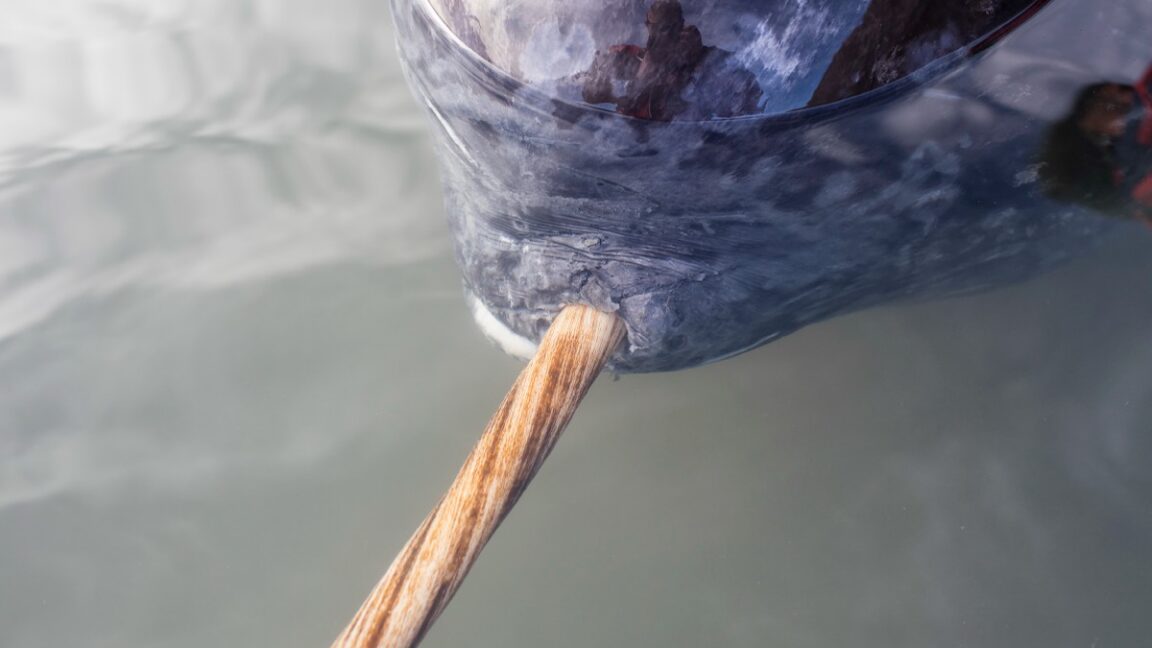
Inuit legend says a woman dragged into the ocean by a harpoon rope became the first narwhal, her twisted hair turning into the spiral tusk. The reality is slightly less mythical: the tusk is a canine tooth in the left upper jaw of male narwhals, pushing through the lip when they're two or three years old and growing up to 1.5 - 2 meters (just under 5 feet to 9 feet 10 inches). Some males grow two tusks, others none. Females usually skip the tusk entirely, and when they do grow one, it's smaller with fewer spirals - yet they outlive the males, suggesting the tusk is more about social status than survival.
Scientists have observed narwhals using their tusks to stun small Arctic cod, and a few unlucky narwhals have been found with tusks embedded in their bodies, hinting at possible fights. The tusks also contain several million nerve endings, which might let narwhals sense temperature or salinity changes in the water. But the tusk's internal structure has been a mystery - until now.
The tusk is made of dentine covered by a thin layer of cementum, surrounding a central pulp chamber. Both layers consist of microscopic collagen fibrils mineralized with hydroxyapatite nanoparticles. The macroscale spiral shape emerges from how those fibrils organize, but nobody had mapped the interior in 3D at atomic, nano, and macroscales. So researchers studied two male narwhal tusk and skull specimens using a combination of advanced techniques: X-ray computed tomography, scanning X-ray diffraction, scanning small-angle X-ray scattering, tensor tomography, and birefringence microscopy. That required booking time on three large synchrotrons in Sweden, Switzerland, and France. They also did standard measurements and mechanical three-point bending tests.
The results: collagen fibrils and hydroxyapatite nanoparticles align along the tusk's longitudinal axis, creating a high degree of anisotropy at all scales. But tiny systematic deviations at small angles produce the twisted structure. The cementum forms the known left-handed helix, while the dentine forms a right-handed helix. This double-helix design gives the tusk its remarkable stiffness and strength, allowing it to withstand bending and twisting without cracking. It also lets the tusk grow straight, unlike an elephant's curved tusk. The team also spotted a finer microstructure in the cementum - collagen fiber bundles radiating outward - which they plan to study further.
"Since whales can live for up to 80 years, their teeth form a kind of historical record of changing environmental conditions throughout the animal's lifetime," said co-author Henrik Birkedal of Aarhus University in Denmark. "And because the North Atlantic is currently undergoing very rapid changes, it is obvious to investigate whether we can trace these changes in the hard tissue of the narwhal tusk. That is what we are now working on."
The study was published in Nature Communications with DOI: 10.1038/s41467-026-75689-z. So the next time you see a narwhal tusk, remember: it's not magic, but it's still pretty impressive - a biological marvel with a twist (well, two).
The Good Times
News in your inbox.
One sardonic roundup, delivered on your schedule. Free. Unsubscribe whenever your tolerance for wit runs out.
Already subscribed but we never reach your inbox? Check your spam folder and hit 'Not spam' (or 'Remove from spam') to bust us out of junk-mail purgatory. You'll be helping everyone else too.
Don't open any of our emails for a month and you'll be automatically removed from the mailing list.
Rewrite Article
Select parts to regenerate with a fresh AI pass. Translations will be updated automatically.
Generate AI Image
Creates a sardonic version of the article image using OpenAI.