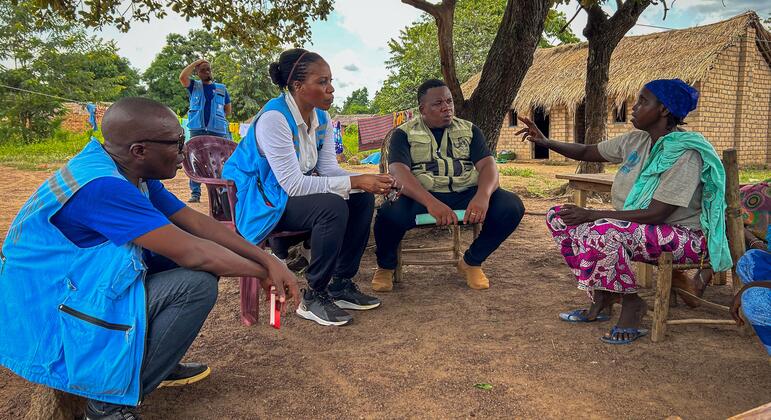
Central African Republic: Progress Threatened by 'We Can't Afford to Slip Back' Funding Cuts
CAR is finally making progress toward stability - but budget cuts threaten to send it right back into crisis mode, because apparently $16 to feed someone for three months is too much to ask.
The Central African Republic (CAR) is doing that rare thing in crisis zones - making actual progress toward stability. But don't get too comfortable: major aid budget cuts are now threatening to undo it all, a senior UN official warned Friday in New York.
Edem Wosornu, Director of OCHA's Crisis Response Division, just returned from her first-ever visit to the country, which she says is “determined to get itself out of crisis mode.” For years, CAR had a “good funding outlook,” with humanitarian appeals raking in 95 percent support. But the 2025 plan? Less than 40 percent funded. So far this year, only 17 percent of the $268 million needed has actually arrived.
“The country is fragile, but the country is hopeful,” Wosornu said, before adding the obvious caveat: “if we don't sustain the funding, we will see ourselves slipping back into crisis mode - a context, a situation, we can't afford.”
CAR has been stuck in recurrent cycles of conflict since 2013, when predominantly Muslim Séléka rebels seized power, prompting the mainly Christian anti-Balaka movement to rise. A UN Mission, MINUSCA, is still trying to keep the peace. Out of a population of about six million, 2.3 million need assistance. Humanitarians are targeting 1.3 million. One in five citizens is displaced.
Wosornu visited Zemio, a southeastern town on the border with the Democratic Republic of Congo (DRC) “where there’s some insecurity.” But the situation has actually improved over the past six months: internally displaced people (IDPs) who were sheltering in a church have returned to their communities. People are farming their lands “when there’s peace,” with support from a UN Food and Agriculture Organization (FAO) project, while the international medical NGO ALIMA runs bi-weekly mobile clinics serving up to 70 people at a time.
During her visit, Wosornu met with CAR President Faustin-Archange Touadéra, the Minister of Humanitarian Action, and local authorities in Zemio. “Clear that things are changing,” she said. “However, it's also very clear that progress can quickly unravel if attention is not sustained, and if funding is not sustained.”
Despite its own fragility, CAR is being “generous.” The country is hosting refugees from Chad. Another 36,000 people from war-torn Sudan have found shelter there and have been given land by the authorities. Among the Sudanese refugees are doctors and nurses who want to support humanitarian operations. The OCHA team on the ground was asking, “how do we support these refugees that have come over but also help them to feed into the economy?”
Wosornu highlighted conversations with locals like Fane, a community leader and mother in Zemio who just wants stability, peace, healthcare, education for her children, and livelihood support. Yet funding cuts threaten the response - even though it only costs $16 to feed a displaced person for three months, and $26 to provide healthcare for an entire year.
International NGOs have closed 20 percent of their offices and satellite offices - 120 out of 634. The UN sexual and reproductive health agency, UNFPA, noted a reduction in reporting on gender-based violence “not because it’s not happening, but because we don’t have the ability as humanitarians to be all over the country.” OCHA has also been hit: “We used to have 15 sub-offices and antenna offices across the country. We've cut that down to seven, and I saw firsthand what that means.”
Humanitarian partners are worried, especially those working on health, because “communicable diseases are very, very rampant,” and CAR is surrounded by several fragile states. Wosornu stressed the need “to do all we can to support the communities on the ground to sustain themselves: from health to education, from education to food security, and everything else that we cover.”
The Good Times
News in your inbox.
One sardonic roundup, delivered on your schedule. Free. Unsubscribe whenever your tolerance for wit runs out.
Already subscribed but we never reach your inbox? Check your spam folder and hit 'Not spam' (or 'Remove from spam') to bust us out of junk-mail purgatory. You'll be helping everyone else too.
Don't open any of our emails for a month and you'll be automatically removed from the mailing list.
Rewrite Article
Select parts to regenerate with a fresh AI pass. Translations will be updated automatically.
Generate AI Image
Creates a sardonic version of the article image using OpenAI.