A Sunflower’s View of Totality: NASA Watches the Moon Crash the Sun’s Party
Sunflowers, solar prominences, and a two-minute cosmic dance: NASA captures the 2026 total solar eclipse from a field in Spain, with jets and balloons joining the party.
On August 12, 2026, the Moon decided to photobomb the Sun for a few precious minutes, and skywatchers in northern Spain got the best seats in the house. The total solar eclipse, where the Moon perfectly aligned between Earth and the Sun, treated those in the path of totality to a rare glimpse of the Sun's outer atmosphere, the corona, while it lasted.
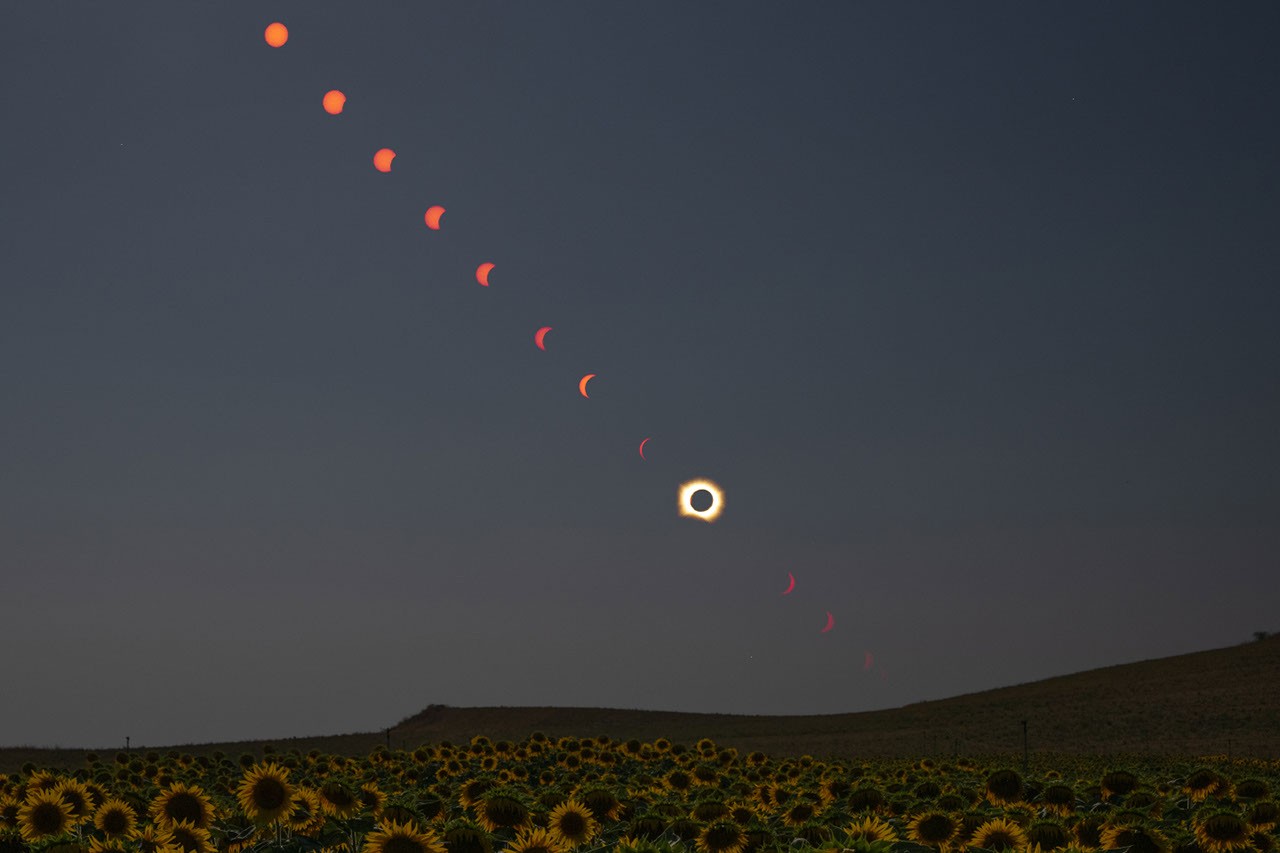
The photographic evidence comes from a field of appropriately themed sunflowers in San Millán de los Caballeros, a town about 40 kilometers (25 miles) south of León. Because, really, what better place to capture a solar eclipse than surrounded by smaller, terrestrial suns? Northern Spain was one of the few land locations in the path, along with parts of Greenland and Iceland.
As the Sun was setting, the Moon's shadow, or umbra, swept across Spain. In León, the partial eclipse started at 7:32 p.m. and ended at 9:22 p.m., right before the Sun dipped below the horizon. Totality lasted about two minutes, starting at 8:28 p.m. Farther east, the Sun set before the show was over - talk about a dramatic exit.
The composite photo, taken before, during, and after totality, shows a glowing loop of plasma called a solar prominence extending into the corona on the left. This plasma, a super-hot gas mostly of ionized hydrogen and helium, flows along the Sun's tangled magnetic fields. Prominences can be many times taller than Earth's diameter, and they're sometimes visible to the naked eye during eclipses - nature's way of showing off.
Solar eclipses are a scientific goldmine for NASA. On August 12, teams staged in Iceland to chase the Moon's shadow in WB-57 high-altitude jets, imaging the corona in visible and infrared light. Meanwhile, the NASA-supported Nationwide Eclipse Ballooning Project launched balloons before, during, and after to measure how Earth's atmosphere reacted when the Sun briefly went AWOL.
If you missed the show, don't worry - the rest of Europe, parts of Africa, Canada, and the U.S. got a partial eclipse, and NASA's image library has photos and video for your viewing pleasure. Mark your calendars for August 2, 2027, when the next total solar eclipse will cross southern Spain, North Africa, Saudi Arabia, and Yemen. Because who doesn't love a good celestial appointment?
The Good Times
News in your inbox.
One sardonic roundup, delivered on your schedule. Free. Unsubscribe whenever your tolerance for wit runs out.
Already subscribed but we never reach your inbox? Check your spam folder and hit 'Not spam' (or 'Remove from spam') to bust us out of junk-mail purgatory. You'll be helping everyone else too.
Don't open any of our emails for a month and you'll be automatically removed from the mailing list.
Rewrite Article
Select parts to regenerate with a fresh AI pass. Translations will be updated automatically.
Generate AI Image
Creates a sardonic version of the article image using OpenAI.