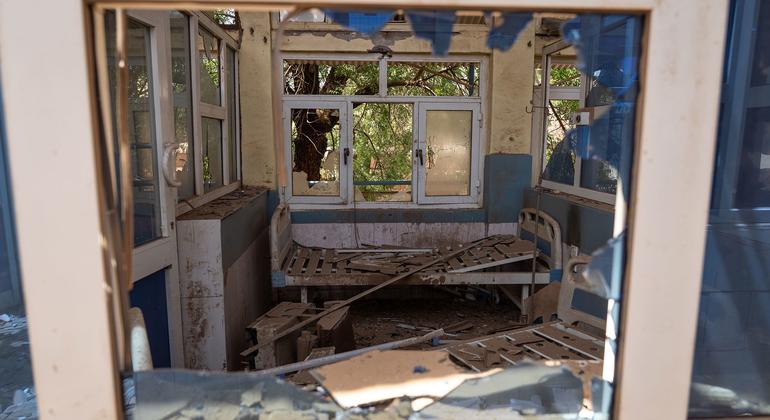
If you were hoping for some good news about the state of healthcare worldwide, you might want to sit down for this one. The World Health Organization (WHO) has been keeping a meticulous list of every time someone bombs, bulldozes, or otherwise disrupts a hospital, clinic, or ambulance, and the tally is not pretty. Since 2018, there have been more than 10,400 attacks on healthcare across 29 countries, resulting in approximately 5,700 deaths and over 8,000 injuries. And here's the kicker: not a single person has been held accountable. Not one.
This year alone, between January and August, WHO recorded over 900 attacks - that's more than four a day - leading to at least 900 deaths and over 1,400 injuries. The hotspots? Ukraine, Lebanon, and the occupied Palestinian territory, with cameos from Myanmar, Iran, Sudan, the Democratic Republic of the Congo (DRC), South Sudan, Russia, Syria, and Nigeria. Because why limit the chaos to one region?
Altaf Musani, WHO's Director for Humanitarian and Disaster Management, briefed journalists in Geneva, painting a picture of violence in its many forms. Heavy weapons were the weapon of choice, followed by outright destruction of healthcare facilities, and then, because humans are endlessly creative, 'psychosocial violence.' That's not a euphemism for a bad Yelp review; it's the kind of fear that keeps patients away and doctors at home. Also, 44 incidents involved the abduction, arrest, or detention of healthcare workers and patients, with 94 people affected - most of them workers held in detention.
But Musani was quick to point out that numbers only tell part of the story. 'When a hospital is attacked, the impact is not only on the people inside the hospital that day,' he said. 'It is the patient who cannot receive healthcare tomorrow. It is the ambulance that cannot make the next referral. It is the healthcare worker who cannot return to work, or medicine supply that can no longer reach facilities.'
And he's got the receipts. A study of 69 attacks in northwest Syria found that outpatient consultations plummeted by 51% the following day and stayed down for up to 37 days. In Sudan, 37% of facilities were reported non-functional in 2026, with only 3% offering inpatient care. In Gaza, all 36 hospitals have been damaged, leaving only half partially functional. Ukraine has seen over 3,000 verified attacks since the conflict began, and the DRC's Ebola response has been hit by 12 attacks since the outbreak was declared in May.
'These are not simply statistics,' Musani insisted. 'Behind every percentage is a patient. Behind every damaged facility is a service lost. Behind every interrupted service is someone who will be left without healthcare.'
When a journalist asked if anyone had ever been brought to account for these attacks, Musani confirmed that of the more than 10,000 verified incidents, 'not a single one has entered the accountability system.' WHO doesn't have the mandate or the expertise to prosecute war criminals, but its Director-General has repeatedly asked - politely, we assume - for parties to be held accountable. Because apparently, the Geneva Convention needs more than a strongly worded letter.
The Good Times
News in your inbox.
One sardonic roundup, delivered on your schedule. Free. Unsubscribe whenever your tolerance for wit runs out.
Already subscribed but we never reach your inbox? Check your spam folder and hit 'Not spam' (or 'Remove from spam') to bust us out of junk-mail purgatory. You'll be helping everyone else too.
Don't open any of our emails for a month and you'll be automatically removed from the mailing list.
Rewrite Article
Select parts to regenerate with a fresh AI pass. Translations will be updated automatically.
Generate AI Image
Creates a sardonic version of the article image using OpenAI.