Teenagers Try to Spark Aryan Apocalypse, Forget to Check Their Own Genetics First
Two teens stage a mosque shooting to kickstart a white utopia, complete with manifesto and Discord broadcast; one attacker was 'half Northern Mexican,' which might complicate the whole white-supremacy thing.
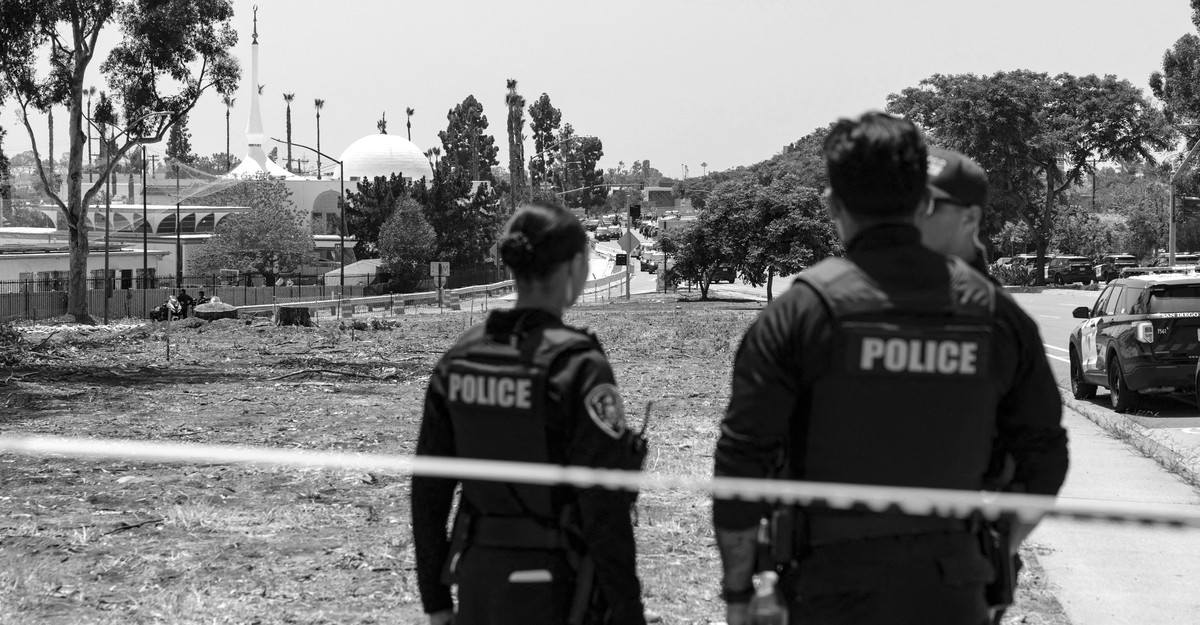
Two teenagers walked into a San Diego mosque on Monday evening wearing Black Sun patches - because the swastika wasn't edgy enough - and carrying assault rifles decorated with white-supremacist symbols in white correction fluid. They killed three people, then fled in a BMW that one of them had stolen from his mom. In the car, 17-year-old Cain Clark apparently shot his accomplice, Caleb Vasquez, before turning the gun on himself. The entire rampage was video-recorded and, within hours, posted on Discord and a website called Watch People Die, because nothing says 'white supremacy' like sharing your crimes with the world.
The attack followed an all-too-familiar script: young men, neo-Nazi paraphernalia, and a manifesto cribbed from the greatest hits of anti-Semitism, 'white genocide' grievance, and admiration for past shooters like Dylann Roof (nine dead in South Carolina) and Brenton Tarrant (51 dead in Christchurch, New Zealand). Clark and Vasquez's manifesto runs 75 pages and, according to Katherine Keneally of the Institute for Strategic Dialogue, suggests they were 'motivated by militant accelerationism' - the belief that only societal collapse can usher in a white utopia. The pair expressed hatred for Black people ('low IQ subhumans'), women ('tend to cause all the problems in the world'), and Jewish people ('The Universal Enemy'), with the phrase 'IT'S THE JEWS' appearing four times. Law enforcement is still verifying the video and manifesto, but researchers at the Institute for Strategic Dialogue obtained copies.
The recording wasn't just for posterity; it was for their Discord community, where extremists and gamers mingle. Researchers call this 'memetic radicalisation,' where violent extremism becomes an online vibe. This approach can even draw nonwhite people to white supremacy. In November, Muhammad Nazriel Fadhel Hidayat, a 17-year-old Indonesian student, allegedly detonated bombs at his school in Jakarta, injuring nearly 100 people. Authorities found neo-Nazi references on his airsoft guns and said Columbine, Roof, and Tarrant were among his influences. Earlier this year, Cody Zoschak of the Institute for Strategic Dialogue suggested the Jakarta bomber didn't fully embrace neo-Nazi ideology but instead 'understood it as a fandom' of the far right.
Clark likely dabbled in the 'True Crime Community' (TCC), a subculture that valorizes mass shootings, especially Columbine. He listed 'True Crime' among his interests in the manifesto. Vasquez, meanwhile, acknowledged that white supremacists might dismiss him as a 'larping spic' - he was 'half Northern Mexican' - but argued he was '70-85% of European genetic descent' from French and Spanish roots. In the 1990s, white-supremacist communities in remote places like East Texas might have rejected him. But in the age of digital extremism, identity is flexible. Fans of accelerationist violence can don whatever persona they wish online. And should mass killers want to inspire those fans, they just need to log into the right Discord server.
The Good Times
News in your inbox.
One sardonic roundup, delivered on your schedule. Free. Unsubscribe whenever your tolerance for wit runs out.
Already subscribed but we never reach your inbox? Check your spam folder and hit 'Not spam' (or 'Remove from spam') to bust us out of junk-mail purgatory. You'll be helping everyone else too.
Don't open any of our emails for a month and you'll be automatically removed from the mailing list.
Rewrite Article
Select parts to regenerate with a fresh AI pass. Translations will be updated automatically.
Generate AI Image
Creates a sardonic version of the article image using OpenAI.