Physicists Do the Math on 'Spacetime Crystals' That Might Become Black Holes, Because Why Not
Physicists finally crack the math behind 'spacetime crystals' that might collapse into black holes, proving once again that the universe is weirder than we thought and that pencil-and-paper still beats supercomputers.
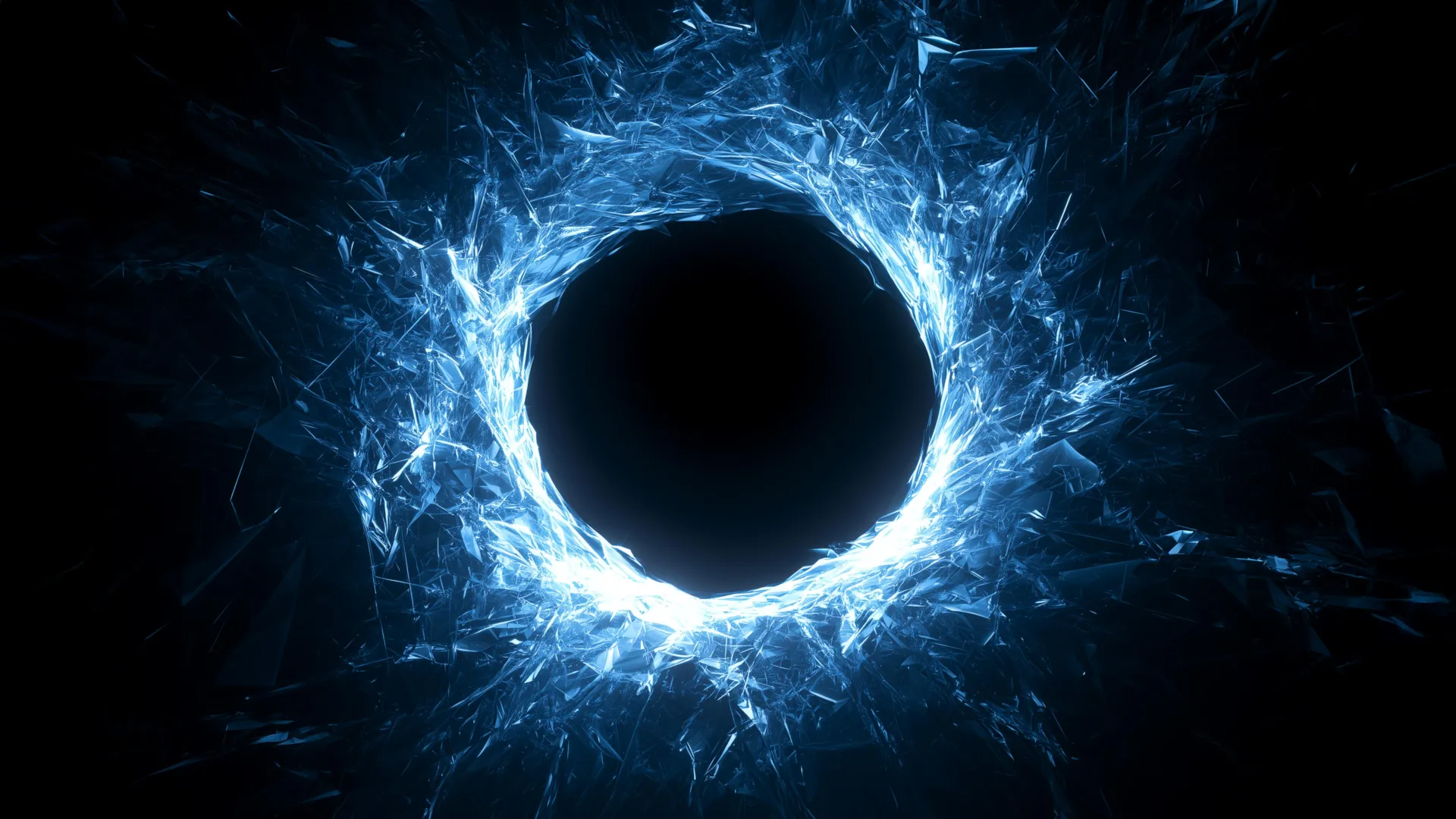
Black holes are usually the kind of thing you associate with dying stars or the centers of galaxies - big, dramatic, hard to miss. But physics, ever the party pooper, says there's no strict lower size limit. Under the right conditions, microscopic black holes could form when spacetime gets into a weird, critical state and organizes itself into a repeating, crystal-like pattern. Yes, spacetime crystals. It's a thing now.
Researchers from Goethe University Frankfurt and TU Wien have finally figured out how to describe this process mathematically. For the first time ever, they derived an exact formula for the phenomenon, using what they describe as essentially "paper and pencil." Because why use a supercomputer when you can just do it the old-fashioned way?
The idea goes back to 1993, when computer simulations first hinted that black holes could spontaneously form through critical collapse - a finely balanced state where a tiny nudge of energy can make all the difference. Think of water at zero degrees Celsius: a tiny change makes it freeze into ice crystals. Similarly, under critical conditions, spacetime curvature can arrange itself into a repeating pattern across space and time, creating a "spacetime crystal."
This crystal is, as Prof. Daniel Grumiller from TU Wien puts it, "a very peculiar and fascinating object." It's an unstable intermediate state that can go two ways: it might just dissolve, leaving behind ordinary spacetime with freely moving particles, or - if you add a tiny bit of energy - it turns into a black hole. Because of course it does.
For decades, physicists struggled to reproduce the simulations with equations. The breakthrough came when the team tried a cheeky workaround: they did the math in more dimensions than our universe has. Our universe has four dimensions (three of space, one of time), but nothing stops you from writing equations for five, forty-two, or even infinitely many dimensions. Surprisingly, the problem gets easier when you crank up the dimensions to infinity. It's like solving a maze by going over the wall.
The team first solved the problem in infinite dimensions, then checked if the solution could be translated back to four dimensions. This mathematical detour allowed them to extract information about critical collapse that had previously been extremely difficult to get analytically.
"Our technique turns out to be remarkably stable," says Florian Ecker from TU Wien. "Depending on the desired precision, we can systematically improve our formulas using additional approximation methods." So, physicists now have a new tool to study black hole formation and other extreme spacetime behaviors without relying solely on computer simulations. Because nothing says 'progress' like doing more with a pencil.
The research was provided by Vienna University of Technology. Note: Content may be edited for style and length - and in this case, a generous helping of sarcasm.
The Good Times
News in your inbox.
One sardonic roundup, delivered on your schedule. Free. Unsubscribe whenever your tolerance for wit runs out.
Already subscribed but we never reach your inbox? Check your spam folder and hit 'Not spam' (or 'Remove from spam') to bust us out of junk-mail purgatory. You'll be helping everyone else too.
Don't open any of our emails for a month and you'll be automatically removed from the mailing list.
Rewrite Article
Select parts to regenerate with a fresh AI pass. Translations will be updated automatically.
Generate AI Image
Creates a sardonic version of the article image using OpenAI.