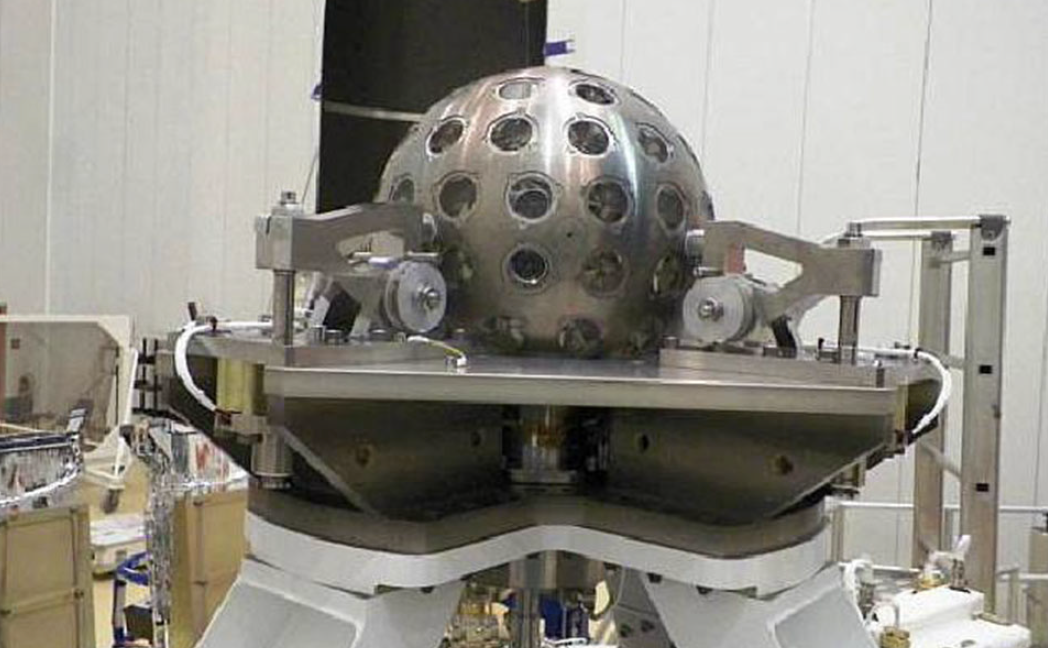
Albert Einstein's general theory of relativity predicts that a rotating mass like Earth drags spacetime along for the ride - a phenomenon called frame dragging, or the Lense-Thirring effect. Measuring it around our pale blue dot has been tricky, since Earth is millions of times lighter than a typical black hole and rotates at a leisurely pace. But a team led by Ignazio Ciufolini of the Wuhan Institute of Physics and Mathematics has now measured the effect with just 0.2 percent uncertainty, thanks to a satellite that looks like a golf ball crossed with a disco globe.
The satellite, LARES-2 (Laser Relativity Satellite 2), built by the Italian Space Agency, is a solid sphere of Inconel 718 alloy covered in 303 retroreflectors. It has no thrusters, solar panels, or electronics - just mass. At 294.8 kilos and a bit over 40 centimeters across, it boasts the lowest area-to-mass ratio of any satellite in medium-Earth orbit, minimizing non-gravitational forces like photon pushes. Launched in July 2022, it sits at about 12,265 kilometers altitude.
The team fired ground-based lasers at LARES-2, whose retroreflectors bounce light straight back. About 200,000 observations from July 2022 to June 2025 pinpointed its position to within 1 millimeter. But Earth's equatorial bulge creates Newtonian forces that dwarf frame dragging. Ciufolini's solution: use two satellites in supplementary orbits - LARES-2 and its older cousin LAGEOS (launched in 1976) - whose orbital inclinations sum to 180.01 degrees. The Newtonian perturbations cancel out, while the relativistic signal adds up.
Even then, the K1 lunisolar tide - a gravitational disturbance from the Moon and Sun - threatened accuracy. The team collected data over one complete 1,050-day precession cycle, averaging out the tide. After removing that and six smaller tidal components, they found a clean drift of 61.3 milliarcseconds per year - the signature of spacetime twisting. The value matched Einstein's predictions with a margin of error of one to two parts per thousand.
The measurement also tested Chern-Simons theory, a quantum gravity alternative that predicts different frame dragging. It didn't rule it out but severely narrowed its scope. Bonus: the experiment precisely measured the K1 tide's strength, which could help earthquake studies. And LARES-2 will keep giving data for centuries - because nothing says 'long-term commitment' like a disco ball in space.
The Good Times
News in your inbox.
One sardonic roundup, delivered on your schedule. Free. Unsubscribe whenever your tolerance for wit runs out.
Already subscribed but we never reach your inbox? Check your spam folder and hit 'Not spam' (or 'Remove from spam') to bust us out of junk-mail purgatory. You'll be helping everyone else too.
Don't open any of our emails for a month and you'll be automatically removed from the mailing list.
Rewrite Article
Select parts to regenerate with a fresh AI pass. Translations will be updated automatically.
Generate AI Image
Creates a sardonic version of the article image using OpenAI.