Brain Cells Break Up: Beloved Long-Term Relationship Turns Out to Be Not That Predictive
Neuroscientists discover that two brain cells they thought were in a predictable relationship are actually just complicated, forcing a rethink of movement disorder research.
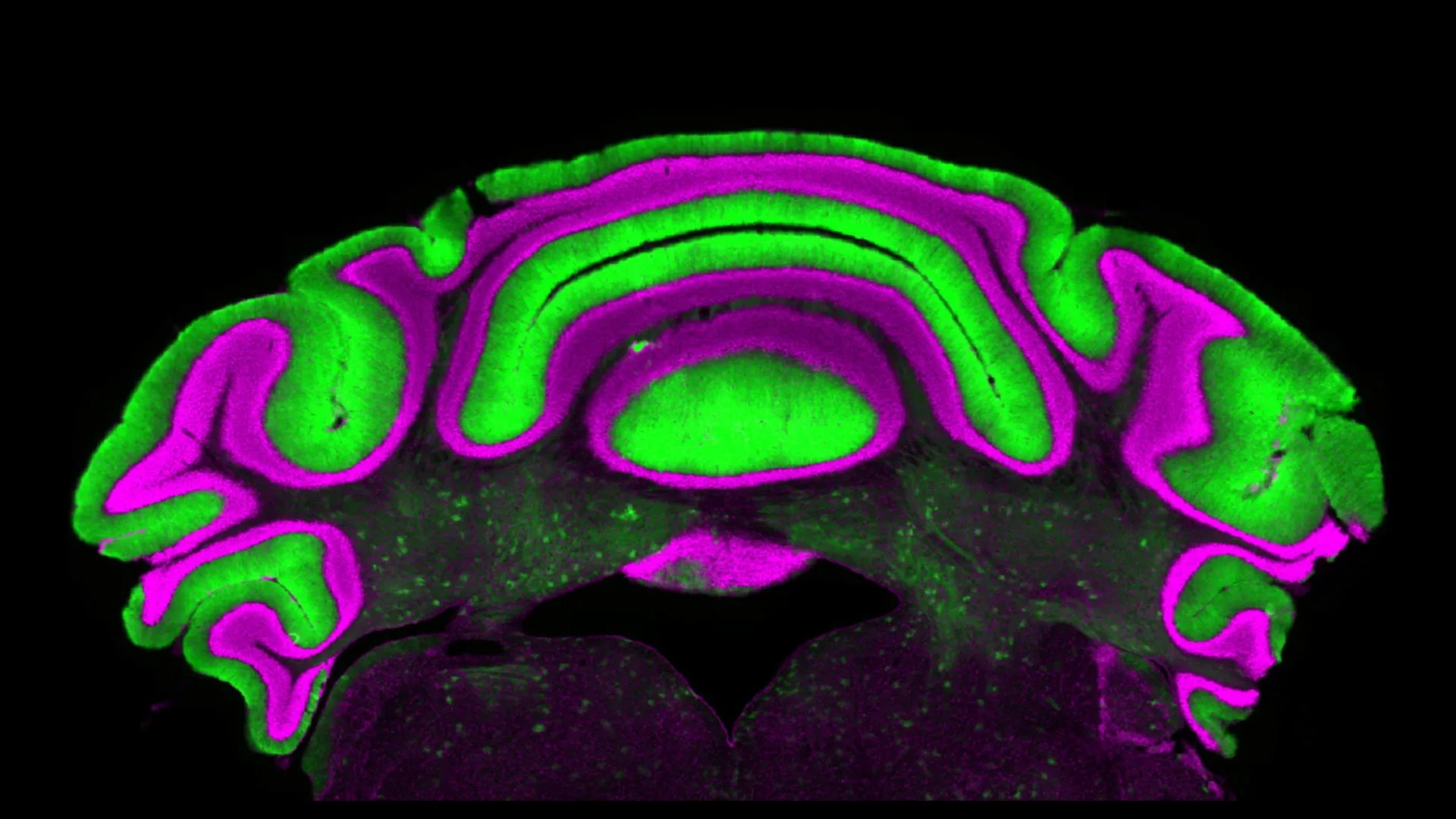
Neuroscientists have spent years assuming that two types of brain cells in the cerebellum - Purkinje cells and deep cerebellar nuclei cells - were in a straightforward, predictable relationship. Spoiler: they’re not.
A new study from Virginia Tech’s Fralin Biomedical Research Institute at VTC, led by Meike van der Heijden and published in the Journal of Physiology, found that activity in Purkinje cells does not reliably predict activity in deep nuclei cells, despite their direct anatomical connection. “There’s very limited predictive power in monitoring one to understand what’s going on in the other,” Van der Heijden said.
The finding upends a long-standing assumption in movement disorder research. For years, scientists focused on Purkinje cells because they sit in the outer layer of the cerebellum - easy to access, like the popular kid in class - while deep nuclei cells are buried deeper, harder to measure, and thus often ignored. But this convenience sampling may have led researchers astray when studying conditions like dystonia, ataxia, and tremor.
To test the assumption, the team analyzed a database of electrophysiology recordings from pre-clinical models of cerebellar disease. The results showed no significant correlation between the two cell populations. “We suggest that if you want to know how the cerebellum is behaving in a disease state, you have to look at the deep nuclei neurons, not just the Purkinje cells,” Van der Heijden said.
The study serves as a cautionary tale: treatments that focus on altering Purkinje cell activity may not produce the expected effects on deep nuclei cells. “We need to be very careful in making assumptions, and to actually do experiments to test our hypotheses,” Van der Heijden added.
The takeaway? In brain science, as in life, the easy-to-observé relationships aren’t always the ones that matter most.
The Good Times
News in your inbox.
One sardonic roundup, delivered on your schedule. Free. Unsubscribe whenever your tolerance for wit runs out.
Already subscribed but we never reach your inbox? Check your spam folder and hit 'Not spam' (or 'Remove from spam') to bust us out of junk-mail purgatory. You'll be helping everyone else too.
Don't open any of our emails for a month and you'll be automatically removed from the mailing list.
Rewrite Article
Select parts to regenerate with a fresh AI pass. Translations will be updated automatically.
Generate AI Image
Creates a sardonic version of the article image using OpenAI.