
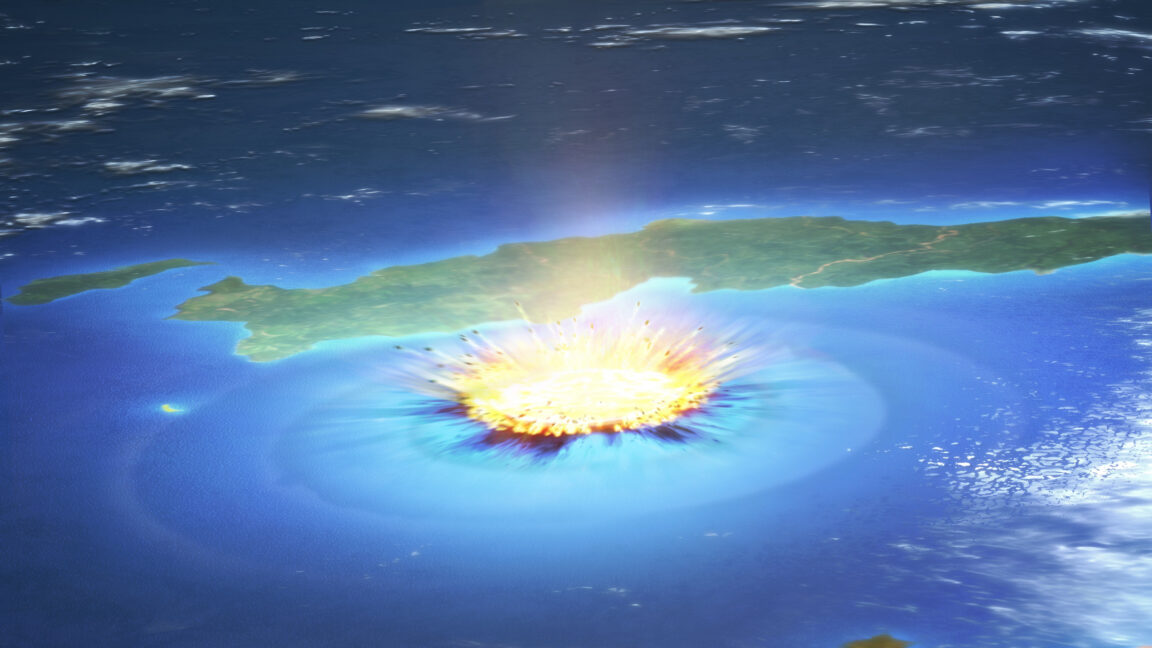
About 66 million years ago, the Chicxulub asteroid smashed into Earth, kicking up tsunamis and dropping hot debris that annihilated non-avian dinosaurs and many other species. But not everything it left in its wake was destructive. This space rock hit what is now the partially submerged Yucatan Peninsula, and at the bottom of the ocean, the impact generated enough heat to create a hydrothermal system that persisted for 8 million years and may have been a hotbed of life.
When researchers drilled for samples in the impact zone in 2016, they studied the types of rock that had formed as a result of the asteroid strike. This gave more insight into what happened in the immediate and long-term aftermath of this cataclysmic event.
The collision was intense enough to cause deformation far beneath the surface. Subterranean effects reached 35 km (almost 22 miles) down, and included the melting of an immense amount of rock. Exposure to seawater made that rock porous. As hot water seeped into the pores, a hydrothermal system formed. The hot water gushing into an isolated region of the freezing depths could have attracted microorganisms and possibly other life forms that were otherwise struggling to survive.
More recently, another team of researchers, led by geologist and planetary scientist Annemarie Pickersgill of the SUERC Center for Isotope Sciences at the University of Glasgow, studied the rock samples for more evidence of its formation and longevity. What they found was that both the scale of this hydrothermal system and how long it lasted had previously been underestimated. It was thought to have been around for only 2 million years, but the new analysis found evidence that it remained in the depths under the Yucatán Peninsula at least four times longer than that.
"Longer periods of hydrothermal activity will generate extended windows of opportunity for prebiotic chemical reactions to occur, life to develop, and micro-organisms to thrive and propagate beyond their point of origin," Pickersgill said in a study published in Communications Earth & Environment.
Hydrothermal systems created by other impacts are all over the planet. Although these systems are considered habitable because of heat and nutrients, signs of life have been hard to find, and linking the timing of an impact to processes that contributed to the flourishing of life is even harder. Microbes have only been found to colonize eight of the 70 underwater impact craters with hydrothermal activity.
What Pickersgill and her team wanted to find out was whether the Chicxulub impact could have created habitable conditions, so she analyzed rock samples to figure out when there was the highest chance of habitability. The work doesn't answer whether the hydrothermal system in that crater was actually inhabited.
The researchers delved into how long the impact crater brought about temperatures and additional conditions that would have been ideal for attracting and holding on to life. Habitable conditions that endure for long periods allow more time to attract organisms that build colonies around a hydrothermal vent.
To determine the duration of the Chicxulub hydrothermal system, Pickersgill recovered samples at the site, drilling 1 km down. She then took radioisotopic measurements of feldspar samples recovered from the site. Feldspar contains potassium, and the decay of that potassium into argon can give an idea as to how old the rock is. Lunar rocks and volcanic formations have been dated this way.
Traces of argon found inside a rock are indicative of potassium decay. Since the gas will also escape from molten rock, this provides a measure of when the rock solidified. How much time has passed since that rock melted can be determined from potassium-argon dating, which involves measuring the amount potassium-40 isotope present relative to the argon-40 it decays into. Levels of argon meant the hydrothermal system stayed heated from 66 million years ago, when the asteroid first hit, to 58 million years ago.
With 8 million years of heat and nutrients, life had more than enough time to colonize the hydrothermal system in the Chicxulub crater. Pickersgill also ran computer simulations of hydrothermal activity in that location. Results suggested that cooling to 90° C (194° F) took between 1.5 and 2.3 million years after the impact at depths of one kilometer. Cooling to below 50° C (122° F) took up to 5 million years, still enough heat for colonies of microbes to thrive. After 6 million years, significantly less hot water was flowing, and by 8 million years, the flow had ceased. These results matched the rock age found by isotope analysis.
Finding how long hydrothermal systems lasted on Earth can guide habitable environments elsewhere. "Chicxulub is still relatively small compared to the impact basins expected on early Earth and observed on other planetary bodies," said Pickersgill. "It is therefore possible that these larger impacts could have created even longer-lived hydrothermal systems and, hence, could have been able to maintain the temperatures and fluid flux required for habitable environments for a minimum of several million years."
Communications Earth and Environment, 2026. DOI: 10.1038/s43247-026-03618-5