citing warnings that AI could cause mass economic displacement and even human extinction, political figures who once wanted nothing to do with each other are now joining forces, scrambling the political landscape just weeks before the midterm elections. The odd couples, unthinkable just weeks ago, are also reshaping the legislative agenda. Republican Senators Ted Cruz and John Thune have teamed up with Democratic Senator Amy Klobuchar on an AI-safety bill; progressive Senator Richard Blumenthal joined forces with conservative Senator Josh Hawley to push a bill requiring AI companies to obtain approval from the Department of Energy before deploying new systems.
Nearly a decade ago, Sanders urged then-President-Elect Trump to reverse his decision to hire Bannon, a pugilistic architect of the MAGA movement, and called him "a racist individual." Last year, Bannon called Sanders a "pussy" for not going after Hillary Clinton hard enough in 2016. But the two were able to put all of that aside today to deliver the same message: If AI has the potential to wipe out humanity, Americans should have a say in how it operates.
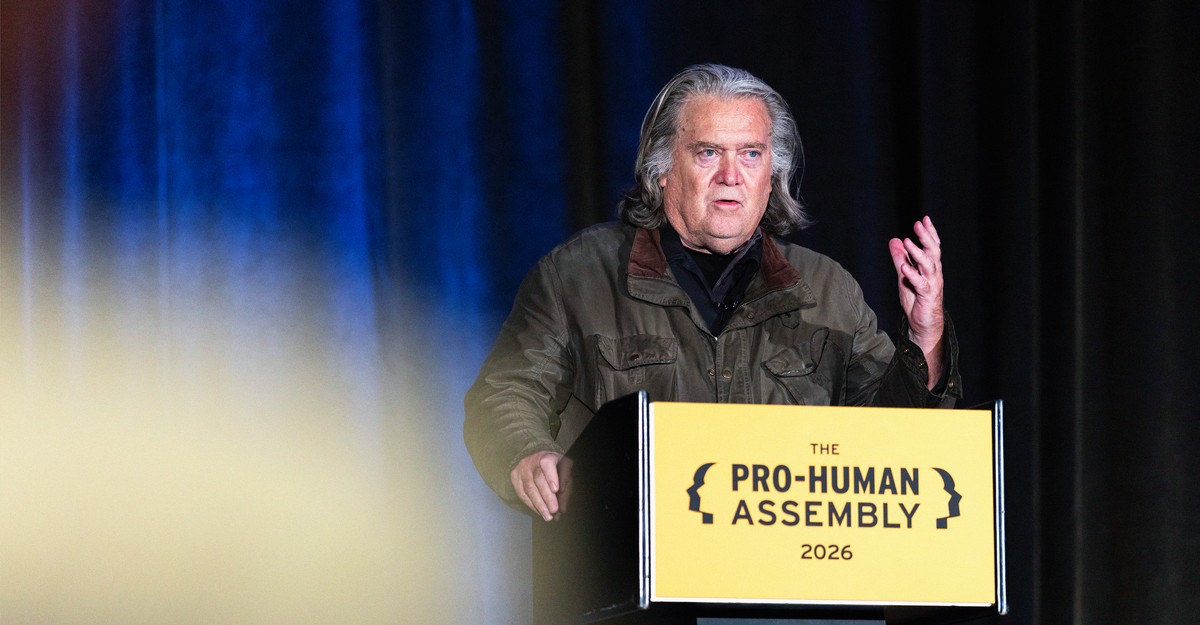
"If the lives of every man, woman, and child are going to be fundamentally changed by this technology, then the people of this country must make the decisions about AI, and not just a handful of oligarchs," Sanders said at the all-day "Pro-Human Assembly." Bannon sounded pretty much exactly the same. "The American citizens are not going to be supplicants to the oligarchs anymore," the MAGA strategist said in what easily could have been a continuation of the Vermont socialist's remarks. "We can't do it."
Standing decidedly outside this spirit of cross-party cooperation is Trump, who has downplayed warnings about AI's risks and called the concerns over the rapidly advancing technology a "hoax." Trump made a surprise appearance at an AI-friendly event yesterday by placing a phone call to Nvidia CEO Jensen Huang and making clear that he does not believe the doomsday warnings that have circulated in recent days. "The robots are not going to be taking over the world," he told Huang, who took the call while speaking at a summit in Los Angeles and put it on speakerphone for the crowd to hear. "That's not going to happen."
Bannon and Sanders, speaking back-to-back, essentially agreed to disagree about Trump. Sanders said that Trump's "ignorance regarding this issue is truly embarrassing" and suggested that the president is not taking the technology's risks seriously enough.
"Obviously, he and I have a quite different opinion of the president of the United States," Bannon told the crowd. "But we're trying to raise above partisanship, and we have to." That line received applause. But overriding Trump's opposition to AI regulation in order to make meaningful policy changes could be a heavy lift. In several social-media posts yesterday, Trump dismissed those concerned about AI's dangers as "Conspiracy Theorists, Treasonists, Traitors, and Leakers." He suggested that AI and the data centers that power it could represent the greatest economic opportunity in American history. "Don't kill the Golden Goose!" he wrote. Some lawmakers and activists, including Trump supporters and detractors, are now attempting to create a formal coalition to push for stronger guardrails around AI. Sanders plans to host a closed-door, bipartisan briefing on AI tomorrow in Washington.
Today's event in Washington was branded by organizers as an opportunity to create a "more human-centric path for AI development." Speakers, including lawm