WHO to Israel: Medicine Is Not a Dual-Use Weapon, Unless Band-Aids Have Become Militant
WHO asks Israel to stop treating bandages like weapons of war as Gaza faces winter, rats, unexploded ordnance and a prosthetics shipment rejected four times.
The World Health Organization has a modest proposal for Gaza: let medicine in. Repeated delays in bringing lifesaving medicines, prosthetics and other supplies from Israel into the enclave risk devastating consequences for Palestinians who urgently need them, the UN agency said Friday.
"A truck full of non-priority supplies or the right supplies arriving too late, doesn't save lives. That's the question that actually matters," said Dr Reinhilde Van De Weerdt, WHO Representative in the Occupied Palestinian Territory.
Nearly 12 months into a fragile ceasefire between Hamas and Israel - a period marked by ongoing Israeli airstrikes and other military activity - Gaza's humanitarian situation remains "overwhelming," according to the UN aid coordination office, OCHA. So overwhelming, in fact, that the word "ceasefire" is doing an awful lot of heavy lifting.
Approved aid can only enter via Kerem Shalom, at the southern tip of the enclave, while Rafah - also in the south - is open only for limited movement of people, including patients needing medical treatment abroad. At least four other main entry points remain closed: Kissufim, Gate 96, Erez and Erez West. That's a lot of closed doors for a place described as being in a fragile ceasefire.
Dr Van De Weerdt called on Israeli authorities to "release the pressure on medical supplies," stressing that essential medicines "should not be considered as dual use" - and therefore banned on the grounds Hamas fighters could use them - "as they are globally accepted standards on medical items anybody needs anywhere to run a hospital or a clinic." In other words, a syringe is not a Scud missile.
In the last six months, one shipment of prosthetics and assistive devices was rejected four times. "Every rejection means another delay for someone who has already lost a limb and is simply waiting for the chance to walk again," Van De Weerdt said. Medicines, by contrast, "move relatively well," with almost 87 percent approved and just over 1 percent rejected - a ratio that suggests the system can work when someone lets it.
UN aid agencies still provide critical assistance to families across the Strip in coordination with Israeli authorities, but the work is impeded by a lack of reliable, timely access. "Our ask is simple and has not changed: we need the unimpeded and predictable entry of humanitarian and health supplies into Gaza at scale," Van De Weerdt said. "We also need a multi-crossing model so that aid isn't forced to trickle down through a limited number of crossings." Trickle-down aid, it turns out, works about as well as trickle-down anything.
Highlighting the "extraordinary health workers" still risking their lives to help others, Van De Weerdt said too few supplies were reaching them and not enough patients were getting the care they needed and deserved. And it's about to get worse, because autumn is ending.
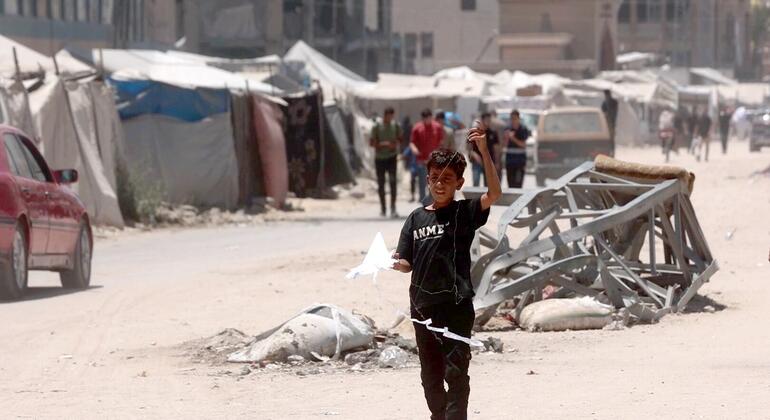
"As winter begins, this urgency to get supplies into Gaza only deepens. Almost two million people are in need of shelter to protect against the cold and the risk of flooding, exposing people to serious health and safety risks, let alone [their] dignity," she explained. Two million people. One winter. Zero margin for error.
As in previous winters, Gaza residents are expected to face a heightened risk of preventable disease outbreaks, linked to the absence of safe shelter, a lack of clean water and a high number of rats, whose bites transmit infection. The destruction of public health laboratories has complicated efforts to identify potential epidemics - because detecting an outbreak is hard when the labs that detect outbreaks no longer exist.
The warning follows OCHA's alert Thursday about serious public health risks from solid waste accumulating in the heart of Gaza City. Recent gains in improving sanitation remain fragile due to a lack of reliable access to heavy machinery and equipment, OCHA said, "or to engine oil and spare parts required to keep them running. Sustained funding for fuel is also critical." Sanitation, it turns out, requires sanitation equipment.
Meanwhile, mine action partners reported they still lack "permissions and equipment" to remove unexploded ordnance hazards identified in the rubble during 37 assessment missions. Thirty-seven missions to find the bombs, and still no permission to remove them. That's not a bureaucratic delay - that's a sequel waiting to happen.
The Good Times
News in your inbox.
One sardonic roundup, delivered on your schedule. Free. Unsubscribe whenever your tolerance for wit runs out.
Already subscribed but we never reach your inbox? Check your spam folder and hit 'Not spam' (or 'Remove from spam') to bust us out of junk-mail purgatory. You'll be helping everyone else too.
Don't open any of our emails for a month and you'll be automatically removed from the mailing list.
Rewrite Article
Select parts to regenerate with a fresh AI pass. Translations will be updated automatically.
Generate AI Image
Creates a sardonic version of the article image using OpenAI.