
The UN has a new worry in Colombia, and it's not just the aftershocks. The recent earthquake, it seems, has created a prime recruiting opportunity for armed groups, and the children are the targets. Because nothing says 'post-disaster recovery' like 'illegal armed groups lurking near damaged schools.'
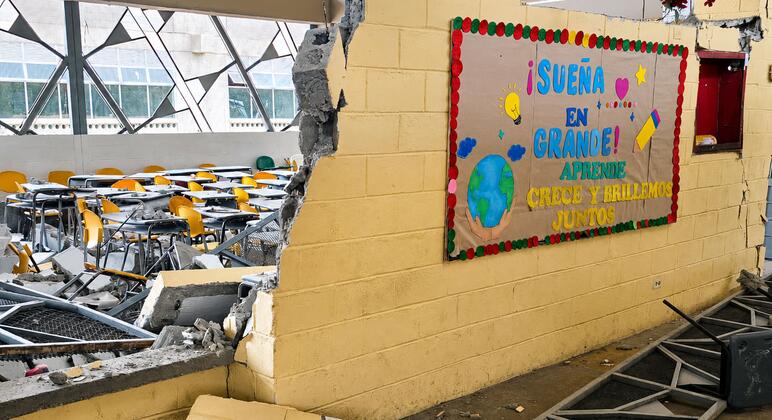
On Friday, the UN warned that the quake that rattled Chocó and Valle del Cauca could crank up the risk of child recruitment, especially with thousands of kids out of school in areas already simmering with conflict. The quake damaged more than 3,800 educational facilities and disrupted learning for over a million students. Nearly 178,000 of those kids attend schools that suffered 'serious structural damage,' which is UN-speak for 'do not let your children near that building.'
María José Torres Macho, the UN Resident Coordinator in Colombia, noted that recruitment was already a concern in these areas before the disaster, where illegal armed groups are as active as ever. 'We are concerned that the situation of children out of school can exacerbate this problem,' she told reporters at UN Headquarters. Because, yes, nothing exacerbates a problem like giving armed groups a pool of idle, vulnerable kids.
In Chocó, some rural schools were completely destroyed, others partially collapsed, and several remain at imminent risk of collapse. Assessments are also continuing in Risaralda and Caldas to figure out which schools can safely reopen - presumably those that haven't become piles of rubble.
For the UN, restoring access to education is a top priority, not just for the sake of learning, but to return children to 'protective environments.' Because school is a protective environment, unless the ceiling falls on you.
The 7.4-magnitude earthquake on 10 August left 331 people dead, 4,449 injured, and 219 missing. More than 406,000 people have been affected across 15 departments and 496 municipalities. Many of the hardest-hit areas were already facing high levels of poverty, isolation, and armed violence - because Mother Nature has a sick sense of timing.
'Those areas most affected are those areas most vulnerable,' Torres Macho said, adding that the pre-existing conflict is creating challenges for both the emergency response and recovery. In Chocó, the UN still doesn't have complete information on the needs of some rural communities, particularly Afro-Colombian and Indigenous communities. Damage to roads, difficulties travelling along some rivers, and electricity and connectivity problems are hampering both assessments and the delivery of aid.
Conflict-related displacement is also continuing alongside the earthquake response. In Sipí, Chocó, around 95 Afro-Colombian people were displaced from the community of Charco Hondo, with concern that displacement could spread to two neighbouring communities. Because one crisis just wasn't enough.
Torres Macho also highlighted the role of local authorities and Indigenous and Afro-Colombian organisations, which have been among the first responders in some of the most isolated areas. At the same time, she warned that some municipalities have limited capacity and are overwhelmed by the scale of the emergency.
Since 10 August, the UN system and humanitarian partners have reached around 72,000 people in 36 municipalities across Chocó, Valle del Cauca, Risaralda, and Caldas with food, water, medical care, medicines, shelter, psychosocial support, protection, and education services. That's a lot of checkboxes.
Following the earthquake, the United Nations updated its humanitarian response plan and estimates that 1.2 million people need assistance. Within that group, around 127,000 have been identified as among the most severely affected and in need of priority support, Torres Macho said. The response requires $148.1 million, she said, but only 40 per cent of that has been received. Because, of course, funding is always a struggle.
Among the most urgent needs are shelter, medical care, medicines, safe water, education, and support to restore livelihoods. In some places, available supplies are already beginning to run out. In Caldas, for example, food and hygiene distributions have relied in part on donations, but those stocks are being depleted, and there is not enough capacity to sustain the next rounds of assistance.
Problems also persist in temporary shelters. Among those assessed in Chocó, Risaralda, Valle del Cauca, and Caldas, 33 per cent have sanitation and hygiene needs, 31 per cent face problems accessing water, and 22 per cent need food.
Torres Macho said the response will also need to move quickly towards recovery and reconstruction, particularly in communities that were already vulnerable before the earthquake. 'It is very important to also provide support to the municipalities, so there is some urban planning and we don't reproduce vulnerability and end up creating another disaster.' Because apparently, we've learned nothing from past disasters.