Supernova Seen Five Times Hopes to Settle Universe’s Speed Limit Dispute
A one-in-a-million supernova (SN Winny) appears five times due to gravitational lensing, offering a new way to measure the universe's expansion rate and maybe end the Hubble tension squabble.
Scientists have known for nearly a century that the universe is expanding, but they still can’t agree on how fast. It’s like arguing over a car’s speed without a working speedometer. Now, researchers from the Technical University of Munich (TUM), Ludwig Maximilians University (LMU), and the Max Planck Institutes MPA and MPE have found a rare cosmic ruler that might finally settle the debate.
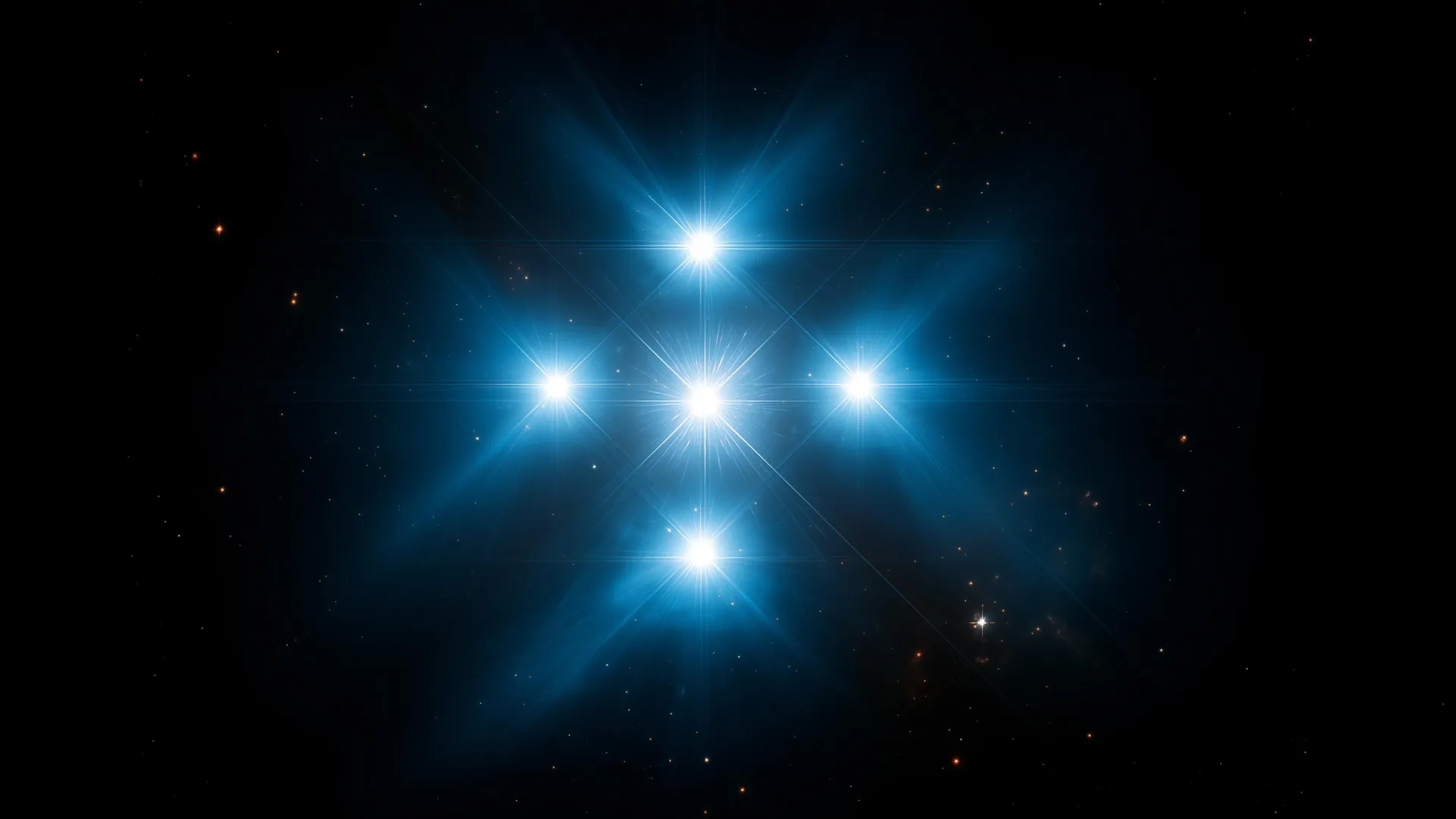
The object in question is a superluminous supernova about 10 billion light-years away, officially dubbed SN 2025wny but nicknamed SN Winny by its discoverers. It’s not just bright - it appears as five separate images in the sky, thanks to gravitational lensing by two foreground galaxies. The light takes different paths, creating time delays that scientists can use to calculate the Hubble constant, the universe’s expansion rate.
“We spent six years searching for such an event by compiling a list of promising gravitational lenses,” said Sherry Suyu, Associate Professor of Observational Cosmology at TUM and Fellow at the Max Planck Institute for Astrophysics. “The chance of finding a superluminous supernova perfectly aligned with a suitable gravitational lens is lower than one in a million. In August 2025, SN Winny matched exactly with one of them.”
High-resolution imaging from the Large Binocular Telescope in Arizona - equipped with two 8.4-meter mirrors and adaptive optics - produced the first color image of the system, showing five bluish points of light around the two lensing galaxies. Most similar systems produce only two or four images, so this quintet is a rare treat. Junior researchers Allan Schweinfurth (TUM) and Leon Ecker (LMU) modeled the mass distribution, finding the galaxies to be smooth and regular, suggesting they haven’t yet collided despite their close proximity.
Currently, astronomers have two main ways to measure the Hubble constant, and they disagree - a spat known as the Hubble tension. The first method, the cosmic distance ladder, builds distances step by step from nearby galaxies, accumulating small errors. The second looks at the cosmic microwave background from the Big Bang, relying on assumptions about cosmic history that are still being debated.
SN Winny offers a third method: a one-step calculation using time delays and lensing mass, with fewer and entirely different systematic uncertainties. Astronomers worldwide are now observing it with ground- and space-based telescopes, hoping to resolve the long-standing speed limit dispute of the cosmos.
Materials provided by Technical University of Munich (TUM). Note: Content may be edited for style and length.
The Good Times
News in your inbox.
One sardonic roundup, delivered on your schedule. Free. Unsubscribe whenever your tolerance for wit runs out.
Already subscribed but we never reach your inbox? Check your spam folder and hit 'Not spam' (or 'Remove from spam') to bust us out of junk-mail purgatory. You'll be helping everyone else too.
Don't open any of our emails for a month and you'll be automatically removed from the mailing list.
Rewrite Article
Select parts to regenerate with a fresh AI pass. Translations will be updated automatically.
Generate AI Image
Creates a sardonic version of the article image using OpenAI.