Astronomers Finally Find That Thing Everyone Was Looking For: A Rocky Exoplanet With an Atmosphere
Astronomers have confirmed an atmosphere on a rocky exoplanet in the habitable zone for the first time, marking a major milestone in the search for life beyond Earth - and proving that theoretical models sometimes actually work.
In a development that will mildly surprise anyone who's watched a sci-fi movie, astronomers have detected an atmosphere around a rocky, Earth-like planet in another star's habitable zone. The finding, published July 16 in Science, offers the strongest evidence yet that planets with broadly Earth-like temperatures and rocky compositions may exist beyond our solar system - and, you know, potentially support life.
"An atmosphere is essential for a planet to support life as we know it," said lead author Collin Cherubim, who recently earned his Ph.D. in Earth and Planetary Sciences from Harvard University. "This is the first time anyone has found an atmosphere on a rocky planet in the habitable zone of another star."
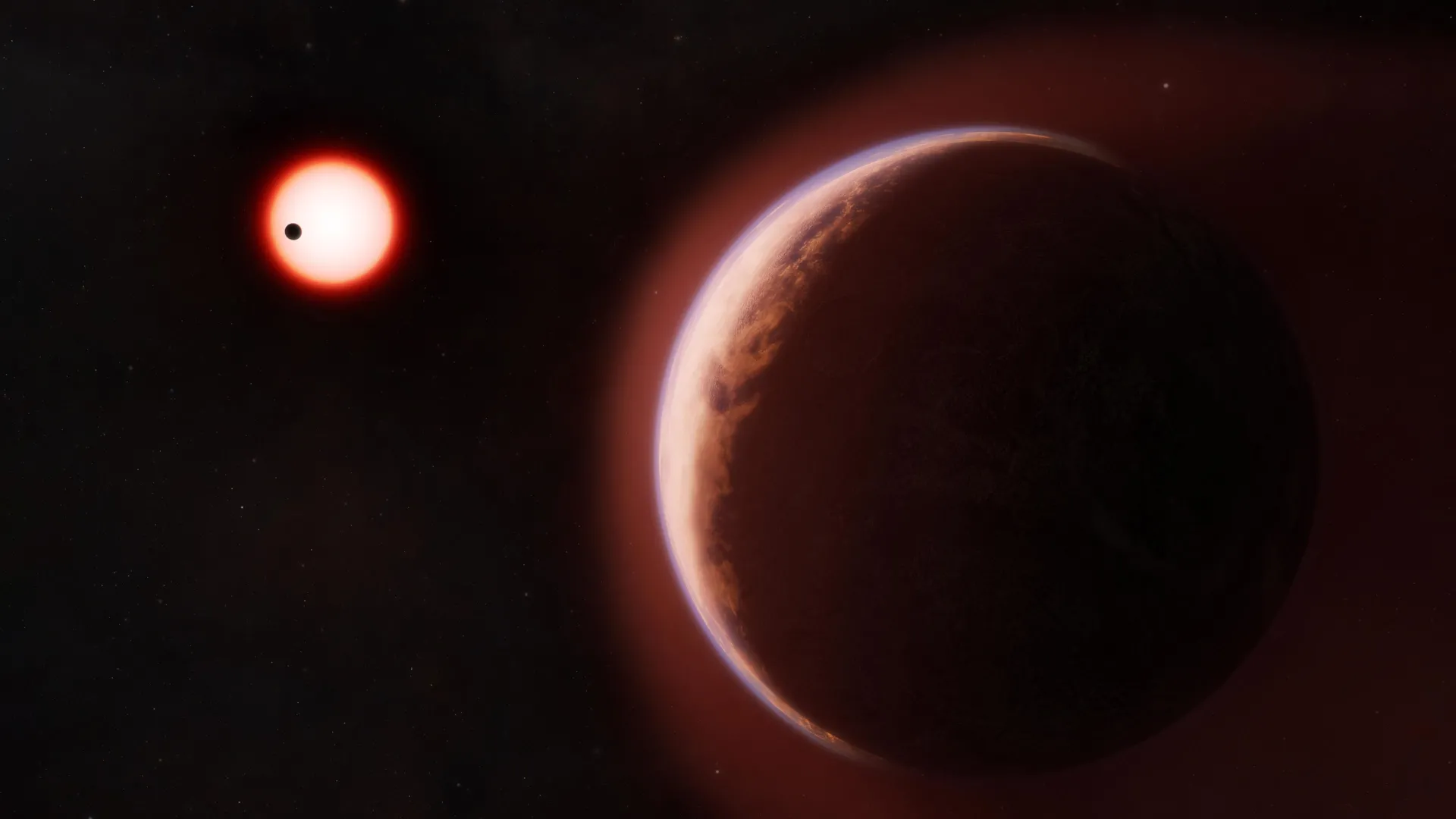
The planet in question is LHS 1140 b, a rocky exoplanet located about 48 light-years from Earth. It orbits a red dwarf star within its habitable zone - that Goldilocks region where temperatures might allow liquid water to remain on the surface. The detection came via observations of helium escaping from the planet, captured using the Warm Infrared Echelle (WINERED) Spectrograph at the Magellan Observatory in Chile.
Scientists have identified thousands of exoplanets, including several rocky worlds in habitable zones, but confirming whether those planets have atmospheres has been one of the most annoying challenges in exoplanet research. "Twenty years ago we wondered whether other terrestrial-type planets even existed," said Robin Wordsworth, Gordon McKay Professor of Environmental Science and Engineering at Harvard and one of Cherubim's dissertation advisors. "Then we learned they're common, and found some in the habitable zone. The next question was whether any of them had managed to keep an atmosphere. Now we know at least one has."
Cherubim and his colleagues developed a theoretical model predicting that the upper atmosphere of LHS 1140 b would contain large amounts of helium slowly escaping into space. They tested that prediction during an unusual event where LHS 1140 b and another planet crossed in front of their star on the same night. The second planet showed no sign of an atmosphere. LHS 1140 b, however, produced a clear signal of helium escaping - evidence that it still retains an atmosphere.
Cherubim's joint advisor David Charbonneau, head of the Harvard Department of Astronomy, initially doubted whether the plan would succeed. "Collin analyzed the planets we knew about and predicted that this one would have a helium atmosphere," Charbonneau said. "Then he organized telescope time, got the data, and the detection was statistically rock solid."
The discovery suggests astronomers may be able to study the atmospheres of rocky exoplanets from the ground by looking for gases escaping into space. Astronomers estimate that the atmosphere of LHS 1140 b has survived for more than three billion years, making it a particularly promising target for additional observations. Cherubim hopes to identify the atmosphere's complete chemical composition and eventually determine whether the planet has surface oceans or other habitability features. He and his colleagues also plan to use the model to search for additional rocky worlds with atmospheres. "This has been a model validation, and hopefully it's just the first of many more observations to come," he said.
The Good Times
News in your inbox.
One sardonic roundup, delivered on your schedule. Free. Unsubscribe whenever your tolerance for wit runs out.
Already subscribed but we never reach your inbox? Check your spam folder and hit 'Not spam' (or 'Remove from spam') to bust us out of junk-mail purgatory. You'll be helping everyone else too.
Don't open any of our emails for a month and you'll be automatically removed from the mailing list.
Rewrite Article
Select parts to regenerate with a fresh AI pass. Translations will be updated automatically.
Generate AI Image
Creates a sardonic version of the article image using OpenAI.