
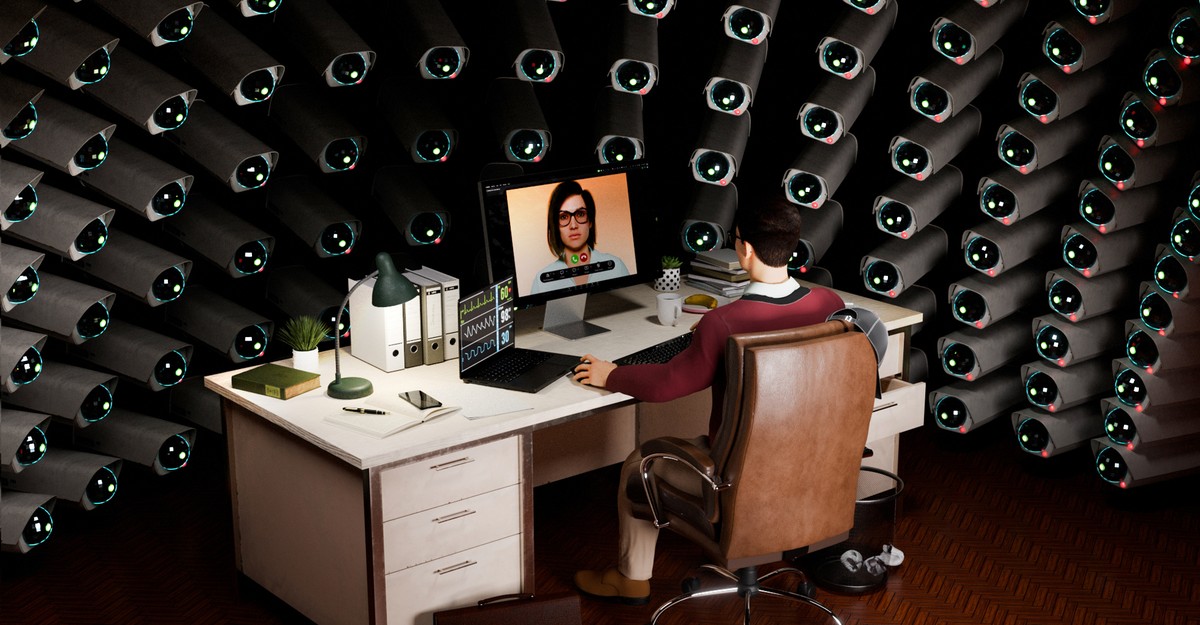
The good news, for me at least, is that the computer thinks I have a nice personality. According to an app called MorphCast, I was, in a recent meeting with my boss, generally “amused,” “determined,” and “interested,” though - sue me - occasionally “impatient.” MorphCast, you see, purports to glean insights into the depths and vagaries of human emotion using AI. It found that my affect was “positive” and “active,” as opposed to negative and/or passive. My attention was reasonably high. Also, the AI informed me that I wear glasses - revelatory!
The bad news is that this software is coming to watch you too, if it isn't already. MorphCast has licensed its technology to a mental-health app, a program that monitors schoolchildren’s attention, and McDonald's, which launched a promotional campaign in Portugal that scanned app users’ faces and offered them personalized coupons based on their (supposed) mood. It is one of many companies in the emotion AI (or affective computing) space. Some products analyze video of meetings or job interviews; others listen to audio for pitch, tone, and word choice; still others scan chat transcripts or emails to spit out a report about worker sentiment. The barrier to entry is shin-high: I used MorphCast at no cost via a free trial, with no special software. At no point was I compelled to ask my interlocutors if they consented to being analyzed (though I did ask, because of my good personality).
Every successful technology needs to find a problem people are willing to pay money to solve. For emotion AI, that problem appears to be worker performance and productivity, especially in customer service and blue-collar labor. If you’ve ever been warned that your call “is being monitored for quality-assurance purposes,” chances are the person on the other end is being assessed by emotion AI: The insurance giant MetLife, like many other businesses, uses software to monitor call-center agents’ pitch and tone of voice. Trucking companies use eyeball trackers, high-sensitivity recording equipment, and brain-wave scanners to find signs of driver distress or fatigue. Burger King is piloting an AI chatbot embedded in employee headsets that will evaluate their interactions for friendliness. Her name is Patty.
In 2022, writer Cory Doctorow theorized the “Shitty Technology Adoption Curve”: Extractive technologies come first to people in precarious circumstances - like low-wage jobs - before they're refined and normalized for people in greater positions of power. Emotion AI’s next step is white-collar work. The Slack integration Aware advertises its ability to continuously monitor messages for “sentiment and toxicity”; Azure, Microsoft’s cloud-computing software, also allows employers to batch-analyze workers’ chat messages. MorphCast’s Zoom extension tracks, in real time, meeting participants’ attention, excitement, and positivity. The emotion-AI company Imentiv advises clients on applying emotional analysis to the job-interview process, promising detailed analysis of candidates’ emotional engagement, intensity, valence, and personality type. Framery, which makes soundproof phone pods sold to companies like Microsoft and L'Oreal, has tested outfitting its chairs with biosensors capable of measuring heart rate, breathing rate, and nervousness.
Last year, the European Union banned emotion AI in the workplace, except for medical or safety reasons. (The regulation prompted MorphCast, founded in Florence, to relocate to the Bay Area.) But the global emotion-AI market is expected to triple by 2030, to $9 billion. It's not hard to imagine a near future where workers in all industries are pushed to work not only harder and more, but more happily and agreeably. This is the new era of employee surveillance: invisible, AI-supercharged, always on.
To have a job is to trade some freedom for money. “The idea that managers or corporations want to keep tabs on what their workers are up to is not a new concept,” Karen Levy, an associate professor of information sciences at Cornell, told me. Using new tech to track people’s emotions without consent isn't new either - see Facebook in the 2010s. Nor is the lack of privacy protection for workers generally: U.S. federal law gives employers broad permission to monitor much of what an employee does on company time, property, and devices, even when off duty. For decades, workers were protected not by law but by reality: Their information may have been collectable, but analyzing such a huge amount was practically impossible. Not anymore. A wave of companies has emerged to extract granular information about how employees spend their time, down to the minute, using location trackers, keystroke loggers, cameras, and microphones. (Employees have, in turn, figured out work-arounds like mouse jigglers and keystroke simulators.) But the product is less the data than these companies’ ability to turn data into narrative: “AI-powered systems can now analyze 100% of interactions rather than the typical 1-3% sample size,” one call-center-monitoring firm's website boasts.
As technological conditions for widespread employee surveillance have fallen into place, so have cultural and economic ones. The pandemic pushed more workers into remote work, out of sight of bosses. Trust between employers and employees is tanking. A recession has been promised for years, and AI is upending the job market: The technologies surveilling call-center staff may soon replace them entirely, while corporations lay off people by the tens of thousands and look for other ways to replace them with machines. The availability of data has turned human resources into “people analytics.” After being bombarded with targeted ads and data-breach news, many Americans have settled into privacy nihilism - knowing all our data are being exploited, even if we prefer not to think about it.
Companies selling digital surveillance advertise worker safety, mental health, organizational efficiency, burnout reduction. (At First Horizon Bank, AI monitors call-center employees’ stress and presents a montage of family pictures when levels get too high.) In practice, these companies seem to be selling an empirical assessment of worker productivity down to the minute. A 2022 New York Times investigation found that eight of the 10 largest private employers in the U.S. track individual workers’ productivity. In one poll, 37 percent of employers said they used stored recordings to fire a worker.
The problem is many of these tools aren't very good at what they claim. A keystroke tracker can't necessarily distinguish mindless typing from focused knowledge production; a breakdown of app usage doesn't tell you much about the kind and quality of work inside the app. At UnitedHealth Group, the Times found, a program used to monitor efficacy docked social workers for keyboard inactivity - even though they were in counseling sessions with patients. (UnitedHealth acknowledged monitoring staff but noted multiple factors go into performance evaluations.)
If computers are flawed analysts of straightforward productivity, imagine applying that technology to something as complex as human emotions. Study after study shows AI replicates the biases of its training data. In 2018, Lauren Rhue, then a professor at Wake Forest University, studied photographs of NBA players and emotion-recognition AI and discovered the tech found Black players to be angrier than white teammates - even if they were smiling. Many emotion-AI products base their rubrics on psychologist Paul Ekman’s theory of basic emotions, which holds that all people experience the same six core emotions: anger, disgust, fear, happiness, sadness, and surprise. That theory has been widely challenged as oversimplistic and methodologically flawed.
Body language is a cliché, but anyone who has spent time around other people knows everyone speaks a different dialect. “Your movements, whether it’s on your face or in your body or the tones that you emit, don’t have inherent emotional meaning. They have relational meaning,” neuroscientist and psychologist Lisa Feldman Barrett told me. They vary based on context, physiognomy, culture, room temperature, vibes. Research suggests that in the U.S., people scowl when angry about 35 percent of the time - meaning a scowl is relatively likely to indicate anger, but you miss 65 percent of anger cases if you only look for scowls. Half the time people scowl, they aren't angry at all. “So imagine a situation where you’re in a job interview,” she said. “You’re listening really carefully, you’re scowling because you’re paying really close attention, and an AI labels you as angry. You will not get that job.”
A hospital call-center employee expressing sadness when speaking with a patient could be read as lacking warmth. A fast-food employee listening intently could be perceived as upset. Although MorphCast liked me, I work in a newsroom in 2026 - it's easy to imagine my little mood dial drifting into the “negative” quadrant for reasons unrelated to my personal pleasantness.
HireVue - a job-screening platform whose clients include Ikea, Regeneron, and the Children’s Hospital of Philadelphia - uses AI to interview and analyze job candidates and promotion-seeking employees. In a 2025 legal complaint, the ACLU alleged that HireVue’s platform didn’t provide adequate subtitles in a promotion interview for a deaf member of the accessibility team at Intuit. The employee was denied her promotion.