
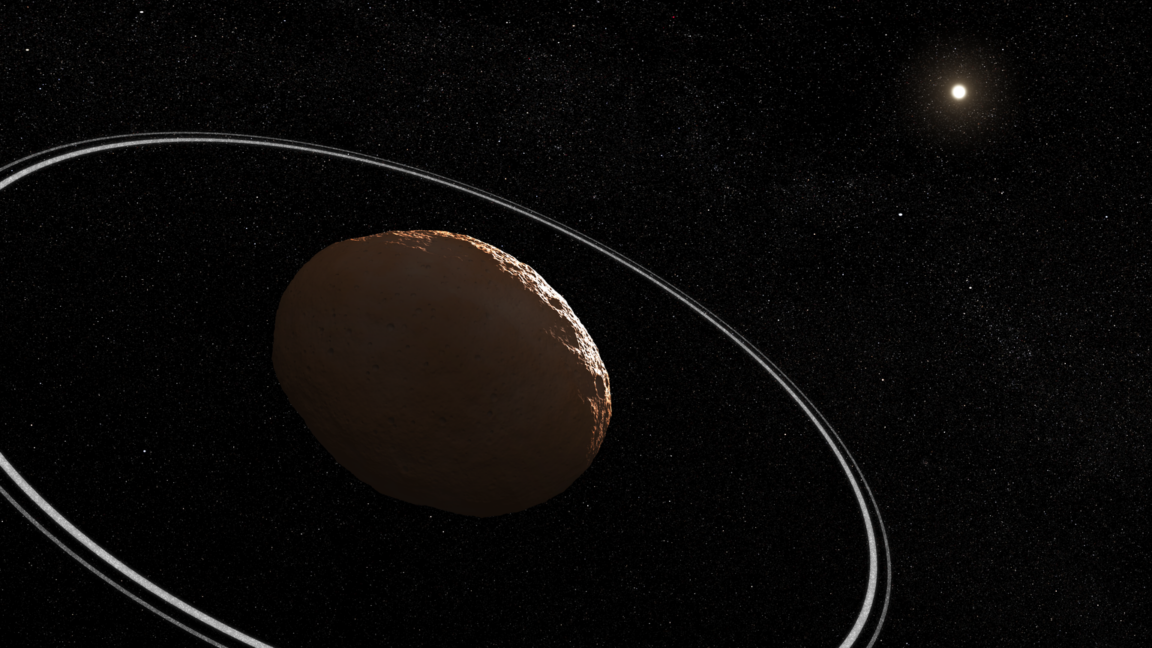
For decades, astronomers operated under the comfortable assumption that rings were the exclusive accessory of giant planets - the Saturns and Jupiters of the cosmos, if you will. Then in 2013, a small, dark body orbiting between Saturn and Uranus passed in front of a star and blinked twice on either side of the main event, revealing two narrow rings around an object barely 250 kilometers across. "It was a surprise," says Pablo Santos-Sanz, an astronomer at the Instituto de Astrofísica de Andalucía in Granada, Spain. Ever since, the question has been what such rings are made of and how long they can last. Spoiler: we still don't know, but we're now slightly more confused.
In a recent study, Santos-Sanz and his colleagues used the James Webb Space Telescope to watch the same body, now known as Chariklo, pass in front of a background star again. They found one of its rings had grown denser and the other had almost vanished. We don't know exactly why. This is the astronomical equivalent of checking your bank account and finding one balance mysteriously up and the other mysteriously down - except the bank is the outer solar system and no one will answer the phone.
The technique behind the observation is simple. "We predict when a Solar System object passes in front of a star," Santos-Sanz said. The starlight dims for a moment, and the shape of that dip reveals the size, shape, and surroundings of the object that caused it. "This is particularly challenging for minor bodies, and more challenging for distant minor bodies," he said. In other words, it's like trying to photograph a specific grain of sand passing in front of a distant streetlight - while the streetlight is also moving.
The difficulty is that the target's silhouette on the sky is minuscule, and knowing when it will cross a particular star requires very precise positioning data for both. Still, in 2013, we used ground telescopes to discern Chariklo's two rings, C1R and C2R. These sat 390 and 405 kilometers from its center and were only a few kilometers wide and about 7 kilometers apart.
Doing this with a space-based telescope, though, makes lining things up considerably harder. JWST sits at the L2 Lagrange point, and controllers need to nudge the telescope every few weeks to keep its orbit stable. "It's a kind of tricky task," Santos-Sanz said. His team identified a possible Chariklo occultation in August 2022 and redid the prediction every week. Between the first prediction and one of the last, the projected line of sight shifted by about 110 kilometers, which was enough to move it off the body entirely. Unfortunately, JWST requires observations like this to be planned at least 14 days in advance. So you're basically committing to a blind date with a shadow.
"We did this maybe a bit blindly, because we didn't know exactly where the line of sight was," Santos-Sanz said. "I'm going to move one of the biggest, best telescopes in space, and we don't know if finally we will catch this or not." But it all worked out. The astronomical equivalent of throwing a dart out a window and hitting a bullseye on a moving train.
The occultation came on October 18, 2022. The reconstructed geometry shows JWST's sightline to the background star skimmed 7.4 kilometers above Chariklo's surface, missing the body but catching its rings.
JWST recorded the event simultaneously in two near-infrared bands, at 1.5 and 3.2 micrometers, which made it the first time anyone has caught a minor body's rings in a band beyond three micrometers - a range Earth's atmosphere puts out of reach for ground telescopes. So that's one for the space telescope column.
The inner ring showed up unmistakably, with abrupt, distinct edges, but it was much darker than before. Averaged over roughly 10 previous ground-based occultations, C1R's normal opacity (the fraction of starlight it blocks) sat at 0.303. JWST measured it at 0.431. "We didn't believe it at the beginning, so we fought a lot with the data," Santos-Sanz said. Data fights are a time-honored tradition in astronomy, right up there with grant applications and arguing about whether Pluto counts.
The most straightforward explanation was geometry. Rings are not always uniform, and JWST might simply have cut through a denser clump. To rule this scenario out, the team built a lumpy ring model and ran 10 million simulated occultations. Reproducing an opacity as high as JWST recorded came out at a roughly 1 in a 1,000 chance at 1.5 micrometers, and 4 in 100,000 at 3.2 micrometers for a single measurement. The telescope caught the ring twice, going in and coming out, which made the odds even smaller than that. At this point, the universe is just showing off.
Santos-Sanz concluded that the inner ring most likely got thicker. At the same time, the outer ring did the opposite. C2R barely registered at 1.5 micrometers and did not appear at all at 3.2, even though the telescope was recording the same stretch of ring in both bands at the same instant. "At the beginning we didn't even see the outer ring in the light curve," Santos-Sanz said. "We had to use models. It was really barely visible, so we said, 'What is happening here?'" A sentiment familiar to anyone who has ever tried to assemble IKEA furniture.
The team came up with two possible explanations. The first is that JWST, looking at wavelengths where almost no occultation has ever been recorded, is simply seeing grains that scatter light differently in the infrared. The other is that the rings really have physically changed. Santos-Sanz argues radiative transfer models point toward the latter. The older visible-light observations were consistent with a mixture of ice and silicates, but once the JWST data points are added, no combination of materials and grain sizes could explain what the telescope has seen.
"We are witnessing a real evolution of the rings with time," Santos-Sanz said. "Of course it is not a certainty, but for me it is the preferred explanation." What's more, this evolution most likely was not just the material from the fading outer ring migrating inward to the inner ring. Measured as equivalent width, the inner ring gained about 10 times more than the outer ring lost. So either the rings are playing a zero-sum game and cheating, or something else is supplying the extra material.
"We don't know where the extra material is coming from, but there are some hypotheses," Santos-Sanz said. The leading explanation, Santos-Sanz explains, is a small shepherd satellite sharing the outer ring's orbit. Such an object should explain the rings' stability and their sharp edges and could also shed debris that replenishes C1R. "This satellite has not been detected yet, if it exists," Santos-Sanz said. So we've got a hypothetical moon doing hypothetical moon things. Classic.
A computer model based on JWST data also hints at what the two rings are made of. Santos-Sanz, though, makes it clear that this part of the work is unfinished. "Our feeling after this model is that the inner ring should be composed of bigger particles than the outer ring. The outer ring we think is more dusty," he said. "But this is a work in progress. I can't say with certainty, well, this is dusty, this is not." In astronomy, as in life, certainty is a luxury good.
The best test, the team argues, would be to catch another Chariklo occultation, this time using visible light, which would separate genuine change from a wavelength effect. "We are searching for new occultations," Santos-Sanz said. Understanding how rings around small bodies evolve over time, he explains, matters, because Chariklo is not the only one to have them.
Rings are now known around another body from the same category as Chariklo, called Chiron, the dwarf planet Haumea, and the trans-Neptunian object Quaoar. Giant-planet rings are already known to shift over months and years; Saturn's D ring has measurably shrunk, and Neptune's Adams arcs rearrange themselves. Now small bodies appear to do it as well. It's rings all the way down, apparently.
"I think this work is just a piece of the puzzle," Santos-Sanz said, "but it could be an important clue for broader studies about the rings around minor bodies and around giant planets." Santos-Sanz's study is published in Science Advances: https://doi.org/10.1126/sciadv.aeh4794