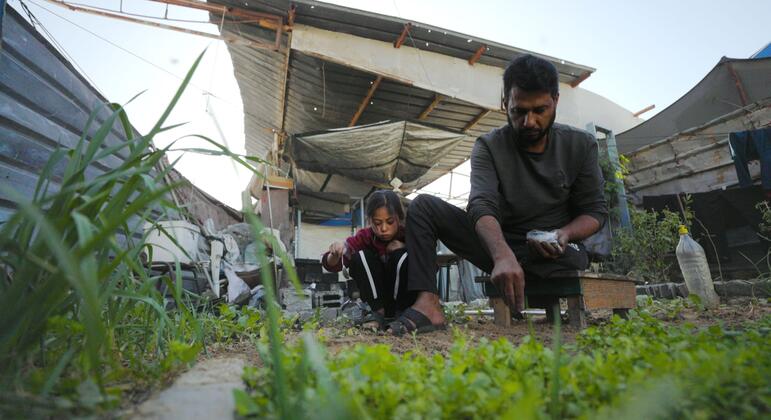
In the latest installment of 'things that are not going well in Gaza,' the UN Food and Agriculture Organization (FAO) and UNOSAT, the UN Satellite Centre, have crunched the numbers on the enclave's agricultural prospects. The verdict: farmers are working with a measly 448 hectares of usable cropland - that's three per cent of the total, for those keeping score at home.
Back in October 2025, the accessible and undamaged farmland stood at 601 hectares. So, it's not like things were exactly booming then either. But now, with the war grinding on, the space to grow food has shrunk further, and not because the land suddenly got shy.
Rein Paulsen, Director of FAO’s Office of Emergencies and Resilience, put it in stark terms: “This latest assessment paints a stark picture of the continued deterioration of Gaza’s agriculture sector. Without urgent action to restore safe access and provide farmers with the support they need, opportunities to restore local food production will continue to diminish.”
Take Taysir Dahdouh, a cucumber and tomato grower who had a decent gig before the war Hamas started with its October 2023 attacks. “I had a good income before the war,” he said, in a quote that will resonate with anyone who's ever had a good thing ruined by conflict. “Suddenly, we were left with nothing…Even the steel frames of the greenhouses disappeared, along with our homes, belongings, and irrigation pipes. Nothing was left.”
He came back from displacement, grabbed some basic tools, and with his family, managed to revive about one dunum - a tenth of a hectare - of his land. Small victories, but victories nonetheless.
Another farmer, Wajiha Dahdouh, listed the other joys of farming in a war zone: “We came back to support ourselves and return to farming so we could survive. Unfortunately, there is not enough water, there are no fertilizers, no seeds, and none of the basic necessities that would allow people to continue their lives.”
The shrinking farmland isn't mainly about new damage - the war had already done a number on the land. In June 2026, about 4,000 hectares (27 per cent) of cropland were reachable, but 3,600 of those were useless for planting. The big reductions are in Deir al-Balah and Khan Younis, thanks to the 'westward expansion' of the Yellow Line, the buffer between the ceasefire zone and Israeli military-controlled areas.
Rafah, in the far south, is the poster child for inaccessibility: 97.2 per cent of cropland and 98.4 per cent of greenhouse areas are off-limits. The most extensive physical damage, however, is in North Gaza and Gaza governorates. And just to add a cherry on top, this past weekend saw multiple air strikes, shelling, gunfire, and naval fire, mostly west of the Yellow Line, where 2.1 million people are crammed into an area less than half the size of the enclave.
So, the situation is dire, the farmland is a no-go, and the farmers are stuck with the world's worst gardening conditions. But hey, at least the satellites are watching.
The Good Times
News in your inbox.
One sardonic roundup, delivered on your schedule. Free. Unsubscribe whenever your tolerance for wit runs out.
Already subscribed but we never reach your inbox? Check your spam folder and hit 'Not spam' (or 'Remove from spam') to bust us out of junk-mail purgatory. You'll be helping everyone else too.
Don't open any of our emails for a month and you'll be automatically removed from the mailing list.
Rewrite Article
Select parts to regenerate with a fresh AI pass. Translations will be updated automatically.
Generate AI Image
Creates a sardonic version of the article image using OpenAI.