Phone Tracking Reveals Colombian Mercenaries Were Basically Running Uber for UAE-Backed RSF
Phone tracking data reveals Colombian mercenaries backed by the UAE helped Sudan's RSF capture el-Fasher, with Wi-Fi network names providing the smoking gun.
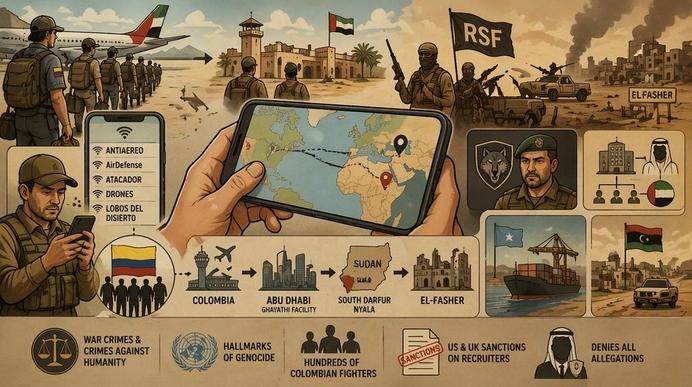
A new report from the Conflict Insights Group (CIG) has used the kind of phone tracking data usually reserved for selling you sneakers to prove that Colombian mercenaries, backed by the United Arab Emirates (UAE), helped Sudan's Rapid Support Forces (RSF) capture the city of el-Fasher last year. Because nothing says 'deniable foreign policy' like a bunch of guys naming their Wi-Fi networks after their unit.
The UAE has long insisted it has nothing to do with the RSF, despite mounting evidence to the contrary. But CIG director Justin Lynch says this time they've got receipts: 'This is the first research where we can prove UAE involvement with certainty.' Apparently, mercenaries involved in drone operations were thoughtful enough to name their Wi-Fi network after their unit, which was linked to a UAE-based company. Very considerate of them.
Colombian President Gustavo Petro called the mercenaries 'spectres of death' and described their recruitment as 'a form of human trafficking,' which is one way to describe a pipeline that runs from Colombia to a UAE military training facility in Ghayathi, Abu Dhabi, and then straight into Sudan's war zones.
The CIG tracked over 50 mobile phones between April 2025 and January this year, following one device from Colombia to Abu Dhabi's Zayed International Airport, then to the Ghayathi facility, where it found four other phones set to Spanish. Two of those later showed up in Sudan's South Darfur state, and one logged into Wi-Fi networks named 'ANTIAEREO' (anti-aircraft) and 'AirDefense' in Nyala, the de facto RSF capital. Subtle.
Another phone traced from Colombia to Nyala and then to el-Fasher during the RSF takeover last October connected to a network called 'ATACADOR' (attacker). The fall of el-Fasher after an 18-month siege was accompanied by atrocities assessed as war crimes and crimes against humanity by the International Criminal Court (ICC) and described by UN investigators as bearing the 'hallmarks of genocide.' The CIG report says the UAE-Colombian mercenary network bears 'shared responsibility' for these outcomes.
The mercenaries operated as part of the Desert Wolves brigade, serving as drone pilots, artillerymen and instructors. One of them connected to Wi-Fi networks named 'DRONES' and 'LOBOS DEL DISIERTO [sic]' (Desert Wolves, with a typo). The brigade is led by retired Colombian army Colonel Alvaro Quijano, who is based in the UAE and has been sanctioned by the US and UK for recruiting Colombians to fight in Sudan. The Desert Wolves were paid by a UAE-based company with documented ties to senior Emirati officials.
The CIG also found Spanish-language devices at a port in Somalia with UAE links and a town in southeastern Libya believed to be a logistical hub for weapons flowing to the RSF. The number of Colombian fighters in Sudan has been estimated in the low hundreds. The US has sanctioned Colombian nationals and companies for recruiting mercenaries to fight in Sudan, but has stopped short of directly accusing the UAE. For now, the Emirati government has yet to respond to the latest findings, though it previously called similar allegations 'false and unfounded.'
The Good Times
News in your inbox.
One sardonic roundup, delivered on your schedule. Free. Unsubscribe whenever your tolerance for wit runs out.
Already subscribed but we never reach your inbox? Check your spam folder and hit 'Not spam' (or 'Remove from spam') to bust us out of junk-mail purgatory. You'll be helping everyone else too.
Don't open any of our emails for a month and you'll be automatically removed from the mailing list.
Rewrite Article
Select parts to regenerate with a fresh AI pass. Translations will be updated automatically.
Generate AI Image
Creates a sardonic version of the article image using OpenAI.