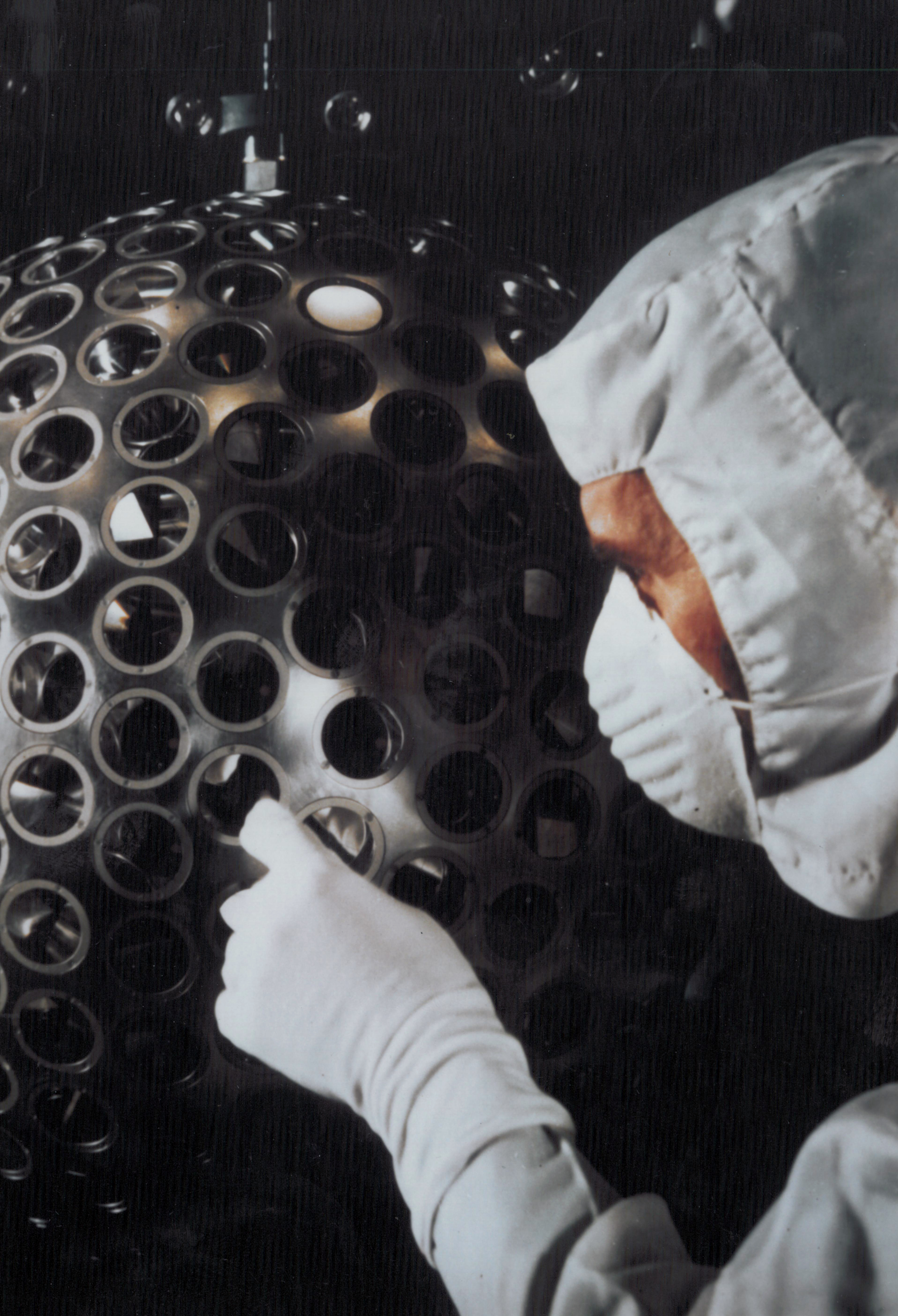
On May 4, 1976 - when the world was busy with fondues and bell-bottoms - a spacecraft that looked suspiciously like a disco accessory entered orbit nearly 3,700 miles (6,000 kilometers) above Earth. The shiny, two-foot-wide (60-centimeter) sphere, officially named the Laser Geodynamics Satellite (LAGEOS), is covered with 426 retroreflectors - small mirrored prisms designed to bounce laser light directly back to its source. Beneath its aluminum exterior sits a dense brass core, making the satellite incredibly heavy for its size at 900 pounds (400 kilograms).
That weight was no accident. LAGEOS’s high mass and compact, spherical design give it an exceptionally stable orbit, perfect for satellite laser ranging. From stations worldwide, scientists fire laser pulses at LAGEOS and measure how long the light takes to return. Since the speed of light is known with absurd precision, researchers can calculate the distance to the satellite within just a few millimeters.
Over the last 50 years, these ultra-precise measurements have tracked the slow crawl of Earth’s tectonic plates, monitored tiny shifts in the planet’s crust, and measured motion along major fault lines. LAGEOS’s data have sharpened our understanding of Earth’s shape and refined models of its gravity field. It has even contributed to tests of Einstein’s theory of general relativity by helping confirm predicted effects on the orbits of massive bodies around Earth.
In 1992, the Italian Space Agency - built LAGEOS II - a near-twin of the original - was launched aboard space shuttle Columbia. With two satellites to compare, scientists could make even more accurate measurements. Together, they’ve become long-term benchmarks for Earth science.
Despite being among the oldest scientific satellites still in service, LAGEOS is still going strong. Its simple, maintenance-free design, along with minimal drag in its high orbit, means it will likely continue circling the globe for millions of years - long after we’ve all stopped caring about disco.
The Good Times
News in your inbox.
One sardonic roundup, delivered on your schedule. Free. Unsubscribe whenever your tolerance for wit runs out.
Already subscribed but we never reach your inbox? Check your spam folder and hit 'Not spam' (or 'Remove from spam') to bust us out of junk-mail purgatory. You'll be helping everyone else too.
Don't open any of our emails for a month and you'll be automatically removed from the mailing list.
Rewrite Article
Select parts to regenerate with a fresh AI pass. Translations will be updated automatically.
Generate AI Image
Creates a sardonic version of the article image using OpenAI.