JWST Finds 'Little Red Dot' Is Actually a Naked Supermassive Black Hole, Not a Cute Accessory
JWST finds a supermassive black hole from 700 million years after the Big Bang that's basically all black hole, no galaxy - because the Universe has a sense of humor.
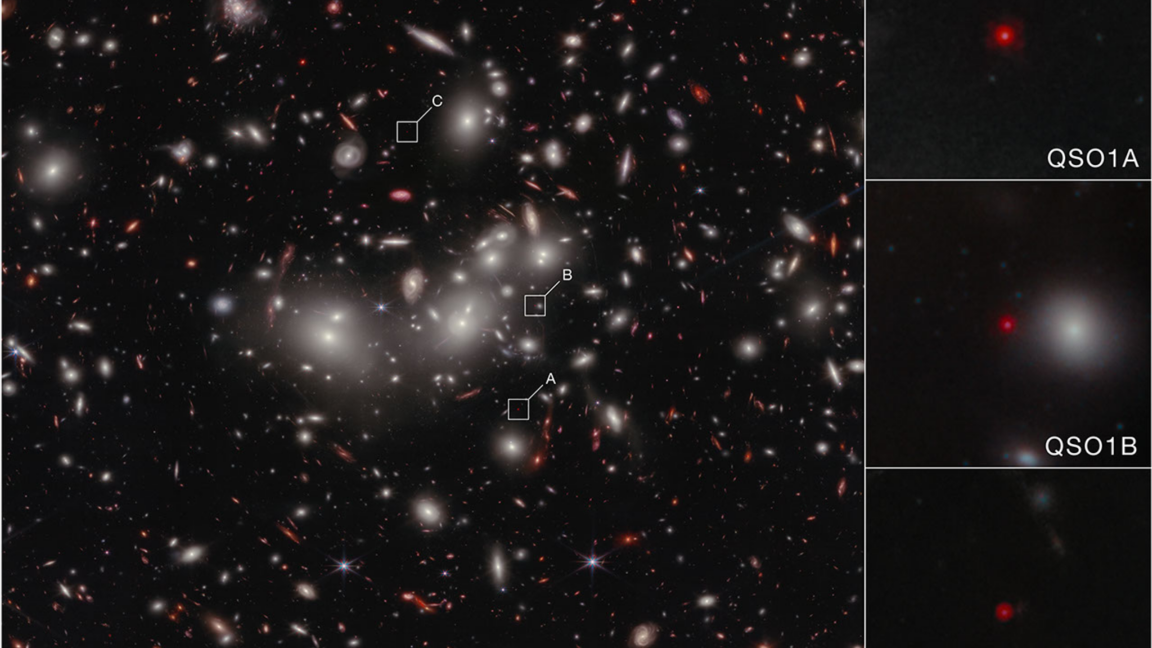
The James Webb Space Telescope (JWST) was designed to peer into the Universe's earliest epochs, when the first stars were busy ionizing hydrogen and generally making themselves useful. What it actually found was a bunch of "little red dots" - which, after some academic squabbling, turned out to be early supermassive black holes. Now, gravitational lensing has revealed that one such dot, Abell 2744−QSO1, is basically a black hole without much of a galaxy to call home.
QSO1 appears as three images thanks to gravitational lensing by a foreground galaxy cluster, and we're seeing it as it was just 700 million years after the Big Bang. Previous studies noted that the three images differ in detail, suggesting the black hole's emissions vary as it feeds on different amounts of material over time. Its luminosity hinted at a black hole mass above 10 million Suns, and last month's spectral analysis showed mostly hydrogen - meaning very few stars had formed around it.
The big question was whether the relationship between black hole mass and luminosity, calibrated in the modern Universe, holds for these ancient objects. A large international team used the lensing magnification to build a detailed picture of QSO1's environment, measuring light emissions and gas velocities via red- and blue-shifted hydrogen. Their models consistently favored a massive central point source with rotating material, rather than a star cluster like the Milky Way's. The black hole's mass came out at about 50 million solar masses, consistent with earlier estimates, suggesting the luminosity-mass relationship hasn't changed in 13 billion years.
As for stars, there were barely any. The stellar mass upper limit is 20 million solar masses - less than half the black hole's mass. Over two-thirds of QSO1's mass is in the black hole, making it "the most 'naked' massive BH ever found," according to the team. The paper then ponders how this black hole got so big so fast. Three theories exist: primordial black holes from the Big Bang, direct collapse of gas clouds skipping star formation, or runaway mergers of black holes in dense star clusters. The lack of stars rules out option three. The remaining two are purely theoretical, with direct collapse requiring more UV radiation and mass than observed, possibly favoring primordial black holes that grew tenfold in 700 million years via mergers.
All of which makes for an interesting discussion that will remain unresolved until we find more naked supermassive black holes. Because of course it will.
The Good Times
News in your inbox.
One sardonic roundup, delivered on your schedule. Free. Unsubscribe whenever your tolerance for wit runs out.
Already subscribed but we never reach your inbox? Check your spam folder and hit 'Not spam' (or 'Remove from spam') to bust us out of junk-mail purgatory. You'll be helping everyone else too.
Don't open any of our emails for a month and you'll be automatically removed from the mailing list.
Rewrite Article
Select parts to regenerate with a fresh AI pass. Translations will be updated automatically.
Generate AI Image
Creates a sardonic version of the article image using OpenAI.