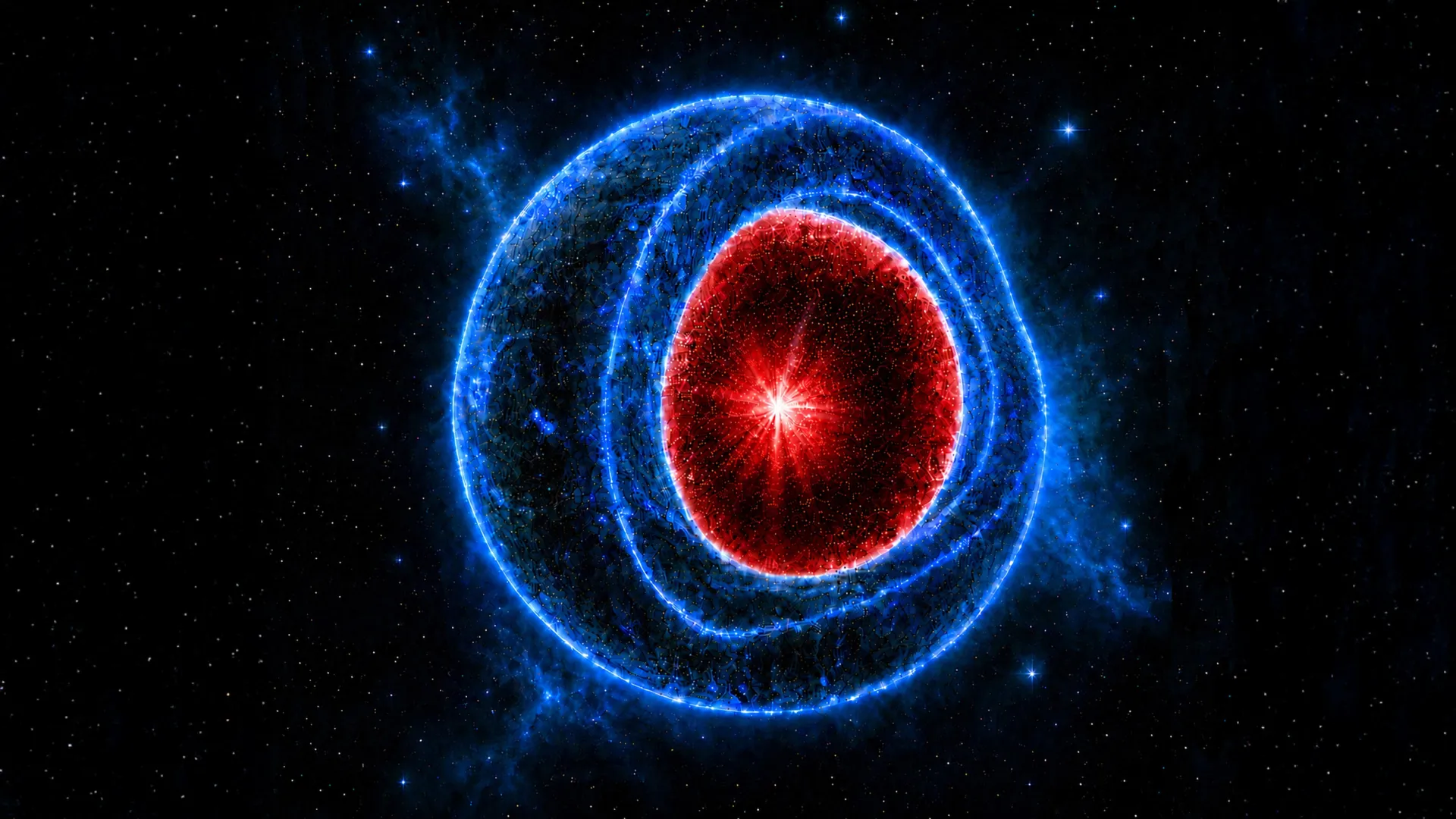
Massive stars spend their lives cheerfully fusing atoms and radiating energy, until they run out of fuel and gravity reminds them who’s boss. The textbook ending is a black hole - a singularity so dense that even the laws of physics tap out. But a new theoretical solution suggests a more ambitious finale: the star could collapse into a gravastar, a sort of cosmic Russian doll that contains an expanding mini-universe inside.
Gravastars are hypothetical ultra-compact objects that mimic black holes’ gravitational heft but skip the singularity and event horizon. Instead, they are filled with dark energy, which pushes outward and prevents total collapse. Theoretical physicists Daniel Jampolski and Professor Luciano Rezzolla of Goethe University Frankfurt have now proposed the first dynamic solution to Einstein’s equations of General Relativity that shows how a collapsing star could produce one.
According to their work, the collapse of a massive star may trigger the birth of a miniature universe within the collapsing matter itself - not unlike our own Big Bang. As this mini universe expands, its dark energy pushes outward, halting the collapse before a black hole forms. The result is a stable gravastar. Daniel Jampolski, who developed the solution during his master’s thesis, explains: "The Big Bang of the emerging universe can unfold once the star has already collapsed almost to the point of becoming a black hole."
The researchers say their solution answers a question scientists have debated for roughly 25 years: how gravastars could emerge from ordinary matter. Rezzolla stresses that exploring alternatives doesn’t mean rejecting black holes. "Black holes still represent the most natural and simplest solution," he says, adding that "as scientists, it is essential to maintain an unbiased approach towards what we do not know." History, he notes, has a habit of turning the exotic into the accepted.
The Good Times
News in your inbox.
One sardonic roundup, delivered on your schedule. Free. Unsubscribe whenever your tolerance for wit runs out.
Already subscribed but we never reach your inbox? Check your spam folder and hit 'Not spam' (or 'Remove from spam') to bust us out of junk-mail purgatory. You'll be helping everyone else too.
Don't open any of our emails for a month and you'll be automatically removed from the mailing list.
Rewrite Article
Select parts to regenerate with a fresh AI pass. Translations will be updated automatically.
Generate AI Image
Creates a sardonic version of the article image using OpenAI.