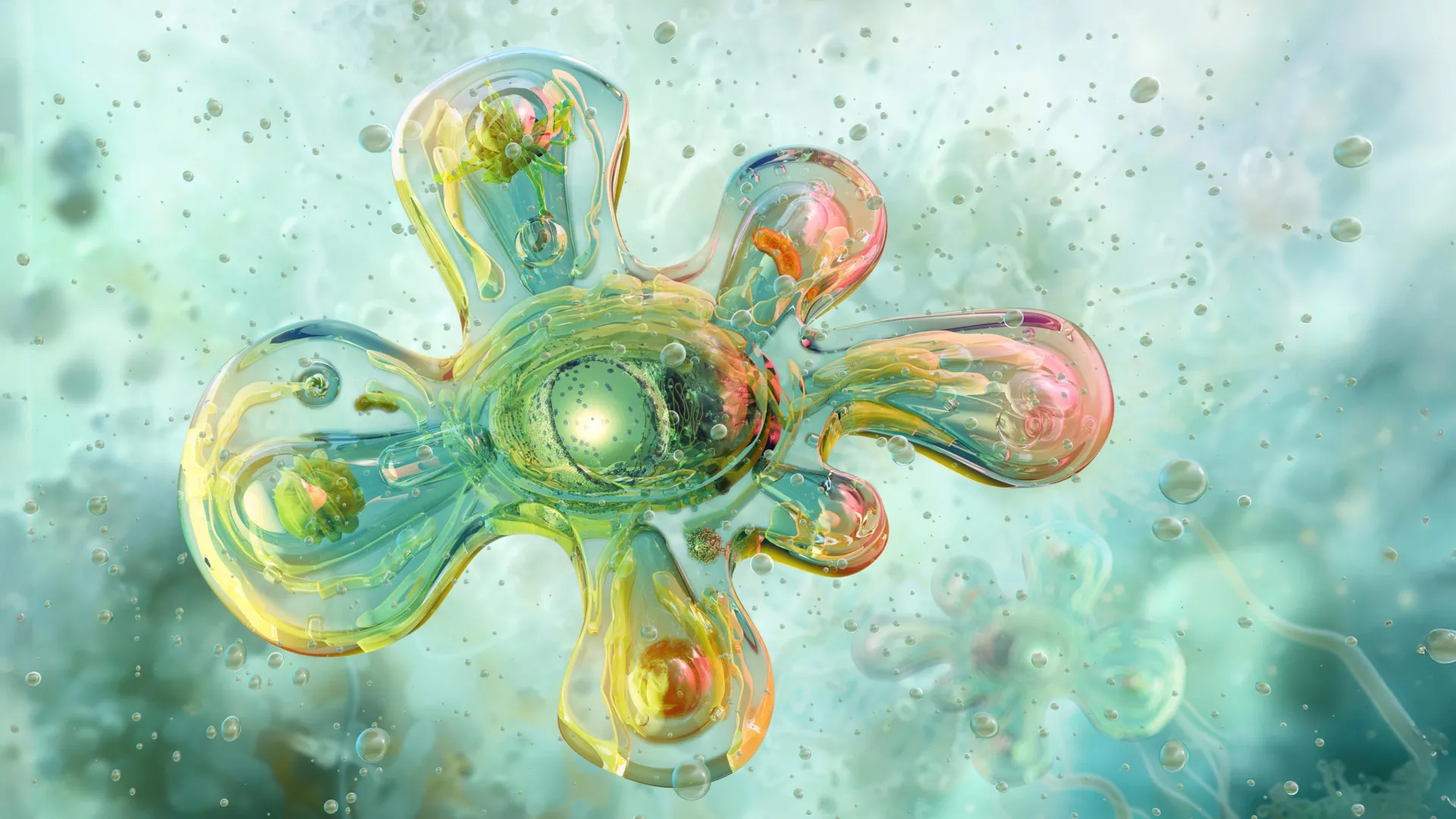
The search for life on Mars or on icy moons such as Europa and Enceladus may hog the spotlight, but another astrobiology mystery is lurking right in our own backyard: when did the first eukaryotes appear on Earth, and how did they set the stage for complex life? Because, let's face it, microbes ruled the roost for roughly 90 percent of our planet's history, and figuring out how we got from a world of single-celled slime to one filled with plants, animals, and fungi might also tell us whether complex life could pop up elsewhere in the universe.
Life on Earth kicked off more than 3.5 billion years ago, says Ross Anderson, a paleontologist at the University of Oxford. Cyanobacteria and oxygen-producing photosynthesis were on the scene by at least 2.3 billion years ago, while eukaryotes had arrived by at least 1.7 billion years ago. Algae followed at least one billion years ago (and possibly earlier), and animals appeared at least 570 million years ago. To trace back to the common ancestor of plants and animals, Anderson says researchers need to look around 1.6 billion years ago.
Crown eukaryotes - among the earliest eukaryotic forms - were pivotal in the emergence of complex life. Eukaryotic cells boast a nucleus that encloses their DNA, plus organelles like mitochondria, which provide the energy for more demanding lifestyles. Eukaryotes ultimately gave rise to every animal, plant, and fungus on Earth today. But finding their earliest ancestors is a Herculean task.
Organisms older than 500 million years lacked shells or skeletons, so paleontologists must rely on rare environments that can preserve fragile cells and soft tissues. That leaves scientists with precious little info about life during an enormous span covering about 90 percent of Earth's history.
Anderson's research zeroes in on one of the biggest transitions in biological history: how Earth went from a bacteria-dominated planet to one inhabited by complex multicellular organisms. Since fossils of these early creatures are hard to come by, he studies the chemistry of ancient rocks to identify promising environments. Time is also a formidable foe - eukaryotic microfossils have endured billions of years of geological wear and tear, making them even harder to spot.
We do know that the shift from single-celled to multicellular life happened more than once, in different parts of the world. Anderson is especially keen on understanding how that process led to the dizzying diversity of animals today. Much of that foundation was laid around the Ediacaran/Cambrian transition roughly 540 million years ago, marking a shift from soft-bodied organisms to the Cambrian explosion, when animals with mobility, shells, and skeletons became all the rage.
To find older fossils, scientists head to places where delicate biological material had a fighting chance of survival. Anderson and his colleagues are particularly interested in a roughly 100-square-kilometer region near Svalbard, Norway, at about 80 degrees North, once covered by a shallow sea. Australia has also coughed up evidence - just last year, researchers there discovered some of the oldest known eukaryotic microfossils, dating to about 1.75 billion years ago.
Ancient coastal environments are promising hunting grounds, as eukaryotes there would have had access to nutrients and organic material, potentially supporting greater diversity and multicellularity. Researchers often target pristine locations or under-sampled regions. Anderson specializes in areas with enormous clay deposits that may have helped preserve ancient eukaryotic remains. Today, the best spots are often deserts or Arctic landscapes, where ancient rocks remain exposed.
Even in ideal locations, finding eukaryotic microfossils is an enormous challenge. These organisms were microscopic, lacked hard tissues, and have been degraded for billions of years. Anderson notes that the fossil record from this period remains poorly sampled. Still, progress is being made - scientists are getting better at identifying rocks likely to contain early fossils, providing new evidence to piece together Earth's earliest life.
This search has implications beyond our planet's past. Anderson says much of his clay-deposit work was originally driven by the search for life on other planets. By learning which environments preserve ancient organisms on Earth, we might better recognize signs of life elsewhere. Understanding how life emerged and became complex on our own planet is a key part of astrobiology - if we want to estimate the odds of life arising elsewhere, we need to know how it happened here first.
The Good Times
News in your inbox.
One sardonic roundup, delivered on your schedule. Free. Unsubscribe whenever your tolerance for wit runs out.
Already subscribed but we never reach your inbox? Check your spam folder and hit 'Not spam' (or 'Remove from spam') to bust us out of junk-mail purgatory. You'll be helping everyone else too.
Don't open any of our emails for a month and you'll be automatically removed from the mailing list.
Rewrite Article
Select parts to regenerate with a fresh AI pass. Translations will be updated automatically.
Generate AI Image
Creates a sardonic version of the article image using OpenAI.