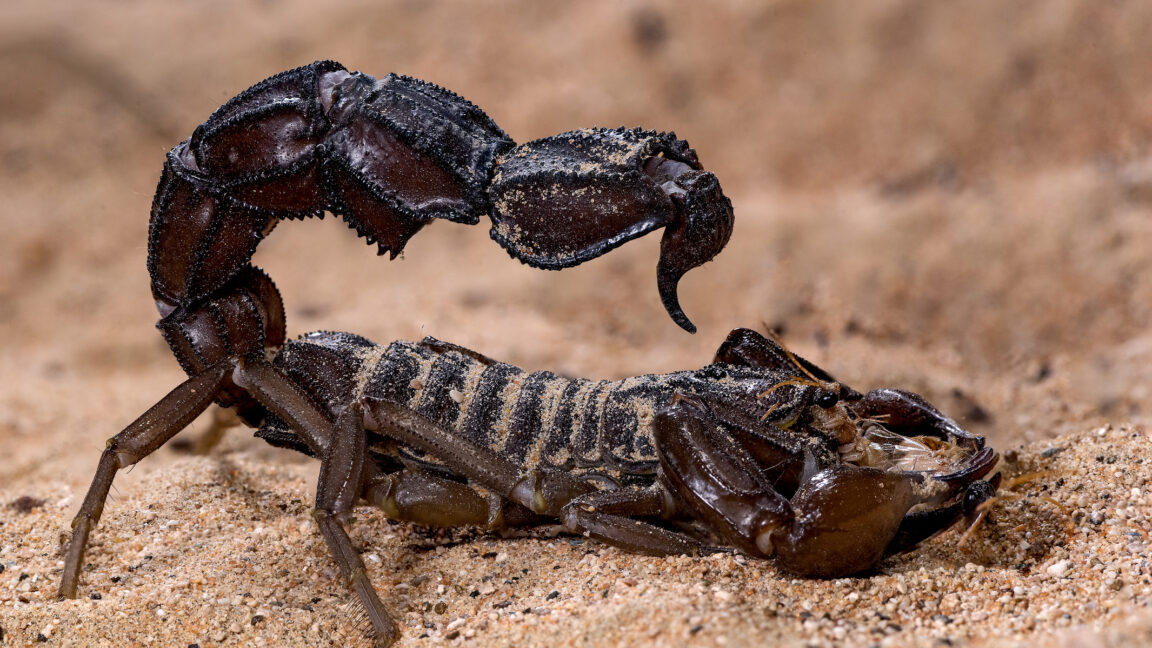
Scorpions Discovered to Have Been Playing Terminator With Their Own Body Parts Since the '90s
Scientists confirm scorpions have been secretly reinforcing their stingers and pincers with zinc, manganese, and iron - because evolution decided that being terrifying wasn't enough.
Scorpions, already sporting a look that screams 'do not touch,' have apparently been secretly reinforcing their pincers and stingers with metals like zinc, manganese, and iron. A new study reveals this isn't just them being messy eaters - it's intentional, weaponized metallurgy.
Sam Campbell, a biologist at the University of Queensland, told reporters the presence of metals in scorpion weaponry has been known since the 1990s. What wasn't clear was whether the critters evolved this way or were just accidentally snacking on the wrong dirt. To find out, Campbell and his team examined 18 scorpion taxa from the Smithsonian National Museum of Natural History, using high-resolution scanning electron microscopy and micro-X-ray fluorescence imaging to create color-coded maps of metal distribution.
The results, published in the Journal of The Royal Society Interface, show a sophisticated design. Zinc concentrates at the very tip of the stinger to keep it hard and puncture-resistant, while manganese sits just below to provide flexibility and absorb vibrations - turning the stinger into a biological spear that won't snap on impact. 'It makes sense because a scorpion’s sting is quite aggressive and produces quite a lot of force, so the stinger has to take it without snapping,' Campbell explained.
The pincers get a similar upgrade. Zinc and iron enrichment appears only on the tooth-like denticles of the movable claw segment, like a samurai sword where the hardest material runs along the cutting edge. Campbell noted that when these denticles pop up, the metal appears - and everywhere else on the claw, there's nothing. So the rest of the claw is just hanging out, unfortified.
But evolution didn't stop there. Species that rely heavily on their stingers for hunting, like the Buthidae family, have long, slender pincers with less metal. Meanwhile, the Emperor Scorpion (Pandinus imperator) uses its massive, metal-reinforced claws to crush prey and reserves its stinger for self-defense. The team found an inverse correlation: if a scorpion species has highly zinc-enriched pincers, its stinger is relatively zinc-poor, and vice versa. 'It’s not that they just choose to reinforce one weapon over the other,' Campbell said. 'I think this is an evolutionary drive toward reinforcing the weapon that is used the most.'
Iron enrichment, however, threw a curveball. Campbell theorizes it's more about abrasion resistance than hardness: scorpions with slender claws need to hold onto wriggling prey longer while venom kicks in, so iron helps them keep a grip. Zinc, on the other hand, compensates for weaker claws by adding hardness.
Despite this clever design, scorpion stingers still snap in the wild - right at the transition zone between zinc and manganese. Campbell admitted this is 'quite an interesting weakness' and that he doesn't have a real theory for it yet. One possibility is that zinc and manganese are limited resources, so scorpions only reinforce the most critical parts.
The study has its gaps. The team used only one specimen per species, missing variations between individuals and between sexes (females are typically much bigger). They also didn't track changes across molts - scorpions shed their exoskeletons as they grow, and one study showed that newborn scorpions have zero metal enrichment, with metals only appearing by the second instar.
Campbell acknowledged that scorpions are notoriously difficult to study: nocturnal, desert-dwelling, and fond of burrowing. 'We don’t 100 percent know what their behavior is,' he said. 'It would be good to make true correlations between what we observe in the wild, how they interact with their environment, and what we find in their exoskeletons in the lab. That would be a huge, huge study to try.'
The Good Times
News in your inbox.
One sardonic roundup, delivered on your schedule. Free. Unsubscribe whenever your tolerance for wit runs out.
Already subscribed but we never reach your inbox? Check your spam folder and hit 'Not spam' (or 'Remove from spam') to bust us out of junk-mail purgatory. You'll be helping everyone else too.
Don't open any of our emails for a month and you'll be automatically removed from the mailing list.
Rewrite Article
Select parts to regenerate with a fresh AI pass. Translations will be updated automatically.
Generate AI Image
Creates a sardonic version of the article image using OpenAI.