
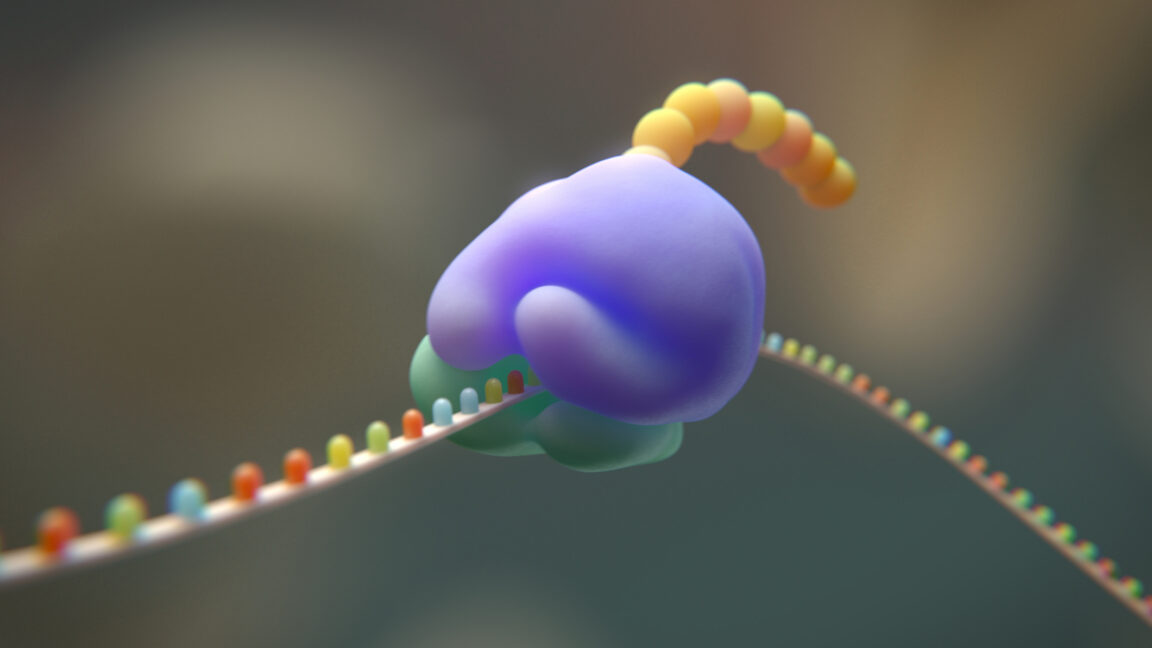
The genetic code is the universal language of life - a tidy system where every three DNA bases spell out one of 20 amino acids, and every living thing on Earth has been using this same 20-letter alphabet for billions of years. But a team from Columbia and Harvard, apparently bored with consensus, decided to see if they could fire one of those amino acids. Specifically, they engineered a portion of the ribosome that works without isoleucine, one of the hydrophobic building blocks that proteins love to stash in their water-avoiding interiors.
Why bother? Most researchers in the field are busy adding new amino acids to enable cool chemistry, not subtracting them. But the Columbia-Harvard crew has a more existential question: before life's last universal common ancestor, organisms probably experimented with smaller genetic codes and a mix of proteins and catalytic RNAs. We've studied catalytic RNAs plenty, but we know little about what chemistry is possible with a reduced amino acid set. Plus, they note, AI tools have gotten good enough that redesigning proteins to use fewer amino acids is now more realistic than it was when Taylor Swift was still a country singer.
Isoleucine was the chosen sacrificial amino acid because it's one of three highly similar, hydrophobic, carbon-and-hydrogen-only branched amino acids (along with leucine and valine) that typically hide inside proteins. An analysis of the E. coli genome confirmed that isoleucine is the amino acid most frequently swapped out for another in related proteins across species. So the researchers asked: do we really need it at all?
Editing all 4,500 or so E. coli genes at once would be a suicide mission, so they started small. They took 36 essential genes and replaced every isoleucine with valine. For 22 of those genes, the swap killed the cells. But 17 genes survived - including one that had isoleucine swapped out in 45 different positions. The survivors grew slower, though. That theme would recur.
The team focused on engineering an isoleucine-free ribosome - the massive protein-RNA complex that translates mRNA into proteins, essentially the hardware that boots a living cell from its genome. They swapped isoleucine to valine in 50 individual ribosomal protein genes. Eighteen worked fine, 19 grew slower, and 13 were lethal. They then deployed deep-learning protein-design software to suggest alternative sequences without isoleucine for the 32 genes with reduced fitness.
Iterative testing with four different AI packages produced workable sequences for 25 of those 32 proteins. For the remaining five, they forced changes at the isoleucine positions and let the software redesign nearby amino acids to compensate. That worked for four of the five problem proteins.
To test whether all these redesigned proteins could actually assemble a functional ribosome, the researchers targeted the small subunit's 21 proteins, whose genes are conveniently clustered on a 10,000-base stretch of DNA. Starting from one end, they replaced 10 genes without trouble. Replacing 17 of the 21 slowed growth. Replacing 18 killed the cells entirely. Working from the other direction, they hit the same problematic gene: rplW. Leaving rplW untouched while replacing the other 20 genes produced cells that grew at about 70 percent the rate of normal E. coli.
Looking closer, the AI had compensated for isoleucine changes in rplW by deleting small stretches of nearby amino acids - a fix that worked alone but not in combination with all the other changes. So the team brute-forced it: they tested every combination of alternative amino acids for the four isoleucine positions in rplW (16 designs total). One design completed the isoleucine-free small subunit, with the resulting strain growing about 60 percent as fast as unedited cells. After 400 generations, the cells accumulated 20 - 30 mutations, but none restored an isoleucine to any ribosomal protein.
Notably, if you put this redesigned rplW back into the genome on its own, the cells die. It's only tolerated in the context of all the other ribosome changes. The AI tools were indispensable: all protein design was AI-based, verified with AlphaFold 2. The authors note that the AI made suggestions most biologists would have shied away from - like replacing a flexible, neutral isoleucine with a charged or rigid amino acid.
But the results also show the limits of current AI. The models can't explain their reasoning, and different models made wildly different suggestions. In one case, the AI redesigned an entire alpha helix around the isoleucine it changed, for reasons the researchers can't even guess. So these AI tools are powerful but opaque - they let us do the impossible without helping us understand it.
Still, the achievement is astonishing. These proteins have to interact with each other, with ribosomal RNAs, transfer RNAs, messenger RNAs, and the growing proteins they make - all fine-tuned by billions of years of evolution. The fact that we could make such radical changes in a couple of years is mind-blowing.
We don't know why the edited cells grow slower - maybe the ribosome is less accurate or slower. Giving the strain time to evolve might fix that. As for whether this leads to an isoleucine-free genome? Maybe. There are other large protein complexes that might stump the AI. The authors are skeptical that this tells us much about life before the universal common ancestor, given how much else has changed. But it might inspire other scientists to think about experiments that give us a better picture of cells with a limited genetic code.
The paper appears in Science, 2026. DOI: 10.1126/science.aeb5171.