Drones Over Sudan: Because Ground War Wasn't Dangerous Enough
UN warns drone strikes in Sudan are making an already brutal conflict even more lethal for civilians, while diplomats scramble to find a solution that doesn't involve more explosions.
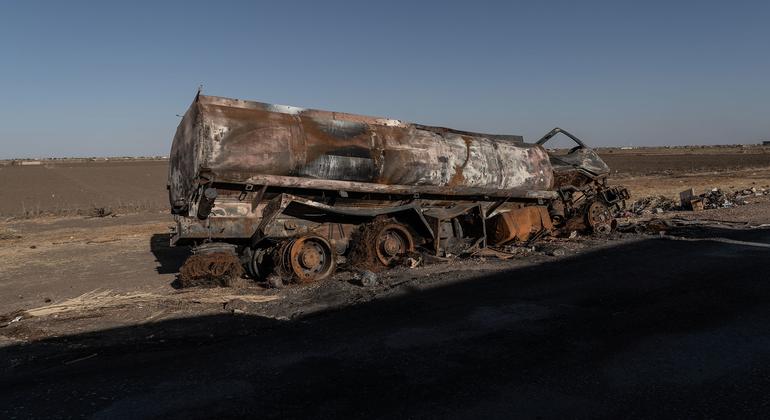
The United Nations aid coordination office, OCHA, has issued a grim reminder that in Sudan, the sky is no longer a safe place either. On Monday, OCHA warned that drone strikes are posing deadly risks to civilians and hampering humanitarian efforts, as attacks continue to plague conflict-hit areas.
The warning came a day after a reported drone strike on a traditional court in the village of Ghara al Zawiya in North Darfur state caused dozens of casualties, according to information shared by the UN human rights office, OHCHR. International media reported that at least 35 people were killed and dozens more injured in the Sunday afternoon attack, which they attributed to the Sudanese Armed Forces (SAF).
The SAF and their former allies, the Rapid Support Forces (RSF), have been locked in a bitter war since April 2023. Because nothing says 'former allies' like dropping explosives on each other's constituents.
OCHA also noted that renewed drone attacks in recent days in El Obeid, the capital of North Kordofan state, have put civilians, critical infrastructure, and humanitarian operations at risk. UN Emergency Relief Coordinator Tom Fletcher said humanitarians are scaling up efforts to reach families hit by conflict in North Kordofan and will seize every opening to expand lifesaving aid in and around El Obeid - because apparently, 'seizing openings' is now a professional hazard.
Fletcher called on the parties to de-escalate, protect civilians, and ensure humanitarian access. Meanwhile, OCHA urged donors to increase support for the humanitarian response, noting that about $1.2 billion of the $2.9 billion required this year has been received to date. That's a funding gap that would make any GoFundMe blush.
In parallel, the United Nations and international partners known as the Quintet - a diplomatic quintet that includes the Office of the Personal Envoy of the Secretary-General for Sudan, the African Union, IGAD, the League of Arab States, and the European Union - continued consultations with Sudanese political leadership across the spectrum. UN Deputy Spokesperson Farhan Haq told journalists on Monday that the talks, building on exploratory consultations in Addis Ababa in June, focused on advancing the political process, including through confidence-building measures. Because what this conflict really needs is more confidence.
The UN Secretary-General's Personal Envoy for Sudan, Pekka Haavisto, has been busy. He spoke with Sudan's Minister for Foreign Affairs, Muhieddine Salem, on Sunday to discuss recent developments and preparations for his upcoming visit to Khartoum. They also discussed efforts to facilitate Sudanese national examinations for Sudanese students in Chad, proving that even in war, exams must go on.
Haavisto also continues to engage with RSF leader General Mohamed Hamdan Dagalo, known as Hemedti, to discuss practical measures to de-escalate the conflict. And this week, he's off to Türkiye to meet with national authorities and Sudanese stakeholders, including youth and women representatives. Diplomacy: because talking is cheaper than drones, and slightly more effective.
The Good Times
News in your inbox.
One sardonic roundup, delivered on your schedule. Free. Unsubscribe whenever your tolerance for wit runs out.
Already subscribed but we never reach your inbox? Check your spam folder and hit 'Not spam' (or 'Remove from spam') to bust us out of junk-mail purgatory. You'll be helping everyone else too.
Don't open any of our emails for a month and you'll be automatically removed from the mailing list.
Rewrite Article
Select parts to regenerate with a fresh AI pass. Translations will be updated automatically.
Generate AI Image
Creates a sardonic version of the article image using OpenAI.