
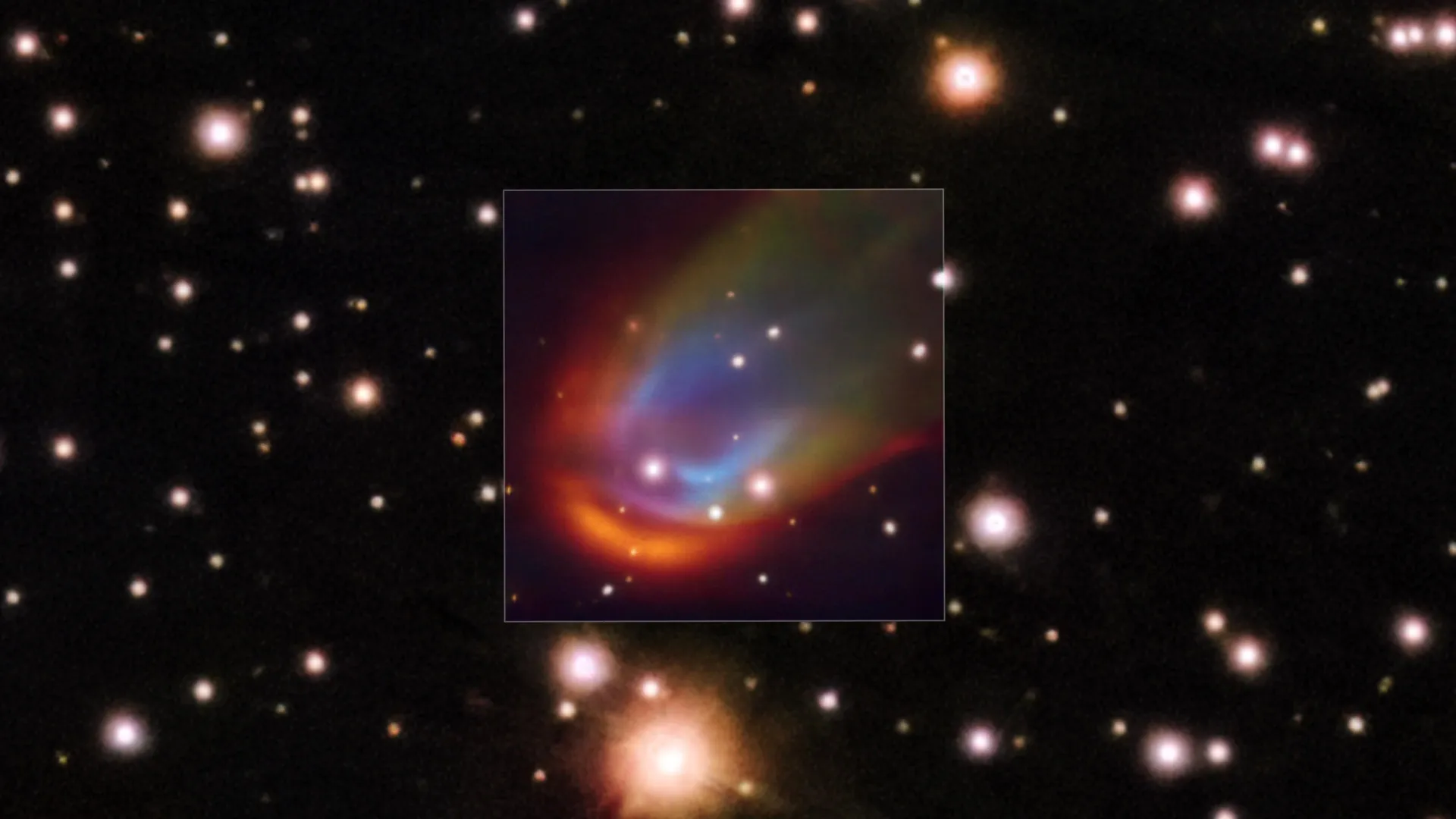
Astronomers have pointed the European Southern Observatory's Very Large Telescope (ESO's VLT) at a dead star called RXJ0528+2838 and found something that, by all rights, shouldn't be there: a shock wave. Not just any shock wave, but one that current physics says this particular stellar remnant has no business producing.
The discovery, published in Nature Astronomy, is the astronomical equivalent of finding your quiet neighbour who never leaves the house somehow hosting a rave. "We found something never seen before and, more importantly, entirely unexpected," said Simone Scaringi, associate professor at Durham University, UK, and co-lead author of the study.
"Our observations reveal a powerful outflow that, according to our current understanding, shouldn't be there," added Krystian Ilkiewicz, a postdoctoral researcher at the Nicolaus Copernicus Astronomical Center in Warsaw, Poland, and study co-lead.
An "outflow," for those of us who don't spend our days staring at dying stars, is material expelled from an object in space. RXJ0528+2838 sits about 730 light-years from Earth and, like the Sun and other stars, orbits the center of the Milky Way. As it moves through space, it encounters gas between the stars, producing a bow shock - essentially a curved arc of material, similar to the wave that builds up in front of a ship.
Here's the problem: bow shocks are typically produced when material flowing away from a star slams into its surroundings. But in the case of RXJ0528+2838, astronomers cannot identify any known process that fully accounts for what they observed.
RXJ0528+2838 is a white dwarf - the leftover core of a dying low-mass star - orbited by a Sun-like companion. In such binary systems, material can be pulled from the companion onto the white dwarf, often forming a disc that feeds the dead star while some matter gets thrown back into space in powerful outflows. RXJ0528+2838, however, shows no evidence of such a disc, leaving astronomers without the usual explanation for the outflow and the surrounding nebula.
"The surprise that a supposedly quiet, discless system could drive such a spectacular nebula was one of those rare 'wow' moments," Scaringi said.
The structure was first noticed in images taken with the Isaac Newton Telescope in Spain, and its strange appearance prompted researchers to investigate more closely using the MUSE instrument on ESO's VLT. "Observations with the ESO MUSE instrument allowed us to map the bow shock in detail and analyse its composition," Ilkiewicz explained. "This was crucial to confirm that the structure really originates from the binary system and not from an unrelated nebula or interstellar cloud."
The bow shock's size and shape suggest RXJ0528+2838 has been producing a powerful outflow for at least 1000 years. That creates another problem: scientists do not yet know how a dead star without a disc could sustain such an outflow for so long, although the system's magnetic field may provide an important clue.
RXJ0528+2838 is known to possess a strong magnetic field, something the MUSE observations confirmed. Instead of allowing material from the companion star to settle into a disc, the magnetic field appears to guide that matter directly onto the white dwarf.
"Our finding shows that even without a disc, these systems can drive powerful outflows, revealing a mechanism we do not yet understand," Ilkiewicz said. "This discovery challenges the standard picture of how matter moves and interacts in these extreme binary systems."
Researchers suspect the magnetic field could be connected to a hidden energy source - which Scaringi describes as a "mystery engine" - but the explanation remains incomplete. According to observations, the white dwarf's present-day magnetic field could sustain a bow shock for only a few hundred years, yet the structure appears to have existed for at least 1000 years. So the magnetic field alone cannot yet explain the full phenomenon.
Astronomers will need to investigate many more binary systems to determine how these powerful outflows can form without discs. ESO's upcoming Extremely Large Telescope (ELT) could play an important role by allowing scientists to study both known systems and much fainter examples in greater detail.
Scaringi expects the telescope "to map more of these systems as well as fainter ones and detect similar systems in detail, ultimately helping in understanding the mysterious energy source that remains unexplained."
So to summarise: a dead star is doing something it shouldn't be able to do, has been doing it for at least a millennium, and the best explanation scientists currently have is a magnetic field that doesn't quite add up either. Astronomy remains humbling.