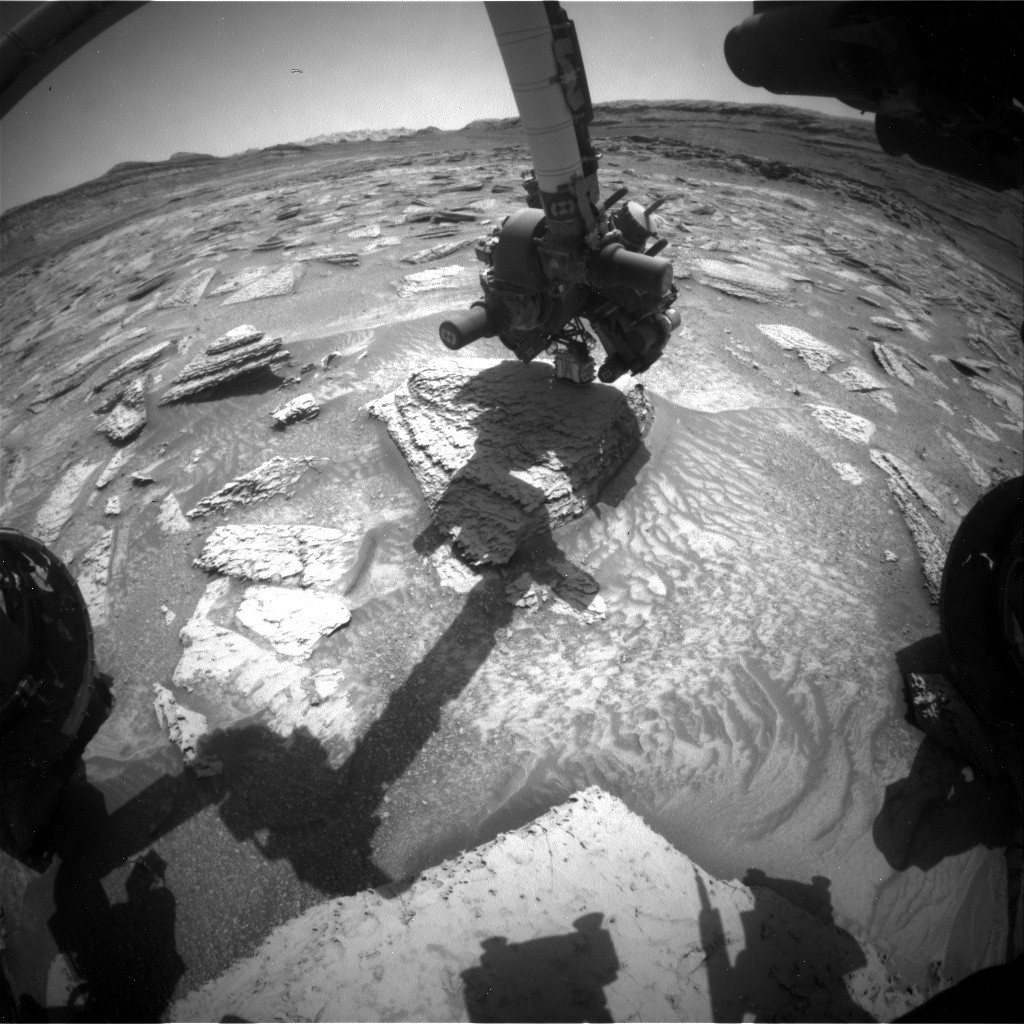
Curiosity Drills New Hole on Mars, Gets a Visit from a Passing Asteroid Probe
Curiosity gets back to drilling after a block-related mishap, while Psyche swings by for a gravity assist and a coordinated atmospheric observation - like a road trip with bonus science.
After a brief, unplanned adventure involving the 'Atacama' block that taught the team more about Martian geology (and possibly about the limits of their patience), the Curiosity rover is ready to drill again. The new target, dubbed 'Campo Marte' - Spanish for 'Field of Mars,' which is either deeply poetic or painfully on-the-nose depending on your tolerance for space puns - sits in the same layered sulfate unit above the boxwork structures. Scientists selected it from a quadrangle named after locations near Bolivia's Uyuni region, because nothing says 'interplanetary exploration' like a theme.
Before drilling, Curiosity performed a full workup: ChemCam LIBS and APXS composition measurements, close-up MAHLI imaging, and additional LIBS rasters on nearby blocks, including some suspicious vein and nodule-like features. Several blocks in this unit, including one called 'Paso Malo,' display a prominent polygonal texture that the team is probably getting tired of seeing. The good news: Campo Marte is substantially thicker than Atacama, so the rover's drill bit should withdraw normally this time, sparing the team from repeating what they're calling 'that particular experiment' but which the rest of us might call 'a small, expensive panic.'
As if drilling a hole on another planet weren't enough, Curiosity also played host to the Psyche spacecraft, which swung by Mars for a gravitational boost on its way to the main asteroid belt. Psyche's ultimate target is asteroid 16 Psyche, a large member of an unusual spectral category that no spacecraft has ever visited - probably because it's tiny and lacks Mars's atmosphere, but hey, it's got a cool name. The flyby gave Psyche a chance to exercise its instruments and calibration pipelines, so Curiosity obligingly scheduled a zenith movie with Navcam to document clouds and a Mastcam solar observation to measure atmospheric opacity. The Mastcam even got a fresh calibration data set, because what's a flyby without a little extra paperwork? Together with coordinated observations from Mars orbiters and the Perseverance rover, these data will help validate Psyche's instruments, proving once again that space exploration is just one big, mutually beneficial carpool.
The Good Times
News in your inbox.
One sardonic roundup, delivered on your schedule. Free. Unsubscribe whenever your tolerance for wit runs out.
Already subscribed but we never reach your inbox? Check your spam folder and hit 'Not spam' (or 'Remove from spam') to bust us out of junk-mail purgatory. You'll be helping everyone else too.
Don't open any of our emails for a month and you'll be automatically removed from the mailing list.
Rewrite Article
Select parts to regenerate with a fresh AI pass. Translations will be updated automatically.
Generate AI Image
Creates a sardonic version of the article image using OpenAI.