
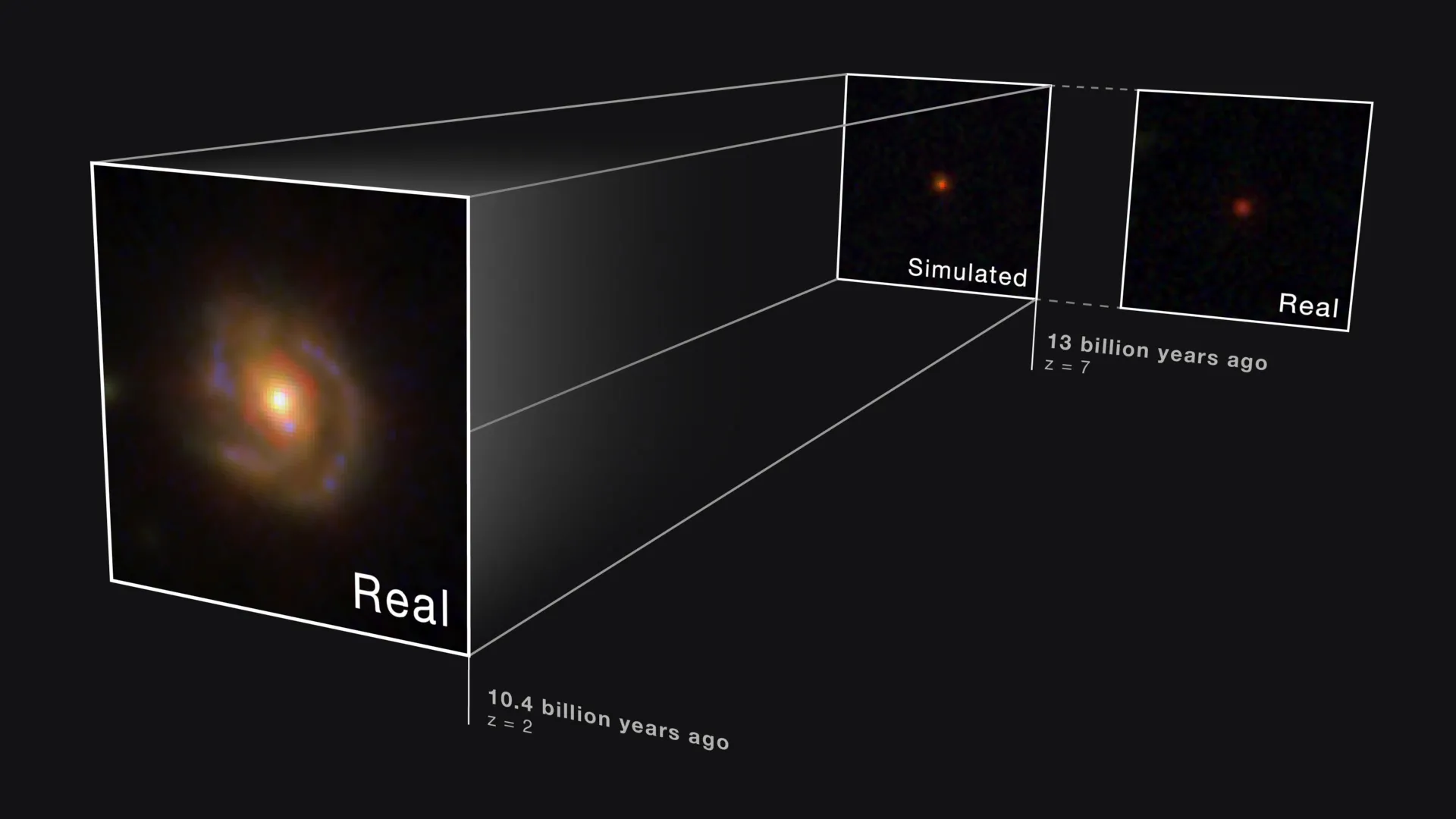
Remember those mysterious little red dots (LRDs) that NASA's James Webb Space Telescope started spotting back in 2022? Turns out, they might not be as mysterious as we thought - or as lonely. A new study suggests these compact, extremely distant red sources could be hiding entire galaxies behind their flashy exteriors.
Since their discovery, astronomers have debated what LRDs actually are. One leading theory is that they're supermassive black holes, specifically active galactic nuclei (AGN). But these dots don't behave like the AGN we see closer to home. They're common at high redshift, but their numbers drop off sharply at lower redshifts, which raises the question: what happens to them as the universe ages?
A team led by Pierluigi Rinaldi of the University of Arizona's Steward Observatory (now at the Space Telescope Science Institute in Baltimore) may have found a clue. Their study, published on July 29 in The Astrophysical Journal, suggests that LRDs might not be a separate population of galaxies. Instead, their weird appearance could be partly due to observational bias - at extreme distances, the fainter surrounding structures just become invisible to our telescopes, leaving only the bright central source.
The team reached this conclusion by studying a lower-redshift spiral galaxy called WISEA J123635.56+621424.2, nicknamed the "Saguaro" because its spiral arms resemble the Sonoran Desert cactus. This galaxy, at redshift 2 (seen as it was about 3.3 billion years after the Big Bang), has a compact red source at its center that looks just like a little red dot - fittingly evoking the cactus's ruby red fruit.
"Everything created in the early universe must evolve into something around us," said co-author George Rieke of the University of Arizona. "We have had little idea of what LRDs become, but these results finally show us how to find their progeny."
The Saguaro was a lucky find. Rinaldi examined thousands of sources, but this one stood out because one of Webb's microshutter arrays happened to be positioned right over its core, allowing spectroscopic data collection. Plus, its lower redshift gave a clearer view of its larger structure. The team combined archival observations from Hubble (ultraviolet) and Webb (infrared imaging and spectroscopy) to study it across the electromagnetic spectrum.
"Because the Saguaro is at lower redshift, we can see the very beautiful and bright host galaxy in high resolution and detail with Webb and Hubble," said Zihao Wu of the Harvard-Smithsonian Center for Astrophysics. "Webb's observations can help us understand how the galaxy and its little red dot-like nucleus are connected."
The team tested whether the Saguaro's compact red center matched LRD characteristics. Hubble and Webb showed the nucleus shines brighter in UV and infrared than in visible light, like distant LRDs. They also separated the galaxy's light from the nucleus's light and checked for X-rays. Most high-redshift LRDs are X-ray invisible, but the Saguaro emitted weak X-rays, detected by NASA's Chandra X-ray Observatory.
"What the X-ray light observations show is that this galaxy has an active galactic nucleus, and a very obscured one at that," said Carys Gilbert, a Master's student at the University of Cape Town. "It's not only obscured but also X-ray weak. That kind of combination could explain the lack of X-ray emission that we see from all other little red dots. It fits the puzzle of little red dots nicely."
Then came the revealing test: they digitally shifted the Saguaro to higher redshifts to simulate how it would look in the early universe. As they moved it farther away, the surrounding galaxy faded from view, leaving only the bright LRD-like center. This supports the idea that many distant LRDs appear isolated simply because their host galaxies are too faint to detect.
"Our theory is that most of these distant sources are affected by this cosmological effect, creating an observational bias," said Rinaldi. "We simply are not able to sample the immediate environment of high-redshift little red dots because their surroundings are just too faint to be observed even with Webb. Little red dots are far more complex than just being a dot. They're just the tip of the iceberg - of a supermassive black hole interacting with its nearby surroundings."
So, LRDs might not be a unique class of galaxy but rather a temporary phase in which supermassive black holes are especially active. The Saguaro could be a link between the high-redshift LRD population and the galaxies we see today. But the team cautions that the Saguaro isn't representative of every LRD - it's just one possible evolutionary stage.
More observations are planned. The team will continue studying the Saguaro and search for similar galaxies at lower redshift. They also plan to comb through Webb's archive for a broader census of LRDs and investigate how their environments influence their evolution. Because, as we all know, every mysterious cosmic object deserves a family tree.
The James Webb Space Telescope, by the way, is the world's premier space science observatory, solving mysteries in our solar system and beyond. The Hubble Space Telescope, still going strong after three decades, continues to make groundbreaking discoveries. Both are international collaborations led by NASA with ESA and CSA, with operations managed by various institutions. But you knew that already, right?