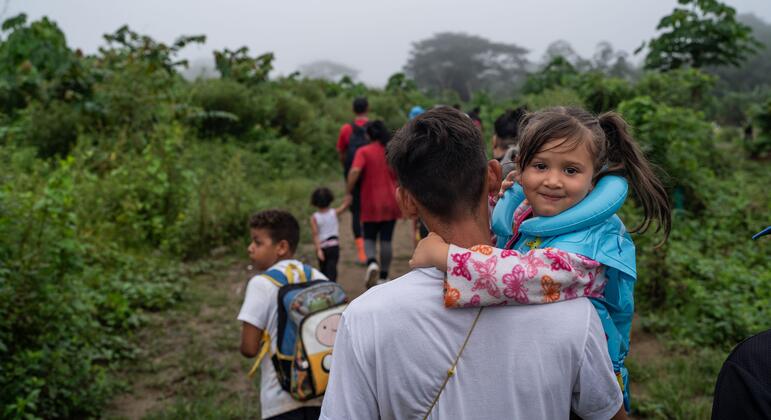
What do more than half of all doctors in Australia, over 40 per cent of US Nobel laureates, and most of the workforce in some Gulf States have in common? They weren't born there. That's right - approximately 300 million people worldwide have packed up and moved from their countries of origin to learn, work, reunite with family, or just see what else is out there.
And they're not freeloading. Migrants send a staggering $1 trillion in remittances each year, which is more than Official Development Assistance and Foreign Direct Investment combined. Take that, anyone who claims migrants are a drain.
UN General Assembly President Annalena Baerbock dropped these numbers as Member States met Thursday to review progress on the Global Compact for Safe, Orderly and Regular Migration - a 2018 voluntary, non-binding agreement that's essentially the world's most polite promise to treat migrants decently.
Baerbock noted that “migration is often treated as a new phenomenon, one that is heavily politicised,” even though humans have been wandering around for thousands of years. “Migration is an inevitable human reality,” she said. “The question is not whether migration is good or bad. The question is whether we manage it well.”
UN Secretary-General António Guterres reported that Member States have taken “concrete steps” to expand regular pathways, strengthen labour mobility, improve search-and-rescue, and support safer return and reintegration. But his report also dropped some grim stats: over four years, at least 200,000 people were trafficked - mostly women and girls - and in just two years, more than 15,000 people died or disappeared along migration routes. Also, families and children are still being detained, and countless workers remain exploited.
Natividad Obeso, a Peruvian migrant advocate in Argentina, put it bluntly: “Migrant documentation shouldn't be a privilege. It should be an accessible right, because when there are no papers, there is detention, fear and criminalisation.”
Amy Pope, Director General of the International Organization for Migration, reminded everyone that well-managed migration fills labour shortages, boosts economies, and strengthens development through remittances and skills transfers. “But none of that, none of it, happens by accident,” she insisted. “It takes cooperation across borders, across sectors, across institutions.”
Guterres outlined six ways to do better: anchor migration governance in dignity and human rights; make migration safer; crack down on smugglers and traffickers like we do with drug traffickers; create real regular pathways for students, workers, families, and people seeking safety; expand opportunities in countries of origin; and invest in better cooperation, especially since “people fleeing conflict and people seeking opportunity increasingly travel together.”
The second International Migration Review Forum wraps up Friday after four days of meetings, round tables, and a policy debate. Because nothing says “progress” like a lot of talking.
The Good Times
News in your inbox.
One sardonic roundup, delivered on your schedule. Free. Unsubscribe whenever your tolerance for wit runs out.
Already subscribed but we never reach your inbox? Check your spam folder and hit 'Not spam' (or 'Remove from spam') to bust us out of junk-mail purgatory. You'll be helping everyone else too.
Don't open any of our emails for a month and you'll be automatically removed from the mailing list.
Rewrite Article
Select parts to regenerate with a fresh AI pass. Translations will be updated automatically.
Generate AI Image
Creates a sardonic version of the article image using OpenAI.