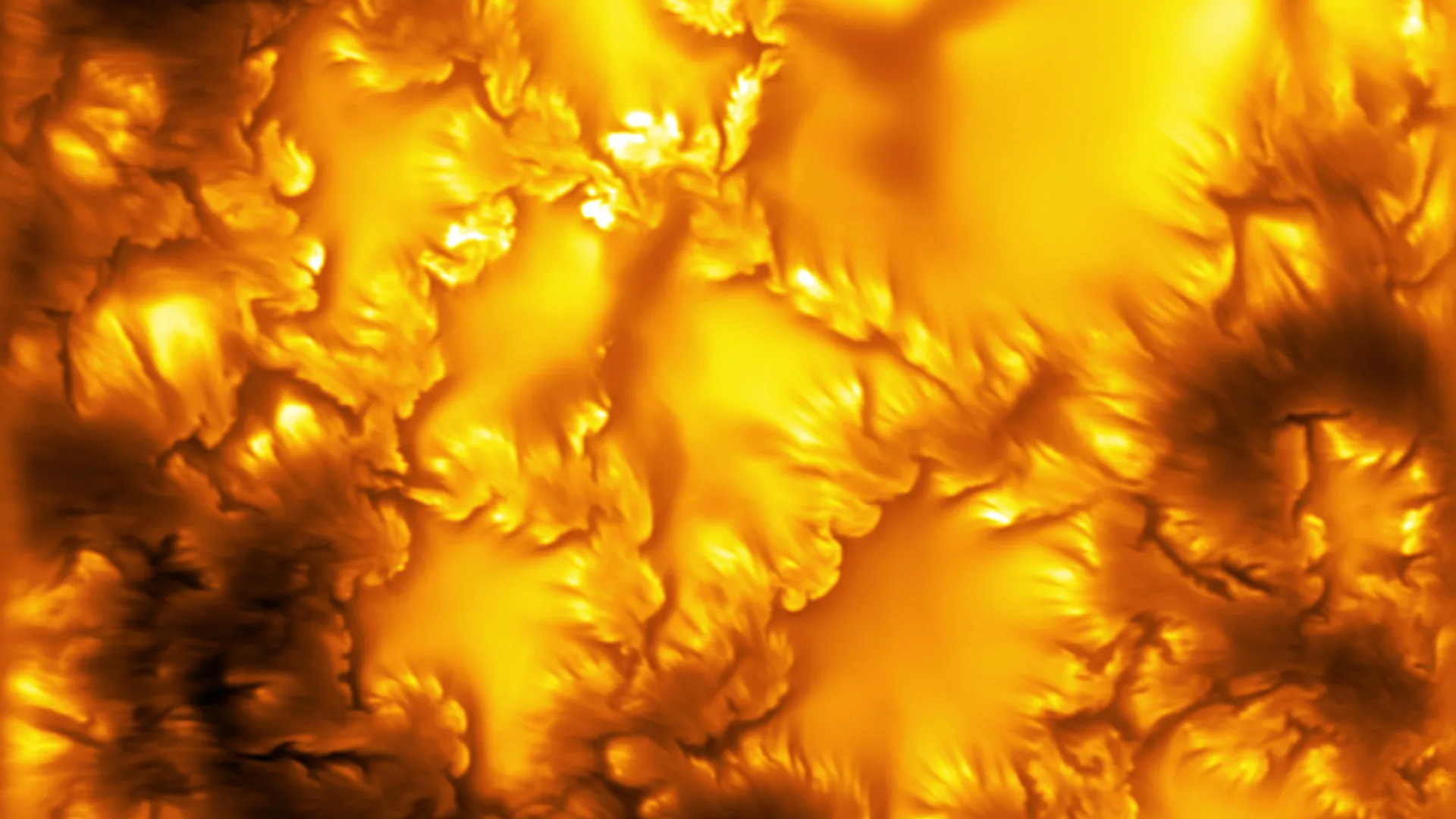
In a stunning display of celestial one-upmanship, scientists have discovered previously unseen plasma vortices swirling across the Sun's surface. Because apparently, the giant ball of fire wasn't already complicated enough.
The discovery, courtesy of researchers from the U.S. National Science Foundation National Solar Observatory (NSF NSO), the Max Planck Institute for Solar System Research (MPS) in Germany, and the High Altitude Observatory (HAO) in the USA, used the NSF Daniel K. Inouye Solar Telescope - the world's largest - to spot these tiny twisters. The telescope, perched in Hawaii, captured images detailed enough to expose plasma motions that had previously been invisible, much to the relief of solar physicists who were running out of things to study.
"To detect the vortices, we needed to resolve structures on the solar surface about 20 kilometers in size," said MPS scientist Michiel van Noort, co-author of the study. "That's like trying to spot a one euro coin from 180 kilometers away, but with a telescope instead of a coin-operated binocular." The team used a broadband imaging camera provided by MPS to achieve this feat.
These vortices appear along the boundaries of granules - the Sun's boiling-bubble-like surface features that range from 500 to 2,000 kilometers across. Hot plasma rises, cools, and sinks, creating a pattern resembling boiling liquid. Now, for the first time, scientists have resolved fringe-like structures along the granule edges, which develop swirling motions akin to ocean waves breaking. Some of these fringes are just over 20 kilometers wide, which is roughly the size of a small town, but on the Sun, that's microscopic.
The researchers suspect these swirls are Kelvin-Helmholtz instabilities, a phenomenon familiar in fluid dynamics when two fluids move at different speeds, creating shear forces that spawn waves and vortices. This same process occurs on Earth in lakes, clouds, and even in the atmospheres of Jupiter and Saturn, so the Sun is just joining the party. At granule boundaries, adjacent plasma layers travel at different speeds, providing the perfect conditions for these instabilities.
But why should we care about tiny solar whirlpools? Because they might explain how the Sun stores and releases magnetic energy, including through nanoflares. Current theories suggest magnetic energy builds up as field lines twist like a coiled spring, eventually releasing energy via magnetic reconnection. The big question has been what twists those field lines in the first place. These vortices, which appear continuously where the magnetic field is strong, could be the culprits, twisting field lines like a cosmic pasta maker.
Moreover, the mini-vortices are highly effective at mixing magnetized and non-magnetized plasma, helping magnetic fields move from the surface into the atmosphere. This could explain the Sun's speedy 11-year magnetic cycle, which current models struggle to account for. The vortices might be the missing piece of the puzzle, showing that minute processes, at the limit of our resolution, significantly determine the nature of our star.
"The newly discovered plasma vortices impressively demonstrate how minute processes - at the limit of what we can resolve using all available techniques - significantly determine the nature of our star," said Sami K. Solanki, MPS director and co-author. So, the next time you see a whirlpool in your bathtub, just remember: the Sun has them too, and they're doing a lot more than swirling your bathwater.
The Good Times
News in your inbox.
One sardonic roundup, delivered on your schedule. Free. Unsubscribe whenever your tolerance for wit runs out.
Already subscribed but we never reach your inbox? Check your spam folder and hit 'Not spam' (or 'Remove from spam') to bust us out of junk-mail purgatory. You'll be helping everyone else too.
Don't open any of our emails for a month and you'll be automatically removed from the mailing list.
Rewrite Article
Select parts to regenerate with a fresh AI pass. Translations will be updated automatically.
Generate AI Image
Creates a sardonic version of the article image using OpenAI.