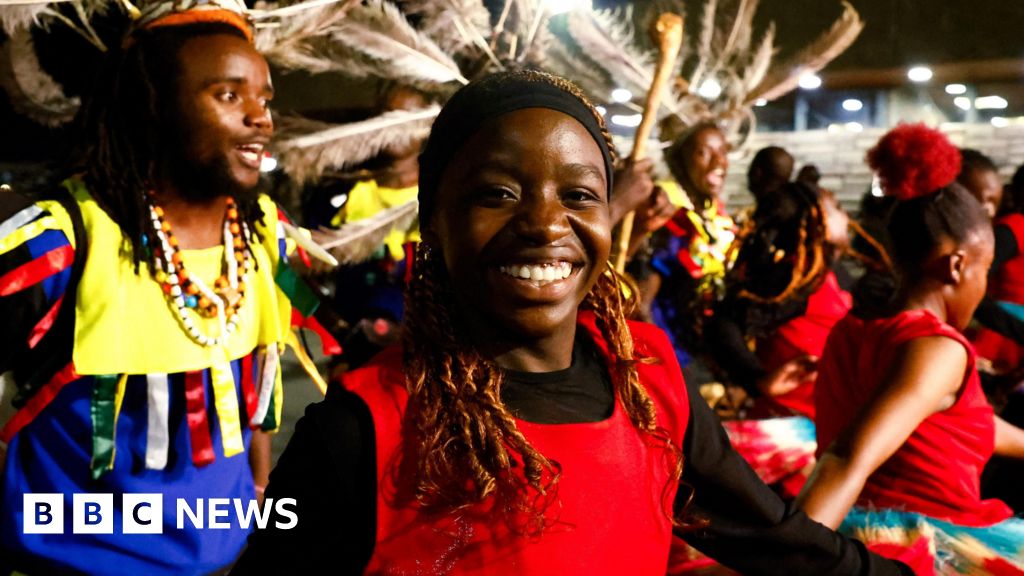
Record-Breaking Marathon Man Returns Home, Gets Dance Party He Definitely Earned
Sabastian Sawe gets a dance party for breaking the marathon record, while Africa juggles volcanoes, coups, gold rushes, and the eternal struggle against gravity and bad government.
Sabastian Sawe, the first human to run a marathon in under two hours, has returned to Kenya to a hero's welcome complete with dancing and music at Nairobi airport. Because when you redefine human endurance, you get a party. BBC Africa correspondent Barbara Plett-Usher was on the ground to witness the celebration, which presumably involved fewer blisters than the actual run.
In other news from across the continent, DR Congo is back at the World Cup for the first time since 1974, with fans in Kinshasa celebrating the team's 1-0 play-off win over Jamaica - a wait so long, the last time they qualified, the internet wasn't a thing.
Meanwhile, lava from the Piton de la Fournaise volcano reached the Indian Ocean for the first time in 19 years, proving that even volcanoes can make a comeback. And Ramadan and Lent haven't overlapped since 1993, but couples like Olanrewaju and Kaosara in Nigeria are observing them together, because interfaith relationships are tough enough without fasting schedules.
Ethiopia unveiled its first unmanned, 'smart' police station where citizens can report crimes on automated touch screens - finally, a cop that never asks for a bribe. Senegalese fans celebrated their team's victory at the Africa Cup of Nations, because football is serious business.
President Yoweri Museveni holds a commanding lead ahead of his main challenger, pop star-turned-politician Bobi Wine, suggesting Ugandans might prefer the devil they know. Ongoing floods in South Africa's north-eastern provinces have led to the closure of the world-famous Kruger National Park, giving the animals a break from tourists.
A boat with motor failure drifted to the edge of a dam, because mechanical failure knows no nationality. Residents of an unnamed main city expressed shock after soldiers tried to overthrow the president - a plot twist that somehow still surprises people. A growing number of women in South Africa are learning to use guns to protect themselves against gender-based violence, because self-defense shouldn't be a luxury.
Fighters from the paramilitary Rapid Support Forces (RSF) have executed unarmed people after capturing the Sudanese city of el-Fasher, according to new videos analyzed by BBC Verify - because war crimes now come with video evidence. Crowds celebrated in the streets of Madagascar's capital Antananarivo after an elite army unit claimed to have seized power, proving that coups are still a thing.
Botswana's diamond-reliant economy is under strain, with the main diamond company seeing a 50% drop in sales last year - turns out, diamonds aren't forever. The battle for Kordofan, home to eight million people, becomes the latest frontline in Sudan's civil war, because peace is a rare commodity.
Turkish authorities hope a youngster named Zeytin can soon be returned to his native Nigeria - a happy ending in the works. Following a gold rush in Lomera, the village population has exploded from 1,500 to 12,000 in less than a year, because nothing draws a crowd like shiny rocks.
The BBC revisits Goma six months after it was seized by M23 rebels, checking in on a city that's seen better days. BBC's Ian Wafula is in central Nairobi amid protests honoring those killed a year ago, reminding everyone that memory is a political act. The Archbishop of Abuja in Nigeria discusses how the next pontiff could be selected, because even the Vatican needs a succession plan.
Finally, el-Fasher residents Mostafa, Hafiza and Manahel film as their home city comes under fire in Sudan's civil war - a citizen's guide to documenting your own destruction.
The Good Times
News in your inbox.
One sardonic roundup, delivered on your schedule. Free. Unsubscribe whenever your tolerance for wit runs out.
Already subscribed but we never reach your inbox? Check your spam folder and hit 'Not spam' (or 'Remove from spam') to bust us out of junk-mail purgatory. You'll be helping everyone else too.
Don't open any of our emails for a month and you'll be automatically removed from the mailing list.
Rewrite Article
Select parts to regenerate with a fresh AI pass. Translations will be updated automatically.
Generate AI Image
Creates a sardonic version of the article image using OpenAI.