Physicists Finally Figure Out How to Steal Energy From a Fake Black Hole (No Actual Spacetime Required)
Scientists build a stationary device that steals energy from electromagnetic waves by pretending to rotate faster than light, proving Penrose's black hole energy heist works in a lab.
Fifty years ago, Sir Roger Penrose had a wild idea: what if you could yoink energy out of a spinning black hole? His plan involved a particle entering the black hole's ergosphere (a region where spacetime gets dragged along for the ride), splitting in two, and having one half escape with more energy than it started with. Yakov Zel'dovich later suggested waves could pull off a similar trick if they bounced off something spinning fast enough.
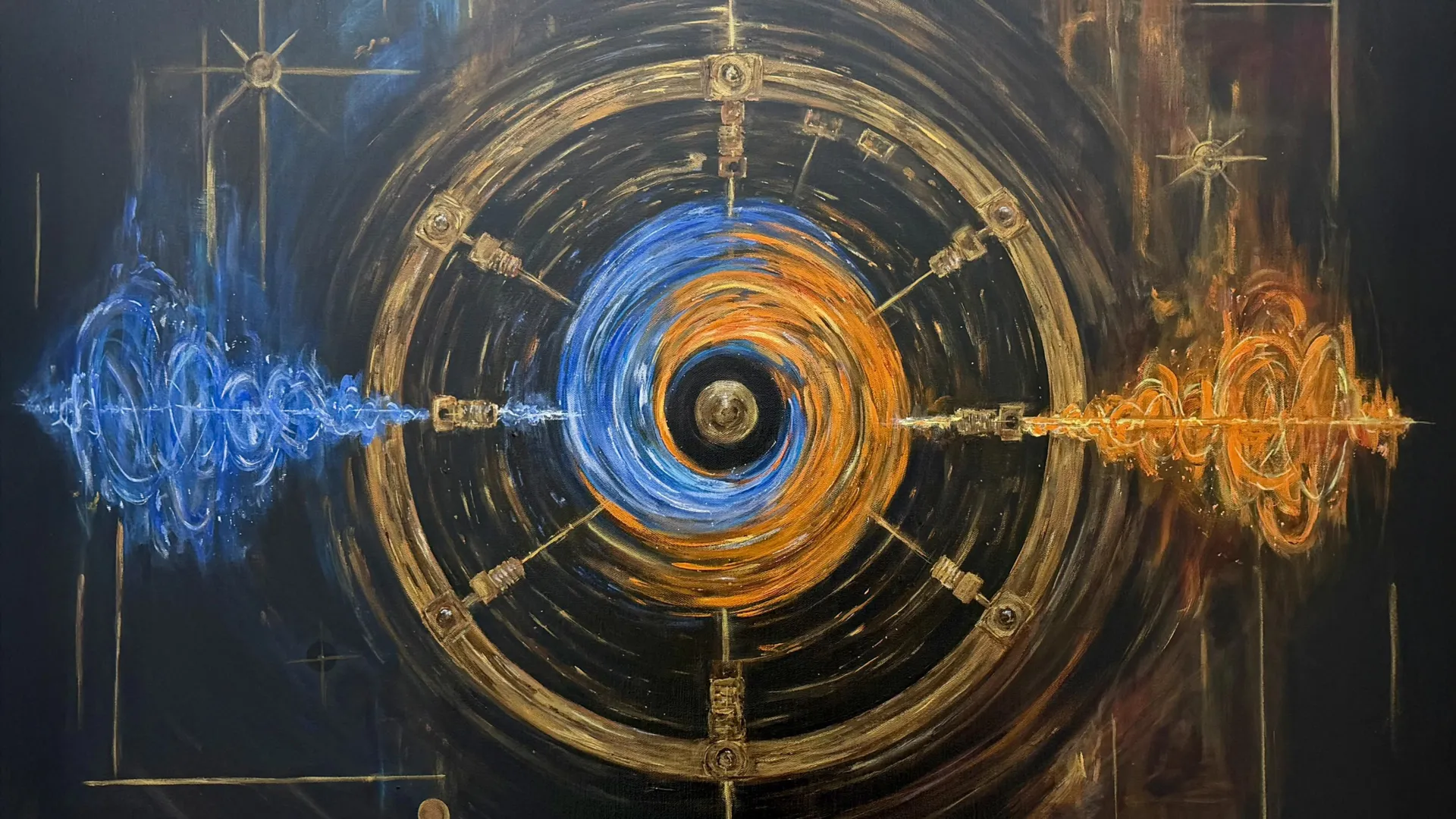
Now, researchers at the CUNY Advanced Science Research Center have actually built a contraption that does this - without the whole "spinning at near-light speed" part. Writing in Nature, the team created a radio frequency device that never physically rotates but tricks electromagnetic waves into thinking they're in a cosmic blender. By rapidly tweaking the properties of a ring of electronic resonators in a carefully timed sequence, they generated a synthetic rotation that effectively spins faster than light. Spoiler: yes, that's allowed in a lab.
"Our approach facilitates a new method of wave-matter interaction in which waves with selected rotational properties extract energy from synthetic time-engineered rotation, producing a form of broadband selective amplification," said principal investigator Andrea Alù, who clearly earned that Einstein Professorship.
Lead author Hadiseh Nasari called the experiment a triumph of turning theory into practice, adding that the platform could help explore everything from astrophysics to quantum science. Co-lead author Hady Moussa explained that waves with the right rotational characteristics happily sucked energy out of the system, recreating the Penrose-Zel'dovich process in miniature.
Beyond black hole physics, the researchers think this synthetic rotation could lead to advances in wireless communications, optics, and quantum tech - once they figure out how to turn a lab demo into something you can actually hold. The work was funded by the U.S. Department of Defense, the National Science Foundation, and the Simons Foundation, which is nice because building fake black holes isn't cheap.
The Good Times
News in your inbox.
One sardonic roundup, delivered on your schedule. Free. Unsubscribe whenever your tolerance for wit runs out.
Already subscribed but we never reach your inbox? Check your spam folder and hit 'Not spam' (or 'Remove from spam') to bust us out of junk-mail purgatory. You'll be helping everyone else too.
Don't open any of our emails for a month and you'll be automatically removed from the mailing list.
Rewrite Article
Select parts to regenerate with a fresh AI pass. Translations will be updated automatically.
Generate AI Image
Creates a sardonic version of the article image using OpenAI.