
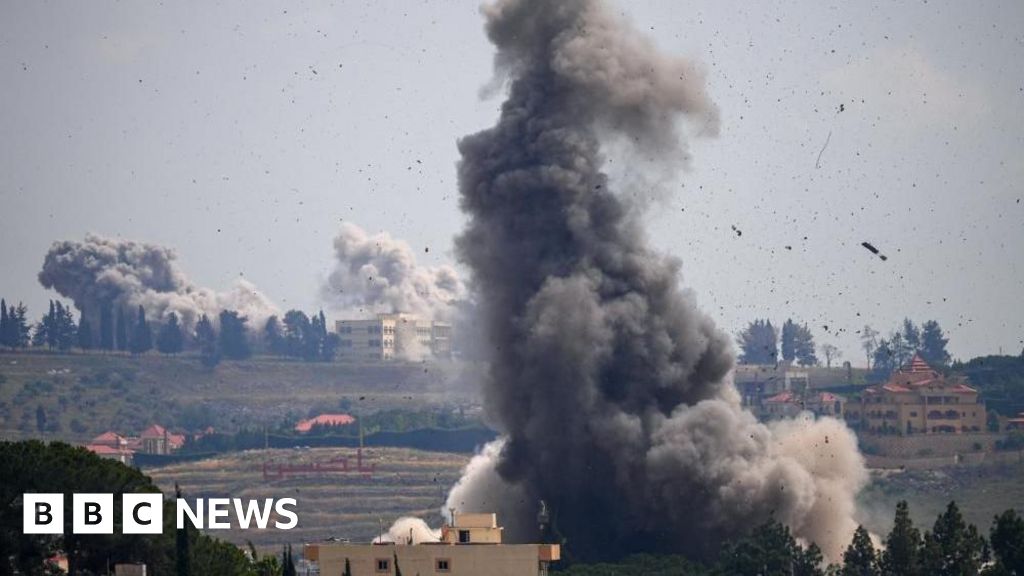
Israel kept bombing southern Lebanon on Tuesday, but managed to avoid hitting Beirut, after a partial ceasefire with Hezbollah that everyone is interpreting very differently.
Under an agreement announced by US President Donald Trump late Monday, Israeli forces would refrain from bombing the capital in exchange for Hezbollah not attacking Israel. Lebanon's government confirmed the deal, though Hezbollah itself has yet to issue a public statement, which is a bit like signing a contract without the other party's signature.
Following the announcement, the Israeli military said it intercepted two projectiles fired into northern Israel. Hezbollah said it attacked Israeli forces in southern Lebanon, where officials reported deadly Israeli strikes. So the ceasefire is off to a rocky start.
The Lebanese health ministry reported four people killed and 127 injured when Israeli air strikes hit buildings next to Jabal Amel hospital in Tyre on Monday afternoon. Among the injured were 39 hospital staff, four in critical condition. The hospital's director, Dr. Wael Mroueh, described the attack as coming without warning: "We were working with patients and displaced people. Business as usual, and suddenly, 'boom'."
The Israeli military said it struck "Hezbollah terrorist infrastructure" in the area and acknowledged damage to the hospital, but emphasized it "was not targeted." It also accused Hezbollah of embedding itself within civilian infrastructure, without providing evidence - a claim that has become something of a broken record in this conflict.
The Lebanese health ministry says 128 paramedics and healthcare workers have been killed and 159 attacks on ambulances and medical facilities occurred over the past three months. A dentist from the Christian village of Qlayaa was killed along with his daughter and son in a drone strike on Tuesday.
Israel issued a fresh evacuation order for Nabatieh town, warning residents it was "compelled to act forcefully" against Hezbollah there because of the group's "violation of the ceasefire agreement." The Israeli foreign ministry said Hezbollah violated Monday's declarations by launching "multiple missile and drone attacks from Lebanon against Israeli communities." Hezbollah's military wing said it targeted Israeli tanks and troops in southern Lebanese towns but did not mention any cross-border attacks, which seems to be a distinction without a difference.
The war began on 2 March when Hezbollah launched rockets into Israel in retaliation for an Israeli strike that killed Iran's supreme leader. Since then, at least 3,468 people have been killed in Lebanon, according to the country's health ministry, and over one million people have registered as displaced. Israel says 25 of its soldiers and four Israeli civilians have been killed.
On Monday evening, Lebanon's embassy in Washington said the government had received confirmation of Hezbollah's acceptance of a US-backed proposal for a partial ceasefire, following a call between President Joseph Aoun and US Secretary of State Marco Rubio. Trump subsequently informed Lebanese ambassador Nada Moawad that he had secured Israeli Prime Minister Benjamin Netanyahu's approval. Trump then wrote on Truth Social that he had spoken to Netanyahu and representatives of Hezbollah's leaders: "They agreed to stop shooting at Israel, and its soldiers. Likewise, Israel agreed to stop shooting at them."
Netanyahu immediately put out a statement saying he told Trump that "if Hezbollah does not stop firing at our cities and citizens, Israel will strike terrorist targets in Beirut." He also said the military would "continue to operate as planned in southern Lebanon." So much for the spirit of the agreement.
Senior Hezbollah lawmaker Hassan Fadlallah said the group would not support a "one-sided" ceasefire and called for a comprehensive ceasefire as a prelude to Israeli withdrawal from southern Lebanon. Parliamentary Speaker Nabih Berri told the New York Times that the group would accept a "real ceasefire," implying this one might be imaginary.
Further negotiations between Israeli and Lebanese diplomats are scheduled for Tuesday and Wednesday in Washington. The diplomatic push came after Netanyahu announced he had ordered Israeli strikes on Beirut's southern suburbs in response to rocket and drone attacks. US news outlet Axios cited two US officials as saying that Trump later "lashed out at" Netanyahu in "an expletive-laden call" and told him not to follow through. Some Israeli politicians criticized Netanyahu for accepting Trump's demand not to attack Beirut. Far-right National Security Minister Itamar Ben Gvir said, "Now is the time to tell... our friend 'no'." Opposition leader Yair Lapid said Israel had become a "client state in full."
Axios suggested Trump's anger was driven by his concern that Israeli escalation threatened negotiations on a deal to end the US-Israeli war with Iran. Iran's Foreign Minister Abbas Araghchi said the US-Iran truce was "unequivocally a ceasefire on all fronts, including in Lebanon" and that "its violation on one front is a violation of the ceasefire on all fronts." Iran's hard-line Tasnim news agency reported that Tehran could suspend indirect negotiations with the US over Israeli military actions in Lebanon.
In other words, everyone is angry, no one trusts anyone, and the ceasefire is about as solid as a sandcastle at high tide.