Good News: We Have an Extra Billion Years Before the Sun Roasts Us All
Scientists use a 3D model to calculate when the Sun will fry Earth - and it turns out we have about 1.9 billion more years of plant life, which is nice.
A new study by Jacob Haqq-Misra of Blue Marble Space and Eric Wolf at the University of Colorado Boulder has looked into the future and concluded that, yes, the Sun will eventually turn Earth into a cinder, but not for a bit longer than we thought. The paper, which opens with the reassuring question “How long will life on Earth survive?,” uses a 3D climate model to refine estimates of when rising solar brightness and falling carbon dioxide levels will make the planet uninhabitable for complex life.
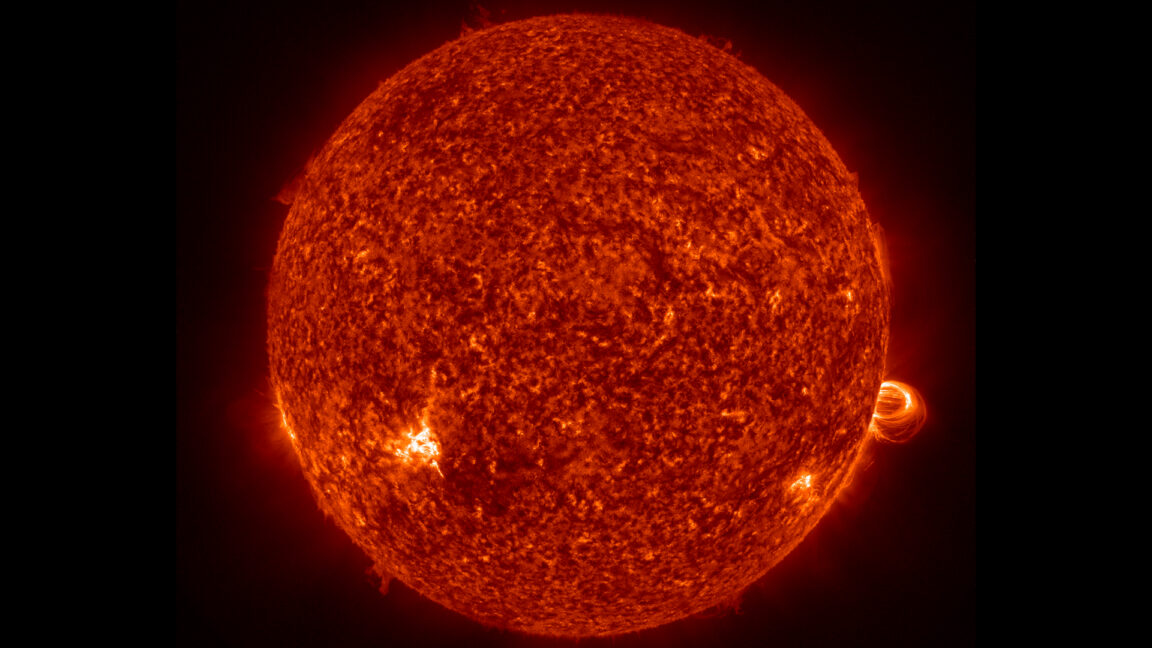
The Sun is brightening steadily as it ages, and in about 5 billion years it will become a red giant that swallows Earth entirely. Before that fiery finale, though, life faces a double threat: too much heat and too little CO₂ for photosynthesis. The cycling of CO₂ through rock weathering acts as a thermostat - warmer temperatures speed up weathering, which pulls CO₂ from the atmosphere, which slows warming. But that same process can starve plants of the gas they need to breathe.
The study ran two scenarios representing extreme ends of the weathering-temperature relationship. In the weak-weathering scenario - where CO₂ stays at modern levels but temperatures rise - the world gets about 21°C (38°F) warmer 1.5 billion years from now, then another 40°C (72°F) by 2 billion years. Most land plants hit their physiological limits at 1.68 billion years, and the last holdouts are cooked by 1.87 billion. The oceans boil off soon after.
In the strong-weathering scenario - where temperature stays constant but CO₂ plummets - levels drop to about 34 parts per million after 1 billion years and below 1 ppm after 2 billion. Most land plants need around 150 ppm; C4 plants can survive down to 3 - 10 ppm, crossing that threshold between 1.35 and 1.64 billion years. A few cheaters like cacti and some marine life can use bicarbonate instead of dissolved CO₂, buying them time until about 1.84 billion years.
The good news? These estimates are more optimistic than previous ones, thanks to the 3D model showing less warming for a brightening Sun, slower CO₂ decline, and a wider range of survivable CO₂ levels for plants. Earlier models often put the expiration date under 1 billion years. Now we’ve got roughly 1.68 to 1.87 billion years before land plants go extinct, and maybe 1.84 billion for the tough ones.
The researchers note that civilization, if it lasts that long, could try geoengineering - like spreading aerosols in the stratosphere to reflect sunlight. Or, more ambitiously, we could move Earth’s orbit or remove some of the Sun’s mass. We have a billion years to figure out the logistics. Evolution might also extend the timeline by expanding plant physiological limits.
Ultimately, the study isn’t about predicting our doom; it’s about understanding the window for life on Earth, which helps astronomers know where to look for it elsewhere. Land plants have been around for nearly 500 million years, and they could persist for almost 1.9 billion more. After that, microbial life will again have the planet to itself, as it did for a few billion years before plants showed up.
The Good Times
News in your inbox.
One sardonic roundup, delivered on your schedule. Free. Unsubscribe whenever your tolerance for wit runs out.
Already subscribed but we never reach your inbox? Check your spam folder and hit 'Not spam' (or 'Remove from spam') to bust us out of junk-mail purgatory. You'll be helping everyone else too.
Don't open any of our emails for a month and you'll be automatically removed from the mailing list.
Rewrite Article
Select parts to regenerate with a fresh AI pass. Translations will be updated automatically.
Generate AI Image
Creates a sardonic version of the article image using OpenAI.