Gaza's Development Erased by 77 Years, Priced at a Cool $71 Billion
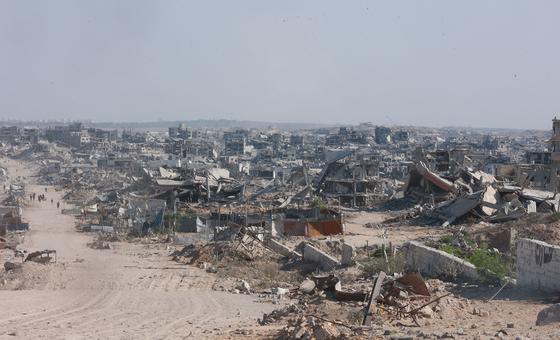
A UN-EU report puts a $71.4 billion price tag on undoing 77 years of developmental backslide in Gaza, cataloguing devastation so complete it reads like a dystopian inventory.
In a joint announcement that somehow managed to make the situation sound even more grim, the UN and European Union declared on Monday that human development in Gaza has been set back by a staggering 77 years. The price tag for a decade of recovery and reconstruction? A mere $71.4 billion.
This cheerful figure comes courtesy of the final Gaza Rapid Damage and Needs Assessment (RDNA), a report co-produced with the UN-partnered World Bank. The assessment breaks down the immediate need to $26.3 billion for the first 18 months, just to restore essential services, rebuild critical infrastructure, and support economic recovery.
The physical damage from the full-scale war that erupted after the Hamas-led attacks on southern Israel in October 2023 is estimated at $35.2 billion. An additional $22.7 billion in economic and social losses brings the total to a number that would make even the most optimistic accountant weep. Entire sectors - housing, health, education, commerce, and agriculture - are described as 'devastated.'
The specifics are a masterclass in devastation: over 371,888 housing units destroyed or damaged, more than 50 percent of hospitals non-functional, and nearly all schools destroyed or damaged. The economy, in a bold move, has contracted by 84 percent.
The human cost is just as efficiently catalogued: more than 60 percent of the population has lost their homes, with 1.9 million people displaced, often multiple times. Women, children, persons with disabilities, and those with pre-existing vulnerabilities are noted as bearing the greatest burden. Local authorities report over 71,000 Palestinian fatalities and over 171,000 injured, with many still missing under the rubble.
The report is intended as the foundation for early recovery planning, stressing that reconstruction must run in parallel with humanitarian action. This framework is aligned with Security Council resolution 2803 (2025), which welcomed the establishment of the Board of Peace led by President Trump as a transitional administration and authorized a temporary International Stabilisation Force (ISF).
In a final note of aspirational bureaucracy, the EU and UN emphasised that recovery should be Palestinian-led, support a transition to the Palestinian Authority, and advance a durable political settlement based on the two-State solution. Planning, they add, should be inclusive, transparent, and accountable, with particular attention to the needs of women, children, the elderly, and persons with disabilities. The assessment concludes by recognising that a set of 'enabling conditions' - a phrase doing a lot of heavy lifting - are essential for any of this to happen.
The Good Times
News in your inbox.
One sardonic roundup, delivered on your schedule. Free. Unsubscribe whenever your tolerance for wit runs out.
Already subscribed but we never reach your inbox? Check your spam folder and hit 'Not spam' (or 'Remove from spam') to bust us out of junk-mail purgatory. You'll be helping everyone else too.
Don't open any of our emails for a month and you'll be automatically removed from the mailing list.
Rewrite Article
Select parts to regenerate with a fresh AI pass. Translations will be updated automatically.
Generate AI Image
Creates a sardonic version of the article image using OpenAI.